But there is also the left and a right function to consider..!
here you go then



But there is also the left and a right function to consider..!


here you go then


 but this will make an interesting read non the less. Good luck with the project.
The detection of the rotation of the wheel is likely to use quadrature encoding which is described below the title 'Incremental rotary encoder'
in this Wikipedia article.
I'm looking forward to seeing your tests and possible final outcome Fred. Personally I don't have any issue with the wonder wheel and indicator

Unfortunately having dismantled the wheel and identified that the outputs of two latching hall effect sensors (marked type 462) go direct to two of the pins on the connector, then it does look as if there is some further processing going on outside the wheel. Whether this is quadrature encoding is impossible to say, but if the two sensors are positioned out of phase with respect to the North/South transitions on the magnetic ring in the wheel, then it seems likely. I have only limited electronics knowledge, and I can't see any way that these outputs could be used directly to indicate a forward or reverse jog of the wheel, so it looks like I am not going to be able to replace these outputs with simple switches.
Now we have (probably) established it is quadrature encoding, you could replace it with an off the shelf device such as those shown in this Farnell search


I wonder if there's a way to get the wheel to work on the KTM, as I use the Nav 6 on that bike, and quite miss the functions of the wheel when I ride that bike?


I love this thread Fred.
I'm so electronically and mechanically inept (and lazy too) that if the wonder wheel bugged me that much, I'd change the bike.
What do you do - re-do BMW's job for them! What's next after the wheel?
Haha - changing the bike was not an option. My other half took some persuading to buy it in the first place! After five previous bikes in the last five years this is supposed to be my forever bike!
Anyway, removing the wheel was fairly easy, it's replacing its function in a different location which is proving more of a challenge.
I love this thread Fred.
I'm so electronically and mechanically inept (and lazy too) that if the wonder wheel bugged me that much, I'd change the bike.
What do you do - re-do BMW's job for them! What's next after the wheel?
Now we have (probably) established it is quadrature encoding, you could replace it with an off the shelf device such as those shown in this Farnell search
I don't think that would be possible as it seems that the inputs from the buttons and wheel are processed by the electronics module in the bike before being sent out to the satnav via its cradle.
What you could possibly do is use the 4 button cradle that is used on BMW bikes which don't have the option of the wheel. You would just need to provide that with a power connection, I don't think it needs any further integration with the bike, so should work on a KTM in the same way as a generic Garmin mount. The four buttons give you the same control over the satnav, albeit not so conveniently placed, as the wheel. I believe this works with the IV and V, but you would have to check for the VI. One drawback of this is that it does not have the integral lock that the cradle for wonderwheel equipped bikes has. Touratech do a locking adaptor for this 4 button cradle for BMW bikes, but I'm not sure if you would be able to adapt that to a KTM.
See here: https://www.bmw-motorrad-bohling.com/uk/bmw-four-button-cradle-mount.html
I did consider one of those, but it was a lot more expensive than the Garmin mount I've got, for not a lot more useful features.


OK - I have now hooked up a couple of multimeters to the wheel rotation outputs and have confirmed that it is a 90 degree out of phase switched output, with a detent on the wheel every 90 degrees. Unfortunately the output is 12V. This would complicate using a 5V encoder as I would need a 5V supply and probably something like a couple of optocouplers to translate the outputs to the 12V pulses expected by the bike. I am also a little confused by the terminology on the specs of alternative encoders when looking for a replacement. The specs refer to the number of detents versus the number of pulses but don't define a pulse. The BMW wheel outputs three complete positive pulses per rotation but the detent means the two waveforms are effectively sampled 4 times per cycle and 12 times per rotation. I'm not sure how that would correspond to alternative encoders so any input would be welcome.
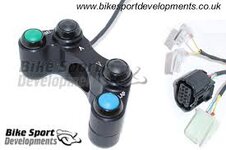
I have also looked at fitting the existing wheel to the right of the switch cluster. Space is not too much of a problem as the mirror and clutch assembly can be moved to the right a little if required. Also the cables coming out of the switch cluster intrude into that gap, but could be clipped back out of the way. There are two remaining obstacles to doing this. The first is how to fix the wheel in position which I can see would not be too difficult. The other more difficult issue is the way the switches for the sideways tilt operate. One of them is activated by a prong on the inner collar, but instead of having a matching prong on the other side of the collar for the other switch, it is part of the add-on plastic moulding which screws onto the grip through the collar and holds the connector in position so that it engages with the socket inside the switch cluster. I think this must be because it would not be possible to insert the collar into position if it carried both prongs. Since I would have to remove this moulding to re-position the wheel I would have to find another way to engage with the second sideways tilt switch, or I could possibly retain the moulding but just cut it down to minimal height.
Fred
Controller is on a Linbus system not Canbus
Canbus sends data to every module on the bus, whether it needs the data or not.
Each module is passive/ active -
From what Fred has described, the rotary device is an opto counter-
it counts pulses of light passing over it, converts the light to a voltage and sends a high low voltage
pulse down the wires.
This is then used to determine the direction of rotation.
eg high low high low high low = turn clockwise - Low high low high low high = turn anti clockwise
As its linbus - The wires run to the device doing the coding decoding bit, not vice versa