
Some questions about brakes

stolzy

Registered user
Joined
Aug 23, 2007
Messages
28,808
Reaction score
10
Location
UK/France
having some problems with my rear pads and I need background info:

1. What makes the pistons go back into the caliper - there's obviously no spring?

2. How hard should it be to push the pistons back?

3. Is it normal that one piston is harder to push back than the other?

4. How far out can I pump the piston (to clean) before the seals pop out?

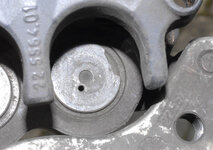
5. Does this damage mean I have to replace the piston?

6. If I do, where can I buy pistons? (the usual suspects don't seem to carry them.

Thanks in advance.
 

Attachments

  • rear_caliper.jpg
    rear_caliper.jpg
    84 KB · Views: 283
having some problems with my rear pads and I need background info:

1. What makes the pistons go back into the caliper - there's obviously no spring?

2. How hard should it be to push the pistons back?

3. Is it normal that one piston is harder to push back than the other?

4. How far out can I pump the piston (to clean) before the seals pop out?

5. Does this damage mean I have to replace the piston?

6. If I do, where can I buy pistons? (the usual suspects don't seem to carry them.

Thanks in advance.

  1. Unless you have a warped disc, nothing. But no pressure between pad and disc means no friction.
  2. Should be able to push them back with one firm finger
  3. No
  4. To the point just before the seals pop out
  5. Probably not
  6. BMW sell seal/piston kits.

Greg
 
  1. Unless you have a warped disc, nothing. But no pressure between pad and disc means no friction.
  2. Should be able to push them back with one firm finger
  3. No
  4. To the point just before the seals pop out
  5. Probably not
  6. BMW sell seal/piston kits.

Greg
Thanks for that, just unlear about item 4 - the only way to find out is to pop one out and have to bleed?
 
Thanks for that, just unlear about item 4 - the only way to find out is to pop one out and have to bleed?

In my experience, they always go further than you think, but the only way to find out is to try it. If they pop out you do have to bleed the line.

Greg
 
You should be able to get the pistons to come out by at least 10mm without problems.
Then get some of that plastic strapping they put arround crates, and use that to clean the surface of the piston.
Pound to a penny, there will be some corrosion behind the seal which is pushing tighter against the piston, so it will be pistons out and full caliper strip and rebuild.

Neil
 
Use a G clamp or similar to easily push the pads back in. I have had calipers that need little pressure and some that need more than my fingers can apply and they have all worked OK. The biggest prob with pistons is the corrosion and dirt that can build up between the piston and the cylinder.

Use the g clamp and hold one piston in, pump carefully until you see a reasonable amount of the old piston. If you judge this by your old pads and a disc width and even space between opposed pistons. Spray a thin lubricant like WD40 on the piston surface and down the "gap" and clean with an old toothbrush or similar. Then clean it up with a rag and pump back in while watching for the opposite pumping out! Then clean the other piston.

Once you have done that you will need to get both pistons in to accept new pads. The best way I find is to fit the old pads and lever between them. The pistons should go back fairly easily.

Also watch for corrosion on pad pins and the end of pads which can make brakes seize on different models.

Biggest prob is over pumping one piston so it pops out (you only do this once:))

If you do one caliper at a time and leave the other on the disc you have far more control of the pistons as you only have to watch one caliper at a time:thumb

PS Use the old pad to clamp against so not to damage the insets or similar in the piston...
 
having some problems with my rear pads and I need background info:

1. What makes the pistons go back into the caliper - there's obviously no spring?

2. How hard should it be to push the pistons back?

3. Is it normal that one piston is harder to push back than the other?

4. How far out can I pump the piston (to clean) before the seals pop out?

5. Does this damage mean I have to replace the piston?

6. If I do, where can I buy pistons? (the usual suspects don't seem to carry them.

Thanks in advance.

The accompanying picture looks very much like a rear caliper and bracket, so Q5 re damage, these are surely hard plastic inserts in the piston - doubtless someone will be along shortly who knows whether they are a service item.

re Q 1, "what makes then go back" is the same as "what makes them go forth" - hydraulic pressure. In effect you have a continuous link from your brake lever to the piston, so when your lever returns then so should your piston (almost).
Again someone else will be along shortly:augie
 
Last edited:
Spray a thin lubricant like WD40 on the piston surface and down the "gap" and clean with an old toothbrush or similar.

NO :eek:NO :eek:NO :eek: FFS:censor: NO:rob,

Do not use any kind of 'oil' or grease near your brakes, it will cause the seals to swell and make the pistons even harded to move.
Use brake cleaner or a toothbrush and some clean brake fluid.
 
The problem corrosion is likely to be in the seal groove, pushing the seal out and making the piston bind, if you are careful it is possible to strip and clean it all and put it together involving no new parts, scotchbrite pan scrubber and brake fluid to clean, red rubber grease to reassemble.
Stewart
 
re Q 1, "what makes then go back" is the same as "what makes them go forth" - hydraulic pressure. In effect you have a continuous link from your brake lever to the piston, so when your lever returns then so should your piston (almost).
Again someone else will be along shortly:augie

Don't think so: fluid can be drawn into the circuit from the master cylinder to allow for increased space in the calipers as the pads wear, the seals in the master cylinder are directional so probably wouldn't "suck" very well, and the return spring on the lever ain't very strong. I think that flex in the caliper piston seals pulls the pistons back a tiny fraction. Now awaiting the next more knowledgeable someone...
 
Don't think so: fluid can be drawn into the circuit from the master cylinder to allow for increased space in the calipers as the pads wear, the seals in the master cylinder are directional so probably wouldn't "suck" very well, and the return spring on the lever ain't very strong. I think that flex in the caliper piston seals pulls the pistons back a tiny fraction. Now awaiting the next more knowledgeable someone...

I don't think they go back at all - they just sit there. The imperfections in the disk mean that they naturally sit at the furthest point from the disk, just touching the high points of the disk. There's no pressure on them at all however so negligible friction.
 
NO :eek:NO :eek:NO :eek: FFS:censor: NO:rob,

Do not use any kind of 'oil' or grease near your brakes, it will cause the seals to swell and make the pistons even harded to move.
Use brake cleaner or a toothbrush and some clean brake fluid.

+1 on this never use anything other than an approved brake cleaner
 
I replaced both front callipers on my 1150GS and pulled a piston out of one of the old units. Instead of a piston with a fully floating seal behind it as I'd seen in older cars there was a seal fitted into a recess in the cylinder. This means that the fluid starts to leak past the piston before it falls out if you are careful. I don't know if the rear calliper is designed the same way.
 
is it reasonably easy to get the dust seals out?

I got mine out intact using a little electrical screwdriver, just make a note of which way round they go, the problem was white crystalline corrosion in the seal groove, once cleaned out the seals were coated with red rubber grease and refitted, it has lasted a couple of years now with no problems, take care to grease the sliding parts too.
Stewart
 
NO :eek:NO :eek:NO :eek: FFS:censor: NO:rob,

Do not use any kind of 'oil' or grease near your brakes, it will cause the seals to swell and make the pistons even harded to move.
Use brake cleaner or a toothbrush and some clean brake fluid.

Apologies for this. It must have been the 20 odd years of working on my own brakes including notorious Yamaha's and having not one problem with using WD to clean the brake pistons. As far as i remember oil or grease don't appear in my post and WD is mainly used by people as a penetrating and cleaning solution.

I guess it's lucky old me and i must thank my lucky stars despite being such a stupid :eek::eek::eek::eek::eek::eek::censor::censor:

I will go and trap my fingers in the door as a punishment for causing such an reaction...:blast

PS Perhaps I should start a poll:D
 
Apologies for this. It must have been the 20 odd years of working on my own brakes including notorious Yamaha's and having not one problem with using WD to clean the brake pistons. As far as i remember oil or grease don't appear in my post and WD is mainly used by people as a penetrating and cleaning solution.

I guess it's lucky old me and i must thank my lucky stars despite being such a stupid :eek::eek::eek::eek::eek::eek::censor::censor:

I will go and trap my fingers in the door as a punishment for causing such an reaction...:blast

PS Perhaps I should start a poll:D
As the OP, only I may dispense forgiveness.

It'll cost you a pint if we ever meet:beer:
 
Starting a poll;

depends on the poll.
was the poll laid up for long?
Charge battery, clean carbs, change oil, drop of oil down plughole and yer sorted.
WD40? - as much as you like.
dont use "Easi start" though - wrecks the internals..... :augie
 
depends on the poll.
was the poll laid up for long?
Charge battery, clean carbs, change oil, drop of oil down plughole and yer sorted.
WD40? - as much as you like.
dont use "Easi start" though - wrecks the internals..... :augie

Ah, but is that a Poll, pole or a Pole. I have heard that Poles don't like being sprayed with WD as it wrecks their hair do:D


Back
Top Bottom
