Also the single cam "Hexhead" has the oil filler cap on the left hand side, same side as the sight glass, while the twin cam has the filler cap on the right hand side (as you sit on the bike) which is on the opposite side as the sight glass, go figure..................


You are using an out of date browser. It may not display this or other websites correctly.
You should upgrade or use an alternative browser.
You should upgrade or use an alternative browser.
1200 GS Camhead or Hexhead
- Thread starter GSCruzer
- Start date

RH side for the filler makes more sense. Oil glass on either side makes sense since also since you can only get the true level when it's on the centre stand or held upright (which is the make-do version and we're not really doing, of course, because then you'd need someone else to hold the moto upright whilst you pour in the oil, regardless of which side the oil opening is on).Also the single cam "Hexhead" has the oil filler cap on the left hand side, same side as the sight glass, while the twin cam has the filler cap on the right hand side (as you sit on the bike) which is on the opposite side as the sight glass, go figure..................
I think none of it really matters. Change the oil regularly and all will be good (don't hold me to that last bit
 )
)
I agree. On my single cam I can fill with oil and just dip my head down to see the oil level in the sight glass.Also the single cam "Hexhead" has the oil filler cap on the left hand side, same side as the sight glass, while the twin cam has the filler cap on the right hand side (as you sit on the bike) which is on the opposite side as the sight glass, go figure..................
When the ex missus changed her single cam to a twin cam it was a faff.
Put a little oil in. Go round the other side to check the sight glass. Go back round to the other side, add a little more, go round to the other side to check the level,
Repeat until you get the correct level.
Warm the bike up. Then repeat the above to get the level correct again.
It never made any sense to me to swap to the other side.
Just a bit of clarity required really but im getting confused - LC i get is liquid cooled but all this talk about twin cam and hex head????? I thought a twin cam was a hex head - so what is my 2011 R200gs k25????
TIA


?? 4 litres bike filledI agree. On my single cam I can fill with oil and just dip my head down to see the oil level in the sight glass.
When the ex missus changed her single cam to a twin cam it was a faff.
Put a little oil in. Go round the other side to check the sight glass. Go back round to the other side, add a little more, go round to the other side to check the level,
Repeat until you get the correct level.
Warm the bike up. Then repeat the above to get the level correct again.
It never made any sense to me to swap to the other side.
No checking required
Bottom of sight glass - half a bottle to top of sight glass half litre if i recall
Joepi5
Registered user
That's what i do as well, drain when hot, leave to drain for an hour or so. Pour in 4 liters and be done with it.?? 4 litres bike filled
No checking required
Bottom of sight glass - half a bottle to top of sight glass half litre if i recall
That's what i do as well, drain when hot, leave to drain for an hour or so. Pour in 4 liters and be done with it.
Well forgive me for thinking on occasion between oil and filter changes there may be a need to add a little to top it up. In which case you need to check the oil level. And on my early single cam it's less bother than running round the bike as I stated earlier.
Or maybe it's easier to drain it all out, then you can measure out 4 litres so you in theory then have the correct amount in the bike when you put it back in. .
Half a litre from the bottom to the top as Santa stated may even be too much or too little.
Silly argument.
I still say it's better on the early model having the filler plug and sight glass on the same side.
Last edited:
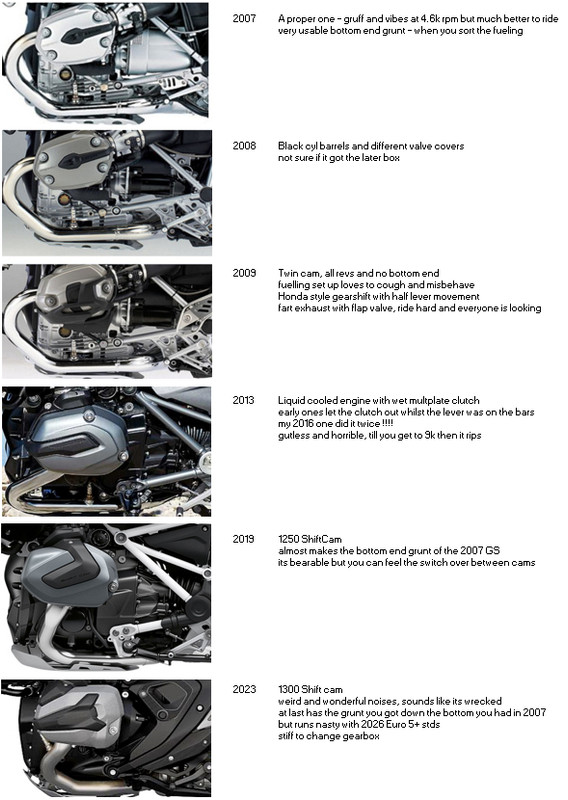
SnowMec
Registered user
Interesting pictures with accompanying texts.
Looks like they were taken from a workshop manual but I don't recognize these from any of my manuals.
I interpret these reviews as a personal reflection and unfortunately I can't agree.
When I finally, somewhat reluctantly, decided to complete my bike collection with an R1200GSA K25 (I needed a bike with a large tank volume) I had ridden a few examples and knew what I wanted.
The reason I was a little hesitant about a GSA is that I have always had difficulty with the telelever that BMW insists on.
I can stand it even if I don't really like that solution, I prefer real front forks.
But engine-wise there was no doubt for me, it was the twincam that I would have.
The older R1200 "hex head" has a very nice engine that unfortunately feels a little reluctant closer to the rev limit.
The difference in active driving is big when you then drive a twincam, which is not only a low-rev engine.
At low revs they are identical in my opinion, I can't tell the difference between them when driving slowly.
For me a twincam is almost like a KTM LC8 when you drive actively, very fun and entertaining.
And a TC almost as nice as a well-adjusted airhead when driving at a legal pace in e.g. city traffic.
There is no time I would choose a hexhead over a twincam if all else is equal, but of course I would rather buy a nice hex than a bad TC
Just my opinion, based on how I experience the difference between these engines.
Best regards
Looks like they were taken from a workshop manual but I don't recognize these from any of my manuals.
I interpret these reviews as a personal reflection and unfortunately I can't agree.
When I finally, somewhat reluctantly, decided to complete my bike collection with an R1200GSA K25 (I needed a bike with a large tank volume) I had ridden a few examples and knew what I wanted.
The reason I was a little hesitant about a GSA is that I have always had difficulty with the telelever that BMW insists on.
I can stand it even if I don't really like that solution, I prefer real front forks.
But engine-wise there was no doubt for me, it was the twincam that I would have.
The older R1200 "hex head" has a very nice engine that unfortunately feels a little reluctant closer to the rev limit.
The difference in active driving is big when you then drive a twincam, which is not only a low-rev engine.
At low revs they are identical in my opinion, I can't tell the difference between them when driving slowly.
For me a twincam is almost like a KTM LC8 when you drive actively, very fun and entertaining.
And a TC almost as nice as a well-adjusted airhead when driving at a legal pace in e.g. city traffic.
There is no time I would choose a hexhead over a twincam if all else is equal, but of course I would rather buy a nice hex than a bad TC
Just my opinion, based on how I experience the difference between these engines.
Best regards

TC all day long

Not sure I would compare a K25 with a 950/990 LC8. Cart horse to race horse in both riding experience and maintenance 
SnowMec
Registered user
I completely agree with you when comparing the vehicles as a whole, but in terms of the engine, I see similarities in riding enjoyment between my LC8 950 and my GSA TwinCam.Not sure I would compare a K25 with a 950/990 LC8. Cart horse to race horse in both riding experience and maintenance
So, I was referring solely to the engine.
As I mentioned, the Hexhead engine lacks a bit of the eagerness to rev found in my TwinCam—a quality that makes me prefer the latter.
If you compare the motorcycles—a completely stock K25 versus an LC8 950—the KTM is the dynamic choice; it performs excellently in stock form at high speeds, even off-road.
My K25 is fitted with Öhlins EC suspension and a 21-inch front wheel, so it works very well for my riding style, though it is obviously not a stock bike.
I am very pleased with the engine and gearbox, as well as the large 33-liter tank—which was the reason I bought the bike in the first place.
My KTM LC8 SuperEnduro had a 14-liter tank, which just doesn't work where I live.
I have the 30 ltr Safari tank on my SE which sorts the issue,
I will say that the stock GS tank has been more than adequate and although we carried a 5 ltr can on the more remote sections it never proved to be an issue. I would have liked a 21” front though
I will say that the stock GS tank has been more than adequate and although we carried a 5 ltr can on the more remote sections it never proved to be an issue. I would have liked a 21” front though
The hex head GS / GSA TC GS /GSA all have telelever suspensionInteresting pictures with accompanying texts.
Looks like they were taken from a workshop manual but I don't recognize these from any of my manuals.
I interpret these reviews as a personal reflection and unfortunately I can't agree.
When I finally, somewhat reluctantly, decided to complete my bike collection with an R1200GSA K25 (I needed a bike with a large tank volume) I had ridden a few examples and knew what I wanted.
The reason I was a little hesitant about a GSA is that I have always had difficulty with the telelever that BMW insists on.
I can stand it even if I don't really like that solution, I prefer real front forks.
But engine-wise there was no doubt for me, it was the twincam that I would have.
The older R1200 "hex head" has a very nice engine that unfortunately feels a little reluctant closer to the rev limit.
The difference in active driving is big when you then drive a twincam, which is not only a low-rev engine.
At low revs they are identical in my opinion, I can't tell the difference between them when driving slowly.
For me a twincam is almost like a KTM LC8 when you drive actively, very fun and entertaining.
And a TC almost as nice as a well-adjusted airhead when driving at a legal pace in e.g. city traffic.
There is no time I would choose a hexhead over a twincam if all else is equal, but of course I would rather buy a nice hex than a bad TC
Just my opinion, based on how I experience the difference between these engines.
Best regards
once used to it, youll never want std forks again
SnowMec
Registered user
My personal opinion:The hex head GS / GSA TC GS /GSA all have telelever suspension
once used to it, youll never want std forks again
Since production of the R100GS ended in 1996 (mine was a '93 model), all "boxer" R-GS(A) models have featured Telelever front suspension and I have never thought this was a good idea.
(Note: I don't count the HP2E as a "GS,"and I know that it has a conventional front fork.)
Many other BMW models have also used Telelever, including my K1200RS.
I’ve ridden many different BMW models with Telelever—and owned two—but I’ve never learned to like the system.
Given the choice, I prefer a conventional front fork, which provides much better feedback on what the front wheel is doing, though I can live with the front suspension on my current bike.
Otherwise, I like most things about my GSA, except, perhaps, the linked braking system.
If BMW releases a R12G/S with a large tank and a low first gear, I might well switch bike (or by one more), but until then, I’ll likely keep my TwinCam.
An R12 G/S with a decent-sized fuel tank would be a true successor to the R100GS—something I’ve been missing for 30 years now.
A conventional fork, a 21-inch front wheel, and the fantastic TwinCam engine make for the combination that suits me best.
Last edited:
with std suspension and old world tyres - when you first ride a R1200GS K25 there is a learning curve to get used to the front - you need to learn it works, but feels odd, and its impossible to know if the front is going to let go
with decent aftermarket shocks, minor tweaks to right height and spring rates and modern suitable tyres, what you get is a bike that copes well with out collapsed roads and allows you to stop and easily handles well enough to beat anyone else out there
My KTM 1290 SAT had hopeless suspension, (active junk, stupidly stiff at the back, way too soft at the front - with muddled incompetent rider mode of hell) but it did feel more normal to steer - when the tyres had warmed up - never knew it was a thing on bikes - but in cold temp cold weather the bike was impossible to ride with severe camber steer at the back fighting the front like you had a puncture. Two mile in and it became normal again ??? But try riding fast and the front end dive is a nightmare to try and manage - it couldn't stop for love nor money - and if you fill the tank full the crazy dive goes in to overdrive - marauding through traffic like you do all day long on a GS becomes a dangerous liability as severe weight transfer you forgot was a thing on a GS - tries to kill you, particularly grabbing a fist full trying to avoid a car pulling across lanes
I had a Triumph 1200 Explorer too - again quite good till you up the speeds and try to stop - whereupon like the KTM it can't
with decent aftermarket shocks, minor tweaks to right height and spring rates and modern suitable tyres, what you get is a bike that copes well with out collapsed roads and allows you to stop and easily handles well enough to beat anyone else out there
My KTM 1290 SAT had hopeless suspension, (active junk, stupidly stiff at the back, way too soft at the front - with muddled incompetent rider mode of hell) but it did feel more normal to steer - when the tyres had warmed up - never knew it was a thing on bikes - but in cold temp cold weather the bike was impossible to ride with severe camber steer at the back fighting the front like you had a puncture. Two mile in and it became normal again ??? But try riding fast and the front end dive is a nightmare to try and manage - it couldn't stop for love nor money - and if you fill the tank full the crazy dive goes in to overdrive - marauding through traffic like you do all day long on a GS becomes a dangerous liability as severe weight transfer you forgot was a thing on a GS - tries to kill you, particularly grabbing a fist full trying to avoid a car pulling across lanes
I had a Triumph 1200 Explorer too - again quite good till you up the speeds and try to stop - whereupon like the KTM it can't
SnowMec
Registered user
The first time I rode a BMW with Telelever was when the then-new R1100RS was released in 1993; I was riding a K1 at the time.
Braking without a conventional front fork felt unique, but I interpreted the design as being well-suited for road use and ABS-equipped bikes.
My K1200RS also had Telelever, which is fine for a street bike.
However, I don't think it should be used on a GS, as the disadvantages outweigh the advantages.
My GSA is fitted with Öhlins EC shocks, and they work well.
I’ve bought Öhlins for all my BMW motorcycles because the stock shocks don't meet my standards.
I run a 21-inch front wheel—which I prefer over the standard 19-inch—and TKC80 tires, as I use the bike primarily on gravel roads and trails.
That said, I’m not entirely happy about the Telelever setup; it was the main reason I hesitated before buying the bike, but I really wanted that engine and drivetrain, along with the 33-liter tank.
If BMW equips the R12G/S with a large tank and a low first gear, I’ll buy one—but until then, my BMW K25 TwinCam suits me best, despite the Telelever.
I’ve owned two KTM LC8s, which are excellent motorcycles. You don’t need to buy new shock absorbers for them, as they come with high-quality components straight from the factory.
The engines perform incredibly well, though they aren't quite as pleasant as a Twin Cam when riding at a more relaxed pace.
Different characteristics.
Braking without a conventional front fork felt unique, but I interpreted the design as being well-suited for road use and ABS-equipped bikes.
My K1200RS also had Telelever, which is fine for a street bike.
However, I don't think it should be used on a GS, as the disadvantages outweigh the advantages.
My GSA is fitted with Öhlins EC shocks, and they work well.
I’ve bought Öhlins for all my BMW motorcycles because the stock shocks don't meet my standards.
I run a 21-inch front wheel—which I prefer over the standard 19-inch—and TKC80 tires, as I use the bike primarily on gravel roads and trails.
That said, I’m not entirely happy about the Telelever setup; it was the main reason I hesitated before buying the bike, but I really wanted that engine and drivetrain, along with the 33-liter tank.
If BMW equips the R12G/S with a large tank and a low first gear, I’ll buy one—but until then, my BMW K25 TwinCam suits me best, despite the Telelever.
I’ve owned two KTM LC8s, which are excellent motorcycles. You don’t need to buy new shock absorbers for them, as they come with high-quality components straight from the factory.
The engines perform incredibly well, though they aren't quite as pleasant as a Twin Cam when riding at a more relaxed pace.
Different characteristics.

lean over the seat and pour it in, pop down and look side you are standing...I agree. On my single cam I can fill with oil and just dip my head down to see the oil level in the sight glass.
When the ex missus changed her single cam to a twin cam it was a faff.
Put a little oil in. Go round the other side to check the sight glass. Go back round to the other side, add a little more, go round to the other side to check the level,
Repeat until you get the correct level.
Warm the bike up. Then repeat the above to get the level correct again.
It never made any sense to me to swap to the other side.

Similar threads
- Replies
- 3
- Views
- 197


- Replies
- 28
- Views
- 4,226


