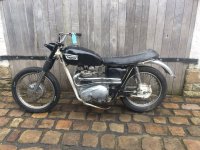
1965 Triumph Bonneville TT

Now it's time to split the crankcase and see just what state the crankshaft is in. Again it came apart really well with no excess force required and no signs of previous mechanical violence. Fingers crossed!

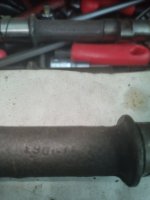
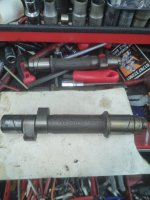
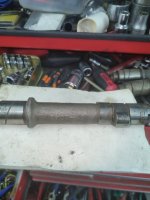
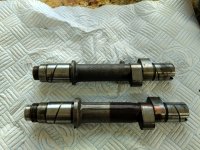
The camshafts are really good, E3134 on the exhaust and E5048 on the inlet. No wear lines or ridges at all. (ignore the raised numbers, they are just casting numbers, the actual part numbers are stamped in. This causes quite a bit of confusion when sourcing parts)
51.jpg

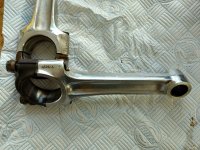
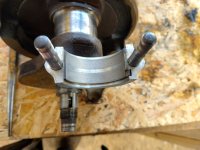
Now for the all-important bit, the crankshaft. I took one conrod off and couldn't believe the condition of the bearing shells, they were perfect!
48.jpg

I looked on the back to check the size and there was nothing except the part number - E3586, which is the standard size bearing. Surely the crankshaft couldn't still be at it's original dimensions after 60 years???

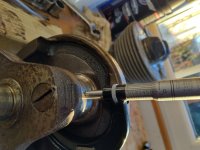
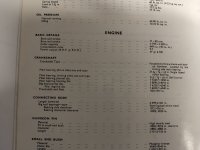
I checked the bearing journals and they looked perfect. I then measured them, 1.6235" which is standard size, unbelievable. (the picture shows slightly less, when measured with the micometer held properly they are 1.6235")
46.jpg47.jpg
 
Last edited:
When I split the crankcases there was no trace of the missing section of cylinder liner, the engine had obviously been rebuilt, and run, with the broken liner. Also there was no evidence of a broken conrod in the past, there are always gouges or holes in the crankcase when this happens. The conrods themselves are in excellent condition with just a few minor scratches that I will polish out before the rebuild. These are made from RR56, a Hiduminium alloy developed by Rolls Royce in the 1930s and supposedly used for the conrods and other parts fitted to the Merlin engines used in Spitfires, Hurricanes, Mosquitoes and Lancasters etc. :thumb2

52.jpg


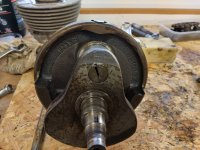
Next up, the sludge trap which does exactly what it says. Some people will know about these and some won't. Most old British bikes don't have oil filters other than a very coarse wire gauze on the oil tank outlet. Anything smaller than about 2mm just passes straight through and gets pumped into the crankshaft, the only part of the engine lubrication system that is pressurised. Everything else is just splash-fed or drip-fed, these are very simple engines. The first Speed Twin was launched in 1937 and the design changed very little over the years.

The oil is pumped into the crankshaft to the big-end journals which are offset from the crankshaft centreline by 41mm to give the stroke of 82mm. When the engine is running centrigugal force throws out any debris that is in the oil to the outside of a steel tube (the sludge trap) where it remains until cleaned out during an engine rebuild.

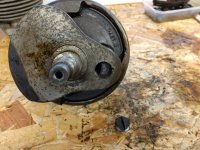
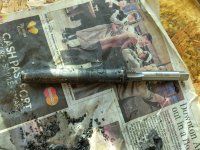
The sludge trap in this crankshaft had never been cleaned as the plug was still in it's original position with only one centre punch mark to retain it. When a new plug is fitted they have to be re-punched in a different place. Now I don't know if this is the original crankshaft but it's certainly never been cleaned out before. The centre punch peens over some metal into the slot and threads of the plug to stop it coming loose.

49.jpg

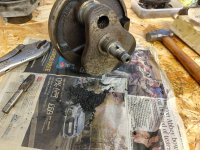
These are notoriously difficult to get out. Firstly the punching has to be removed by either drilling or with a Dremel etc. Then an impact driver is needed to unscrew the plug, a good bit of heat also helps as sometimes they are Loctited in too. With the plug removed the build-up of sludge is obvious on the outside of the trap. The sludge is the grey bit, the black bit is the remaining empty space in the trap. This one is about two thirds full, if they fill up competely then the oil supply to the big ends is blocked off with dire results. This is also why you shouldn't put modern oil into old bikes, the detergents in the oil can loosen the sludge causing it to be pumped into the bearings. :(

53.jpg

So, I've started to remove the sludge so I can then extract the trap, clean it all scrupulously and then fit a new trap and plug. This will take some time!

54.jpg
 
When I split the crankcases there was no trace of the missing section of cylinder liner, the engine had obviously been rebuilt, and run, with the broken liner. Also there was no evidence of a broken conrod in the past, there are always gouges or holes in the crankcase when this happens. The conrods themselves are in excellent condition with just a few minor scratches that I will polish out before the rebuild. These are made from RR56, a Hiduminium alloy developed by Rolls Royce in the 1930s and supposedly used for the conrods and other parts fitted to the Merlin engines used in Spitfires, Hurricanes, Mosquitoes and Lancasters etc. :thumb2

View attachment 367181


Next up, the sludge trap which does exactly what it says. Some people will know about these and some won't. Most old British bikes don't have oil filters other than a very coarse wire gauze on the oil tank outlet. Anything smaller than about 2mm just passes straight through and gets pumped into the crankshaft, the only part of the engine lubrication system that is pressurised. Everything else is just splash-fed or drip-fed, these are very simple engines. The first Speed Twin was launched in 1937 and the design changed very little over the years.

The oil is pumped into the crankshaft to the big-end journals which are offset from the crankshaft centreline by 41mm to give the stroke of 82mm. When the engine is running centrigugal force throws out any debris that is in the oil to the outside of a steel tube (the sludge trap) where it remains until cleaned out during an engine rebuild.

The sludge trap in this crankshaft had never been cleaned as the plug was still in it's original position with only one centre punch mark to retain it. When a new plug is fitted they have to be re-punched in a different place. Now I don't know if this is the original crankshaft but it's certainly never been cleaned out before. The centre punch peens over some metal into the slot and threads of the plug to stop it coming loose.

View attachment 367184

These are notoriously difficult to get out. Firstly the punching has to be removed by either drilling or with a Dremel etc. Then an impact driver is needed to unscrew the plug, a good bit of heat also helps as sometimes they are Loctited in too. With the plug removed the build-up of sludge is obvious on the outside of the trap. The sludge is the grey bit, the black bit is the remaining empty space in the trap. This one is about two thirds full, if they fill up competely then the oil supply to the big ends is blocked off with dire results. This is also why you shouldn't put modern oil into old bikes, the detergents in the oil can loosen the sludge causing it to be pumped into the bearings. :(

View attachment 367185

So, I've started to remove the sludge so I can then extract the trap, clean it all scrupulously and then fit a new trap and plug. This will take some time!

View attachment 367186
I've been waiting for you to get to the sludge trap. Good stuff and I now know where I can take my 6T crank for its sludge trap removal as I've never done it and I know it's a bastard to do.😉 Well done 👏
 
Now for some bad news, the timing side (right hand) cylinder liner has a big chunk missing which is usually caused by a snapped conrod. Bugger. :(

It's still serviceable as the piston rings don't come anywhere near the missing section but Im not sure whether to use it or not which is a shame because the bores and pistons are perfectly good.

View attachment 367139
Ok,numpty question,if you needed to can you get the liners replaced?

Great progress so far,loving this thread

Kimbo
 
I've been waiting for you to get to the sludge trap. Good stuff and I now know where I can take my 6T crank for its sludge trap removal as I've never done it and I know it's a bastard to do.😉 Well done 👏
I can remove it for you but I'm not cleaning it out. :D
 
Ok,numpty question,if you needed to can you get the liners replaced?

Great progress so far,loving this thread

Kimbo

Makes two of us, I wondered the same?

Great write up Number 6 - An education :thumb2
Not a numpty question at all. They can probably be replaced by a specialist engine reconditioning firm but it wouldn't be cost effective, a new set of Aerco cylinders is less than £300 and I believe they're made on the same tooling as the originals. The liners on theT150 and Rocket 3 triples are available as spare parts and can be replaced as the barrel casting is aluminium and can be heated up so it expands and loosens it's grip on the liners. They still need pressing out with a hydraulic press though. The new liners just drop straight in if the barrels are hot enough, I've done a few of these myself but again it isn't cheap, new liners are £70+ each and then they need to be bored to size afterwards. With the 650 twins the problem is that the barrel casting and the liners are both made of similar cast iron so heating them up doesn't help as they both expand at the same rate, I certainly wouldn't attempt it. :thumb2
 
Got the sludge trap out. An M16 tap fits perfectly, I'd only gone in a few turns and the trap started to spin and it pulled out quite easily. If they're really stuck then tapping for about 1/2" or so and then screwing in a length of M16 threaded rod and drawing it out with a large washer and nut works well.

55.jpg

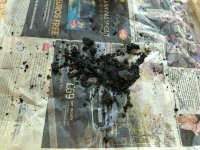
This is the crap that came out of just the tube. I haven't started to clean the crankshaft yet, it's a filthy job and it needs to be absolutely spotless because the oil goes from here directly to the big-end bearings.

56.jpg

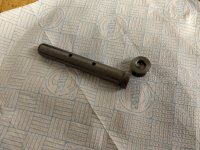
New trap and plug ready to be installed once the crank is cleaned. You can get them with a hex head to take an allen key which makes them much easier to remove the next time.

IMG_20241128_194951_HDR.jpg
 
Last edited:
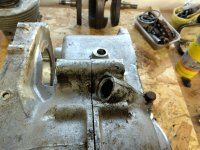
The crankcases are now completely stripped and just need a good cleaning. Depending how bad they are I may get them vapour blasted, I'll be having the cylinder head and rocker boxes done so might just get them all done together. Matching frame and engine numbers are essential if paying good money for an old Triumph but what many people aren't aware of is that the crankcase sections are also numbered and these should match too. When manufactured they are machined as a pair to ensure correct alignment of the crankshaft and camshaft bearings. With the engine in the bike the only way to check these on twins is with a mirror as they are on the bottom of the engine.

61.jpg
 
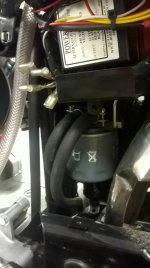
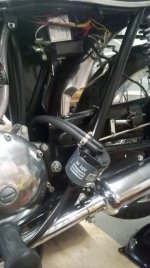
Do you fit an external oil filter to rebuilds?
That way you get less sludge deposited in the sludge trap
 
Do you fit an external oil filter to rebuilds?
That way you get less sludge deposited in the sludge trap
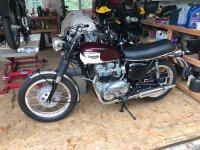
I do usually but I won't be doing to this one, it will only do very limited mileage and I'd like to keep it original. This is my 1967 T120R which I use quite a bit, I've also got them on my T150s.

WP_20230131_15_30_34_Pro.jpg

WP_20230131_15_33_28_Pro.jpg

27.jpeg
 
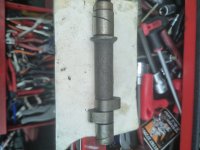
There's actually 3 camshafts in total
20241129_171516.jpg20241129_171516.jpg
 

Attachments

  • 20241129_171621.jpg
    20241129_171621.jpg
    88.6 KB · Views: 15
  • 20241129_171610.jpg
    20241129_171610.jpg
    143.3 KB · Views: 14
  • 20241129_171523.jpg
    20241129_171523.jpg
    120.1 KB · Views: 14
  • 20241129_171644.jpg
    20241129_171644.jpg
    115.7 KB · Views: 14
Only one that does not have the extra after the thread, has no numbers (Appears to have been ground off)
The others have partial stampings, but not easy to read.
Their probably from my old man's drag racer, he used to campaign a twin engined bike with a big blower

Yours if of any use...
If you have good contacts in the Triumph world I've been looking for a '67 TR6C for ages
 
Thanks for that Neil but I don't think they're any use to me. (y) I have a 67 TR6C and also a 68, they're both restoration projects, once I've finished this one I intend to build them both up at the same time. This is the 68, the 67 is completely dismantled.

1.jpg
 
Great write up.

About 30 years ago I rebuilt a 1963 T90, 350cc.

I stilll have my old notebooks from the time and a copy of a tuning booklet by Stan Shenton. (Tuning based on 500cc Daytona, but I applied the principles to the 350).

Another, Wish I had never sold it.
 
@jonnierocket.

That cable is annoying. It is the throttle cable with a mid-adjuster. It is correct to route it upwards like that (as in same as a trials bike), but it does need shortening a bit. Reduces the chance of it snagging.

I also note that is only a single carb version Mr McQueen is riding.

Fo the ISDT preparation a spare set of cables were routed to clutch, brake, throttle and taped ** to the handlebars in position to enable quick change if a cable failed.

**Possibly not taped in 1964, but tied on with the john Bull rubber tie on strap.


Back
Top Bottom