Building the front wheel.
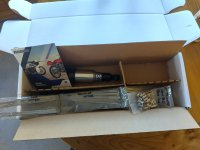
I get my spokes and rims (if needed) from Hagon, they're great quality and they always ask you to confirm exactly what size rim and hub you're building and for what model of bike. I've never had a problem with the parts they supply.
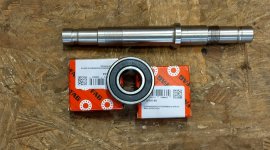
New stainless steel spindle and good quality wheel bearings. The wheel bearings are actually metric size which makes them reasonably priced, the Imperial size engine and gearbox bearings are now very expensive.
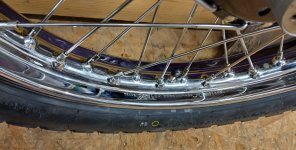
I'm using the original Triumph wheel rims, the front is a Jones WM2 19" the rear is a Dunlop WM3 18", I had them re-chromed by Castle Chrome in Birmingham, again excellent service and a top class job but not cheap! A new replica rim is cheaper than having one re-chromed but I prefer originality where possible.
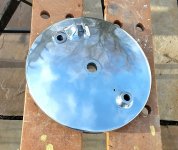
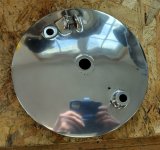
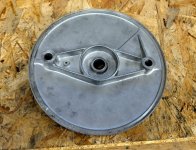
The front hub was powder coated by Triple S, another top class business.

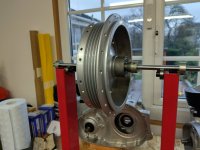
This is what use for wheelbuilding, it's a Sealey tyre-balancing stand.
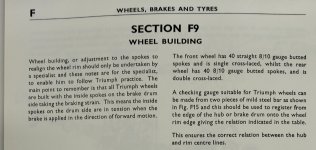
The Triumph workshop manual is very detailed, even explaining the reason for the spoke pattern.
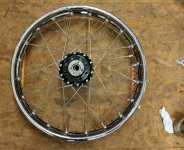
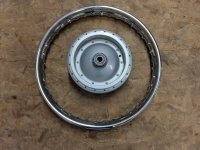
Rim and hub laid out ready for the first spoke set.
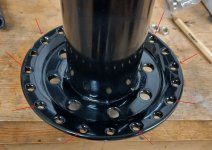
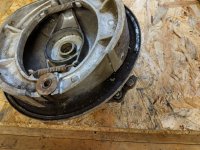
This is the right hand or brake side of the hub. Triumph also use the terms drive-side and timing side, mainly in regards to the engine but sometimes when referring to the whole bike. Drive-side is the chain side (left) and timing-side is where the timing gears are located (right).
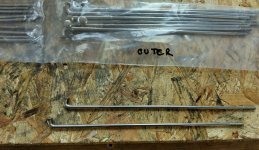
These spokes are the 'outers' they have a 78 degree bend at the head end.
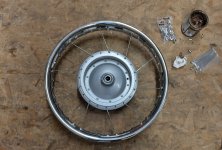
Next, the inner spokes (arrowed), these are the ones that are under tension when braking. They have a 100 degree bend. The wheel roates in the same direction as the arrows.
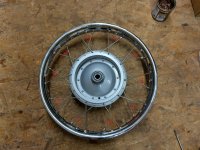
Then the left side spokes, these are all the same and are just straight spokes.
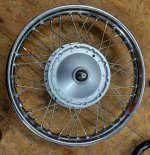
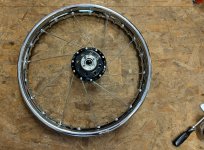
Time to get the wheel trued on the stand. This can take some time because you have to adjust three things all at the same time, concentricity, wobble and offset. It gets easier with practice, the trick is to adjust each spoke a litle bit at a time, if it all goes wrong just slacken them all off and start again. I don't use a dial guage, just a steel rule held close to the rim, it's surprising how small a gap the eye can see, accurate to within 0.010" Once it's true I trial fit it in the forks then adjust the offset to get it central.
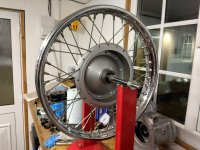
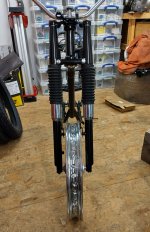
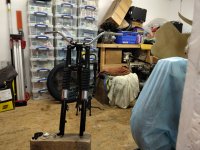
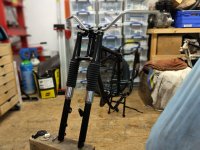
The front wheel in the forks with the rim central between the fork legs. I then build the rear wheel so that the rim is inline with the front rim.