Africa in 5 months

This is so very good. Thank you.

(It also reminds me why I live in EAST Africa!)

Sean
 
Mauritania truck spill

We came across an overloaded truck which tipped on its side on a rare bend somewhere in Mauritania. This is the carnage:

<iframe width="640" height="480" src="http://www.youtube.com/embed/4bAWxEVSWK4?rel=0" frameborder="0" allowfullscreen></iframe>
 
W e had been looking forward to Ghana for quite some time; its safe, stuff works and finally we will be able to converse with people in English. The land of milk and honey.

Dropping down from the northern border with Burkino Faso, we headed for Mole National Park. Somewhere along the 150km of dirt track to Mole I hit a sand bank and had my first proper off. This resulted in a lost pannier, mangled crashbar and fairly decent shiner on my tank. And so a second trip to the bush welders was required, those special people whose preferred tool, after a welder, is a hammer or similar blunt object with which my panniers can be beaten into submission. The welder saw this in a slightly different light to me, "Europeans manufacture, Africans fix". Well kind off, it all depends on your definition of fix...

Mole was great, for the first time since Rabat we had 2 off days and they were very much needed. We spent most of our time round the pool waiting for nightfall when it cools down to "bearable". On the second night we trekked out to a remote tree hide and slept under the stars. This included a walk to the waterhole around the 2 resident elephants who seem to spend most of their time in the water waiting for it to cool down to bearable.

<img class="alignnone" title="" src="http://i1190.photobucket.com/albums/z447/rsstler/Ghana/P1000368_edit0.jpg" alt=""/>
Mole water hole. Thats an elephant in there, it never moved in 3 days, we are pretty sure it was chained there.

<img class="alignnone" title="" src="http://i1190.photobucket.com/albums/z447/rsstler/Ghana/P1000356_edit0.jpg" alt=""/>
As I wash, so do they

From Mole it was on to Accra. The road was fairly good until the last 30kms where it degenerated in to a multi-lane dirt race track which the local taxis use as an opportunity to overtake, undercut or break down, sometimes all 3 at the same time. Madness.

Arriving at Accra, we found a place to stay called High Spirit Guest House, a rasta beach bar in Coco beach which is named after it's extremely accomodating owner. We were greeted like local celebrities, 2 crazy white men who have travelled from London on "power bikes". Many photos of the bikes were taken and of course we were warned of neighbouring countries that were dangerous and not safe like Ghana.

Everywhere we went people thought we were twins, apparently they can't tell us apart. Cars would scream past and the driver would bellow "Eh, are you twins?". We even had this a police check point whilst fully suited and helmets on.

With Adrian due to head back to SA for a week I decided I was going to stay on for a bit of R&R. High Spirit and his crew of irie brothers were awesome, within a few days I'd become a member of the Coco beach family. I spent my time going to reggae beach parties, chilling with the crew in their recording studio and of course waiting for it to cool down to bearable...

<img class="alignnone" title="" src="http://i1190.photobucket.com/albums/z447/rsstler/Ghana/P1000444_edit0.jpg" alt=""/>

<img class="alignnone" title="Banku dinner" src="http://i1190.photobucket.com/albums/z447/rsstler/Ghana/P1000439_edit0.jpg" alt=""/>
Dinner of Banku and Cassava, Adrian not quite grasping the concept of eating with your hands

<img class="alignnone" title="High Spirit crew" src="http://i1190.photobucket.com/albums/z447/rsstler/Ghana/P1000457_edit1.jpg" alt="" width="712" height="514" />
High Spirit and his irie crew, from left to right, Riko, High Spirit and Abigail

<img class="alignnone" title="Ghana funeral coffins" src="http://i1190.photobucket.com/albums/z447/rsstler/Ghana/P1000410_edit0.jpg" alt="" width="712" height="514" />

Funderals here are big affairs, they usual last about 3 days and cost a fortune. This bloke is a custom coffin maker who will build you a coffin of your choice. Popular past coffins include mobile phones, cameras or bottles of beer displaying your expiry day

They are extermely religous here, cars and taxis will proudly proclaim their devotion through the medium of the bumper sticker. Some bumper stickers make more sense than others. A few of my favorites include:
"Shut you face, are you Jesus?"
"God will deliver. One day..."

They follow up this seemingly randomly generated text in their roadside adverts saying thing like:
"Protect your family with a treated mosquito net. Don't take Malaria for granted!"
 
Fantastic!

Keep it coming!
 
Tobeni

That's what I would call the unified region of Togo, Benin and Nigeria when I become president of the world, but let's just keep this as the title of the blog post for now.

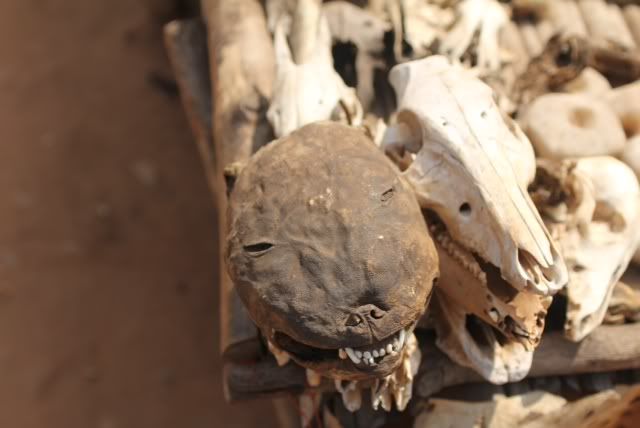
After our extended stay in Accra (and my short visit to SA for Gareth and Carrie's wedding), we did the 188km journey to Lome, Togo. To us this was exhausting, so we decided to take the next day off. We stayed a couple of nights at the Hotel Gallion and explored the city. We perused the massive city market and made a visit to the famous fetish market (first brought to our attention by Tsiklonaut of this parish), where you can buy all manner of dried animals for your "white magic" and Voodoo rituals. Apparently all the remains are derived from animals that have died from natural causes. Apparently.

The next day we made for Nigeria, however thanks to a thumping hangover after a late night drinking session with some fellow hotel guests, crack of noon became crack of afternoon. We made it through the busy border into Benin and headed for Cotonou. We arrived quite late, crashed in a very cheap guest house and left early the next day. However, apart from the usual West African driving standards, we can't really bad-mouth the place.
And so into Nigeria. Our passports were frisbee'd to about 5 different people, all slightly more senior than the previous. We smelled a request for some cash, however we had our preemptive strike ready: "We are so happy to be in Nigeria as tourists, we have heard so many good stories about how friendly everyone is to tourists and we are looking forward to enjoying your lovely country as tourists." This resulted in them being too embarrassed to ask for money. We were in and we parted with nothing. According to even Nigerians, this is a world first.

Nigeria is overpopulated, polluted, congested and loud. The police are notoriously corrupt and are always fishing for some "dash". The locals pay up, mainly because their vehicles are so unroadworthy, it's the only way they can still operate. Also, motorcycle riders would rather pay up than wear a helmet, which is apparently compulsory. No one seems to spot the error. When accosted by the local force, we would just smile and say, "No, I'm sorry I don't have any foreign currency for you, how far is it till [insert name of next town]?"

The driving standards are diabolical. There is a theory that Nigerians fancy themselves as time travellers, and that if they go fast enough, they can beat time.

They are also awe-struck by our motorcycles, or "power bikes" as they call them. They look at the speedometer and assume that the last number on the dial indicates its top speed, therefore that is the speed at which we are travelling at.
They were a friendly bunch, it has to be said, but with the high congestion, noise and pollution, it's difficult to sell the place. We originally planned on heading to Abuja to shop for visas, however when we found out we wouldn't be able to obtain the Angolan visa there (change in policy), and we could get the Gabon visa in Yaounde, Cameroon, we made for Calabar in the South East, where we could also pick up the Cameroon visa (which we got in a mere 2 hours). The guide book painted a promising picture of Calabar, so we decided to stay for 3 days. We also used this opportunity to do much needed bike maintenance. Calabar wasn't that great, but in hindsight, it was probably nice by Nigerian standards.

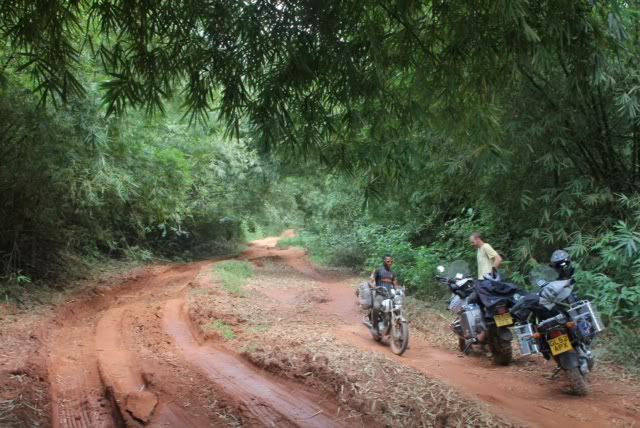
And so we headed to the border. There were two options into Cameroon, the busy one at Ikon and the quieter and closer one at Ikang. We picked Ikang, which on the Michelin Map, is shown as a major road. Now we know why it is quiet. The road started out brilliantly, the best road we had been on in Nigeria. It then disintegrated into a muddy, rutted mess. When we finally got to the border, we were treated like celebrities, mainly because we were the 3rd foreign people to pass through there this year. One was a Canadian woman on a motorcycle (who incidentally got lost for 3 days in the jungle after parking up to look at a nearby waterfall, finally being rescued by some local hunters), and two Portuguese chaps in a 4x4 that passed through in the wet season. "They had much trouble... Much trouble," said the Immigration Officer.
The next 29km into Cameroon was a baptism of fire. The road was an undulating track of muddy, rutted hell in a tunnel of green. We loved it and hated it, and would have definitely high-fived each other afterwards, if we had the energy. Here's a short clip:

<iframe width="853" height="480" src="http://www.youtube.com/embed/3mPlP3IR3Kc?rel=0" frameborder="0" allowfullscreen></iframe>

So we've learned a new term from an expat we met in Lome, which sums things up nicely: WAWA, or West Africa Wins Again. We use this amazingly often.

Fun with long exposures. This was back in Ghana:
photo.jpg


The first semi-official confirmation of the temperatures we've been subjected to:
photo-1.jpg


Fetish market in Lome, Togo:
photo-3.jpg


photo-12.jpg


Dried chameleons:
photo-14.jpg


photo-13.jpg


Time for some bike maintenance:
photo-8.jpg


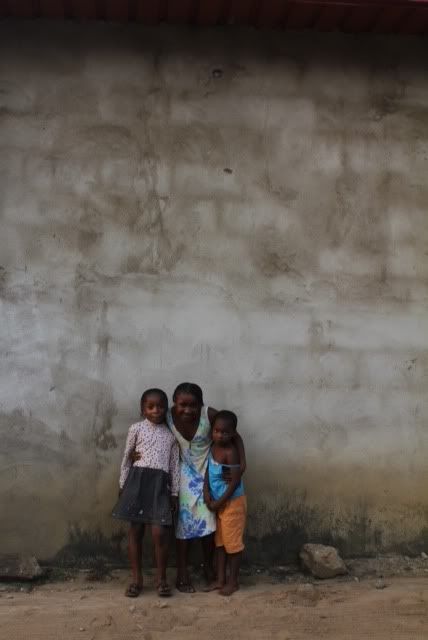
The kids at our Calabar hotel:
photo-7.jpg


Nigeria - 419 Land.
photo-9.jpg


About the only exciting thing in Calabar was a floating fuelling station:
photo-11.jpg


The official border crossing between Nigeria and Camaroon:
photo-5.jpg


This chap told us about the Canadian woman who got lost in the jungle:
photo-6.jpg


Stuck in a rutt, literally. The side stand wasn't down here, mother nature was holding the bike upright.
photo-4.jpg
 
Good to see you boys doing good and having a great time. :clap
 
KTMs in Africa

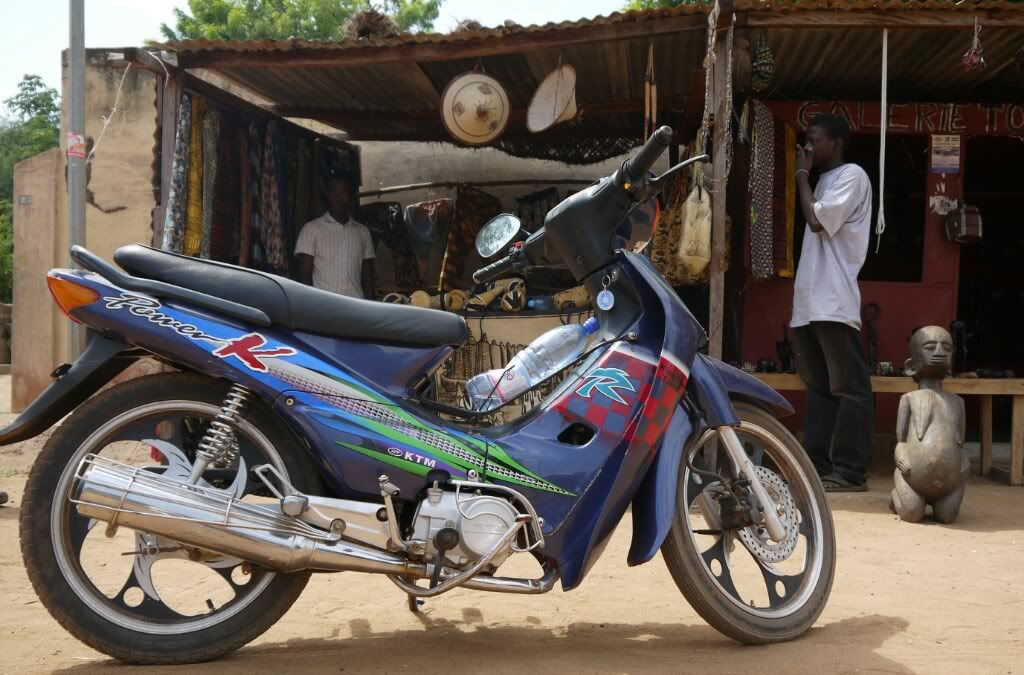
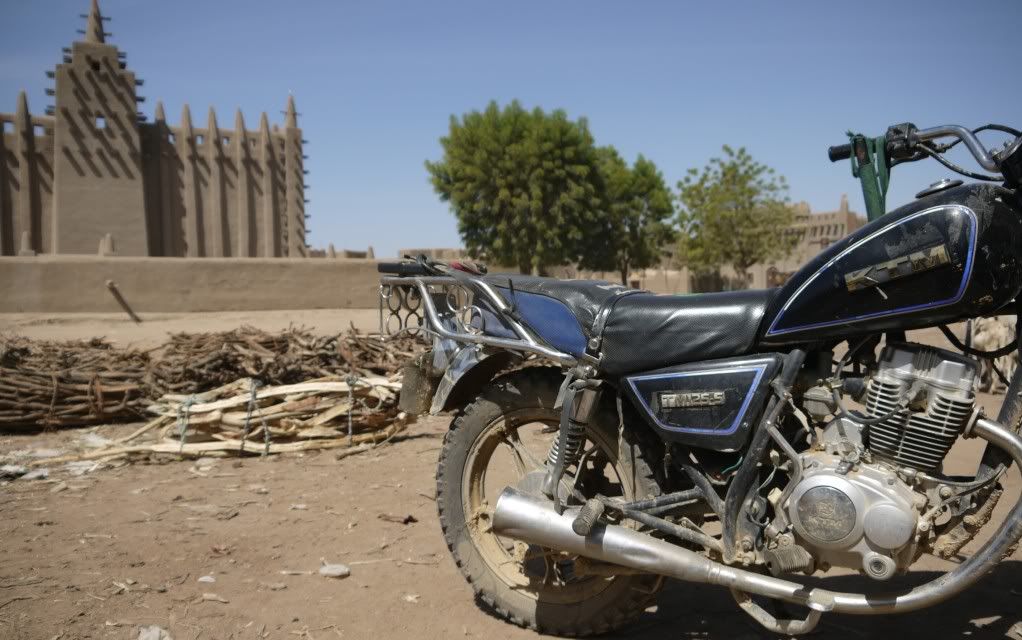
Most of you are probably unaware of KTMs presence in Africa, but they are massive out here. KTM appears to have a completely separate product line which is more suited to the hard African conditions. The African KTM is smaller than the orange bikes we are familiar with and they come in a multitude of colours. They are extremely popular, traveling through Mali it seems as though everyone has one.

P1000245-1_edit0.jpg

The latest automatic "Power K" model from KTM

Whilst smaller, their load carrying capacity is phenomenal. A small KTM can easily carry 2 pillions and a couple of large bags of rice, or 3 pillions at a push. Ideally suited for the school run, I have witnessed a young gent of about 9 years old lifting 3 of his mates home from school. Yes, they are so easy to ride that children can operate them. It is only a matter of time before the out dated laws preventing children riding them are changed.

One trait that the African KTM shares with it's Austrian counterpart is that of built quality. It is frequently cited in the various African KTM owner forums that they are just not built to last. The most common problem being a failed suspension, which typically occurs several days after the 12 month warranty period has lapsed. It is not clear if the suspension problems are related to the excessive loads which these small motos are forced to carry.

P1000323-1.jpg

And older manual KTM in front of the Djenne Mosque

These bikes are normally heard before they are seen, their owners constantly keeping the revs in the red while punishing the clutch at pace. It can be quite embarrassing struggling up a muddy rutted track only to be overtaken by a 125cc KTM being ridden 3 up.

I only hope that KTM International will see the light and bring the African KTM to the rest of the world.

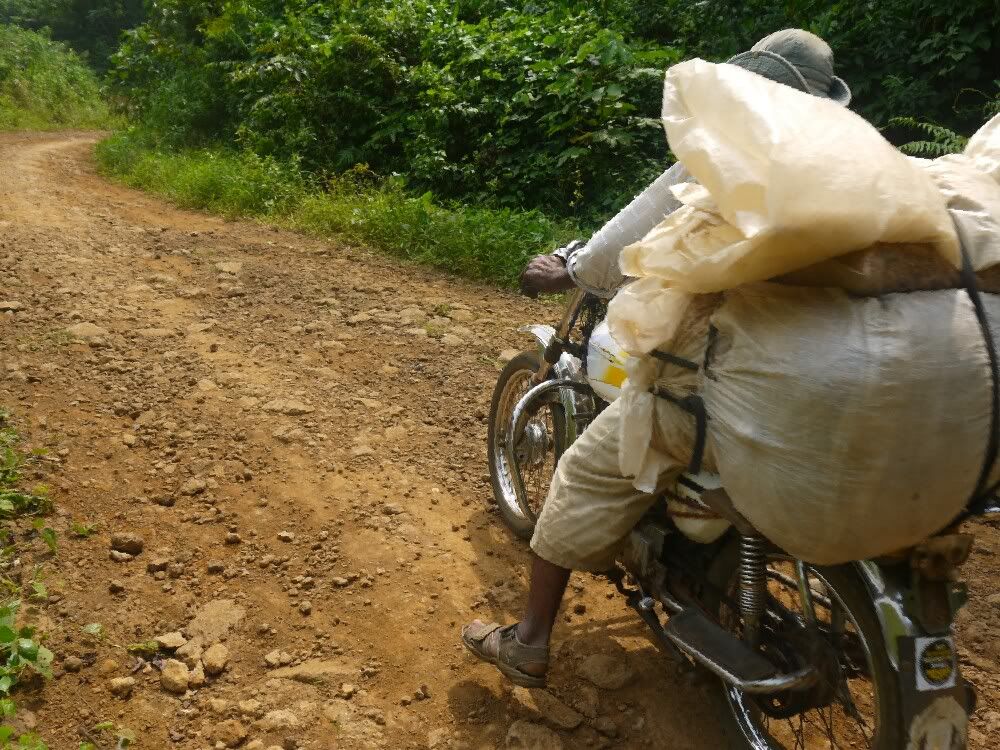
On a more serious note its amazing what these guys can do with cheap chinese bikes (not just the KTMs). They will buy a bike, re-inforce the sub-frame and use it as a taxi. These small bikes have a low center of gravity and the rider remains seated the whole time, paddling through the rough stuff. They routinely carry 200-300kgs, which is good to know because that's the weight of my bike.

P1000670_edit0.jpg

A moto rider demonstrating the "paddle" technique


** For those interested, KTM stands for KingTown TianMa Motors and they are made in China. Obviously.
 
Good to hear you made to Cameroon (we were there on wet season), it's fairly easy going all the way to Brazzaville if you take the Dolisie road. :thumb

Did you get DRC and Angola visas already into passports before you left?

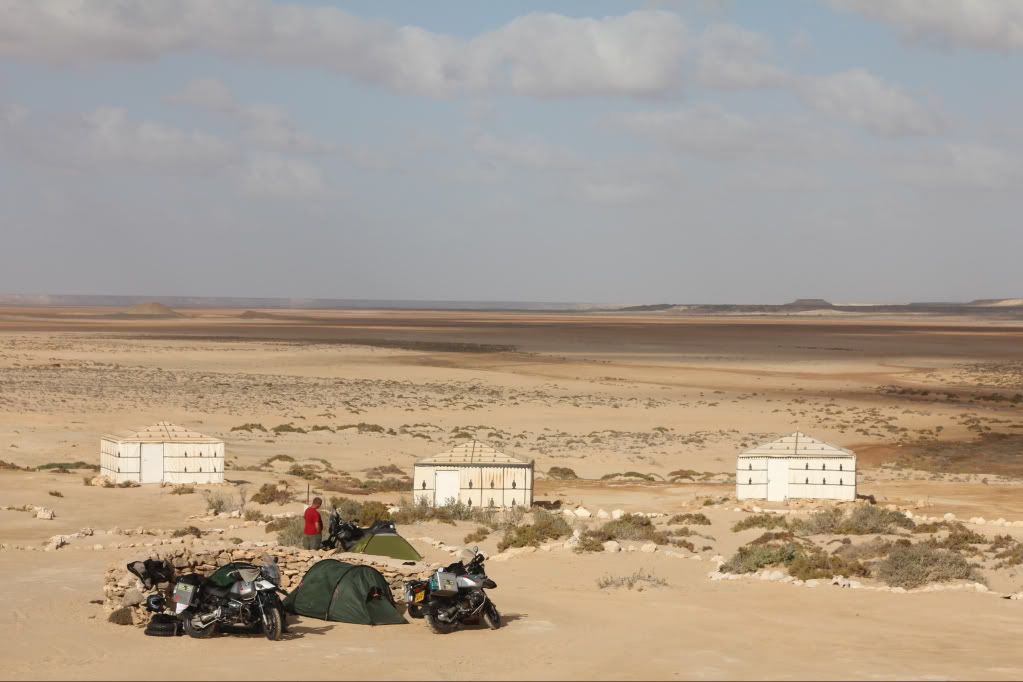
That's Macek the golfer at our first desert camp:
4b4237cc.jpg

I wonder where did you get the idea of buying Hilleberg Nammatj tent afterall? I though only idiots like me buy 'em.

Next time if you can, please fasten the wind ropes on those places, at least the rear and front ones when surrounded by a camping's windwall - the mighty Hilleberg tent looks kind of sad on the pic above! :D

Safe travels,
Margus
 
Margus,
We followed your travels with interest, thanks for the info on the roads to Brazzaville.

We got the DRC visa before we left, but we have to get the Angolan visa en route. There's a thread on HUBB we're keeping a close eye on, which is being updated by a few travellers ahead of us.

I've mastered the art of pitching that Nammatj in 2 minutes with 4 pegs. Those wind ropes have been totally redundant up to now!

BTW, I think we passed you two riding through Morocco back in October (25th or 26th)? It was on the dual carriage way around Marrakech. It was raining at the time, which incidentally has been the last time we've ridden in rain. That's all about to change pretty soon, we're sure!
 
Cameroon

Following on from Adrian’s post about our baptism of fire entering Cameroon; the roads from the border, if you can call them that, were an absolute mess. The 30km of ruttered mud tracks from Ekong to Etu took us 3 hours and this was the dry season. It would have been completely impassable in the wet.

The road improved marginally as wecontinued to Bamenda in the western highlands. We rejoined the main route from Nigeria and hit the motorway, brand new tar with awesome twisties through mountain passes and tropical rain forest. Amazing riding

P1000519_edit0.jpg

Brand new tar in the Cameroonian Highlands

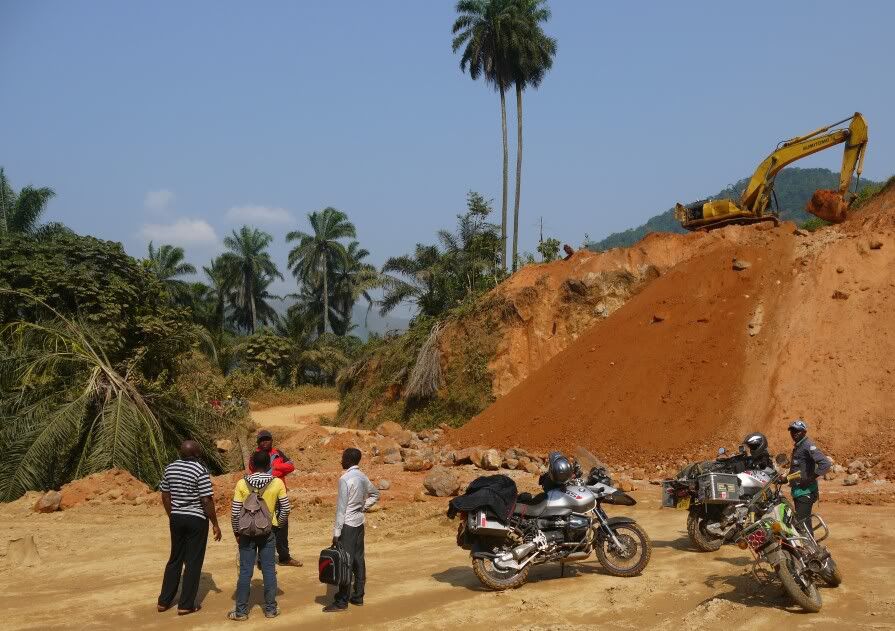
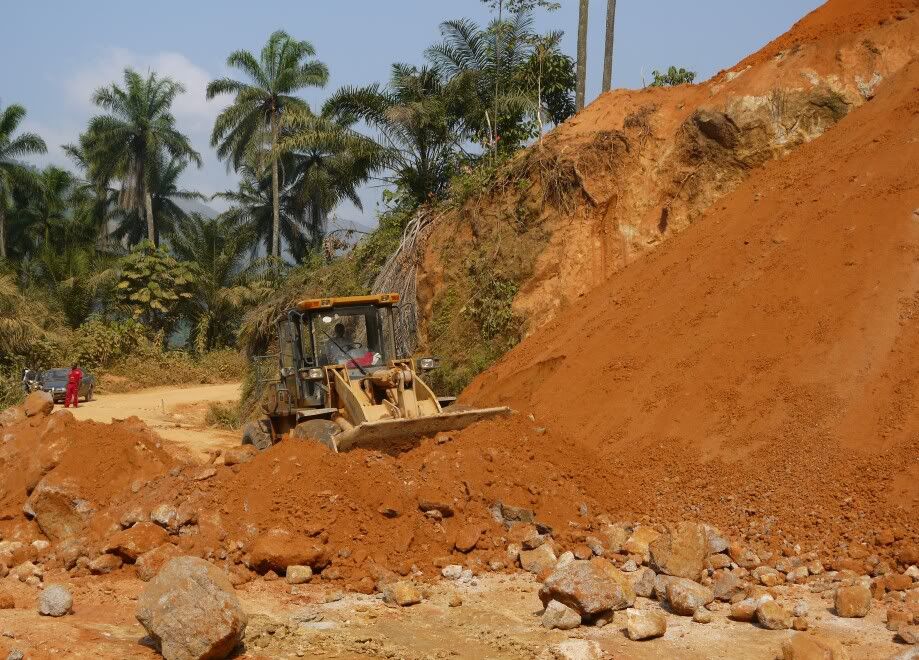
We have learnt to be very suspisious of new tar in Africa and soon our fears were confirmed, the road was not finished… The next 50kms was through a contruction site, the motorway traffic driving along and amoungst the construction site. We rounded a corner and found the road completely blocked by a massive wall of earth. At the top, a Chinese bloke with a digger was throwing rubble down towards to road. None of the locals seemed to know what was happening, but they did not seem too concerned. So we waited, not that there was anything else that we could do. An hour later another bloke arrived with a bulldozer and cleared a new diversion. In true west African style the backlogged traffic began a frenzied race, overtaking any and everyone ahead of them.

P1000526_edit0.jpg

Soon to be new tar, but for now the road is completely blocked

P1000527_edit0.jpg

Rescued by a bulldozer

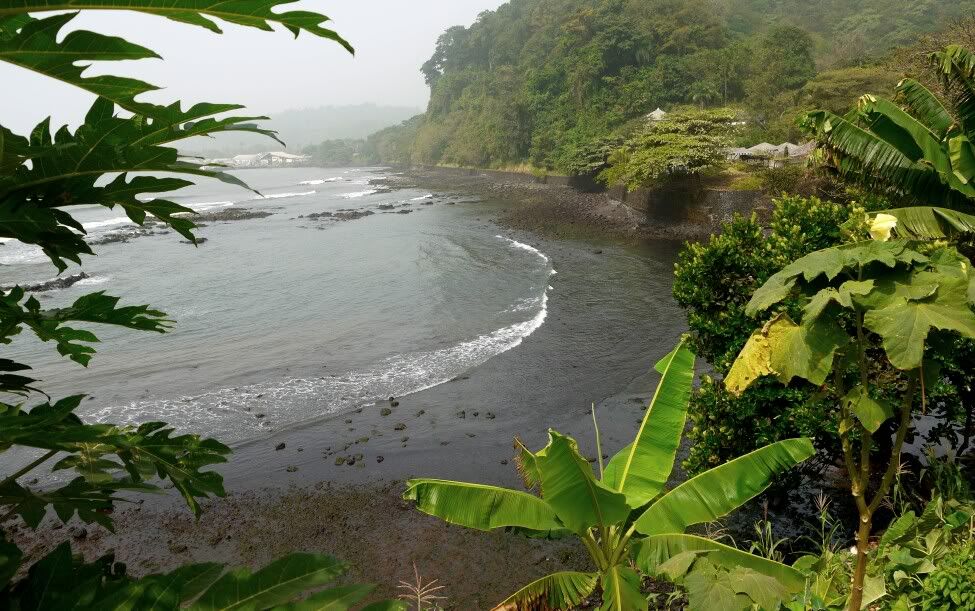
From the Highlands we headed down to Limbe on the south west coast. Beneath Mount Cameroon, the quiet seaside town of Limbe was originally founded by English missionaries and it has kept a colonial feel. With it’s lush rain forests and dark volcanic beaches, we thought Limbe would be a good place for a break. We checked into a great little place called Hotel Miramar inside the botanical gardens overlooking the sea. We were hoping to see Mount Cameroon but were not sure if it was possible from Limbe, it was quite cloudy when we arrived. We asked one of the staff:
“Can you see Mt Cameroon from Limbe?”
“Yes, everyday”
“But not today, because of the clouds?”
“No, not today. But everyday when there are no clouds.”
We did not see Mt Cameroon during our week in Limbe, it was cloudy everyday. Later, we learnt that the clouds marked the start of Hamattan, dry winds that blow dust from the Sahara. The dust is incredibly fine, 0.5 to 10 micrometers in diameter, creating a layer of cloudy mist throughout west Africa.

P1000530_edit0.jpg

Limbe, with our hotel on the right

P1000585_edit0.jpg

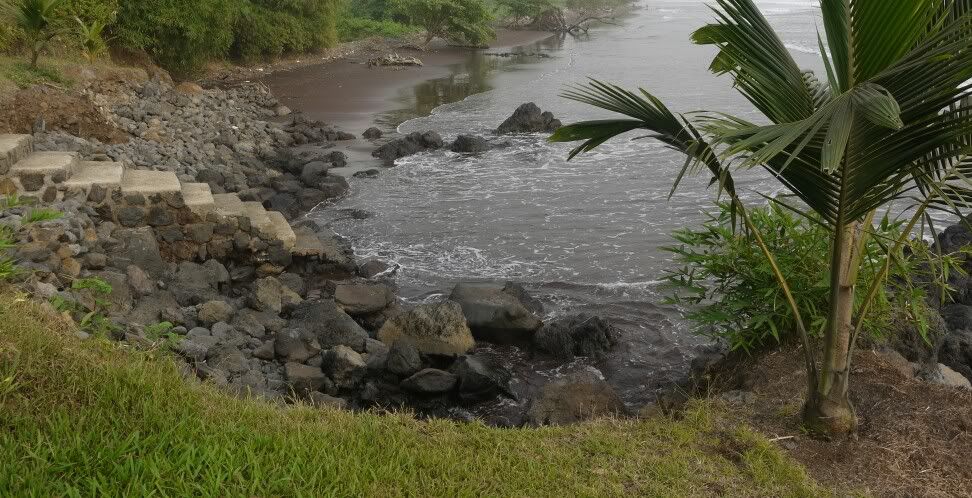
Chocolate sand of 11 mile beach

P1000534_edit0_edit0.jpg

Volcanic rocks, some as recent as 1999

We hired a guide to show us the rain forrests. He jumped onto the back of my bike and directed us to the Bimbea rain forest and mangrove trail. The first thing you notice when you enter the rain forest is the humidity, it hits you like a wall. There is no movement in the air and within seconds you are drenched in sweat. We walked through the rain forest down to the mangroves where the forest spills out on the beach.
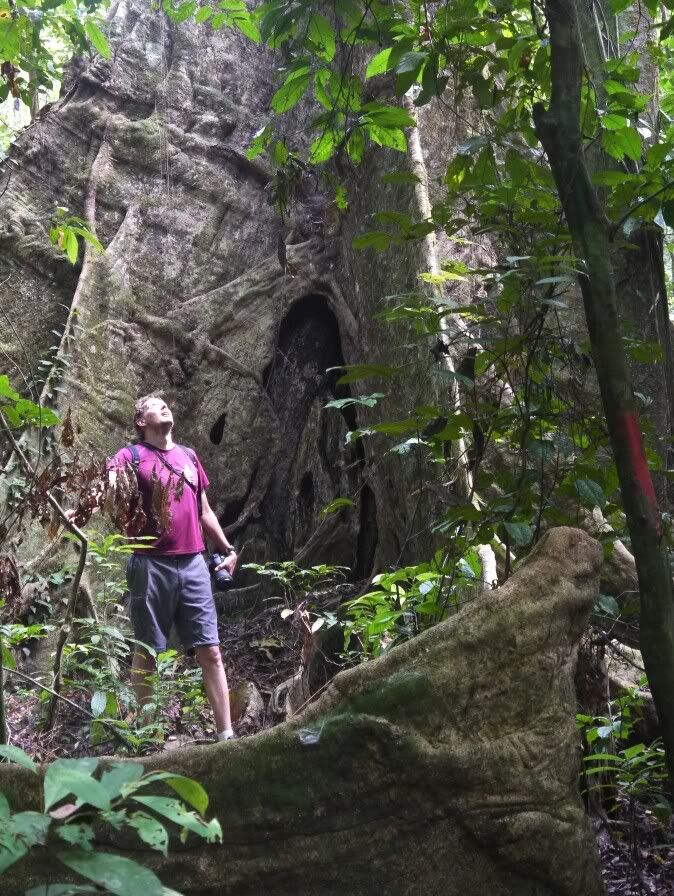
The trees are spectacular, some are 300 years old and at least 3m in diameter. Some so old that you can walk through their hollowed out cores.

P1000668_edit0.jpg


P1000663_edit0.jpg


P1000623_edit0.jpg


P1000653_edit0.jpg

Jungle spilling out on to the beach

photo_edit0.jpg

Within seconds you are drenched

We stayed at Limbe for a week, mainly because its a great spot, but we were not sure how long it would take to get our Gabon visas in Yaounde. Not wanting to repeat our Rabat experience of staying in a Capital over the weekend, we aimed to submit our visa application on Monday.

En route to Yaounde, we were pulled over by police, expecting the usual hassle we launched into our normal routine, “We are tourists, Cameroon is beautiful, what football team do you support?”
Nothing, they were insistent that we pull into the lay-by. No information was forthcoming. After questioning a few other quarantined locals, we gathered that the president, Mr. Biya was driving passed.
“This is tyrany, he acts like a dictator” they protested, “He can’t treat us like slaves, sometimes we wait many hours like this”
To be fair, I’d do the same if I was president. Forget coups and assasination, the standard of driving out here is so bad that a car crash is probably the greatest threat to Mr. Biya. As soon as the president drove past, all hard feelings were forgotten and the crowd went crazy. We saw him by the way. Well, his hand at least. Mr. Biya is well liked here and we can see why; the people are happy and the country relatively properous and stuff just seems to work. Of the African countries that we have passed through, Cameroon is the one that seems to have got it right. We have enoyed it more here than anywhere else and would recommend it as a tourist destination. With the Presidential convoy gone, it was time to begin the usual west African frenzy of overtaking everyone ahead of you, we are getting quite good at this now.

We pressed on to Yaounde and found a place to stay at the Presbyterian Church guesthouse. Run by a French Cameroonian lady and her Swiss husband, this bizarre fusion of nationalities has lead to a rather strict, if unusual, set of rules;

No washing of clothes, that is what the servants are for.
No cooking in the kitchen, it is private.
Guests are to use the outside toilets after 22h00 (which is locked by the way)
You will be home by 21h00 or incur a 1000CFA fine per hour of lateness
Light manners are strictly forbidden (never did figured this one out)

We decided to camp, party becuase it was cheap but mainly because the dorm beds were packed in like sardines.

We submitted our Gabon visa application on Monday, handed over 100EUR in fees for yet another over-priced African visa and limped home feeling rather violated. With our visas ready the next day, it was goodbye to Cameroon and on to Gabon.

Gabon marks the beginning of the next stage, we move from west to central Africa and cross from the northern to southern hemispheres. As we cross the equator we will be moving from the dry to rainy season. The rain and the roads of central Africa are probably our biggest concern of the trip, more on that soon to follow…
 
Gabon-Bon

Sweet, sweet Gabon, how we loved your roads, all curvy, smooth and new.

Gabon was one huge surprise for us. Reading other travellers accounts of this place did not paint it in a favourable light. Unfriendly people, especially if you couldn't speak French, bad roads, poor facilities and amenities, the list of grievances went on. And so armed with this knowledge we entered into Gabon with much trepidation and caution. It was all for naught. Other than having to progress some distance into the country before having our passports stamped, the border crossing from Cameroon into Gabon was seamless.

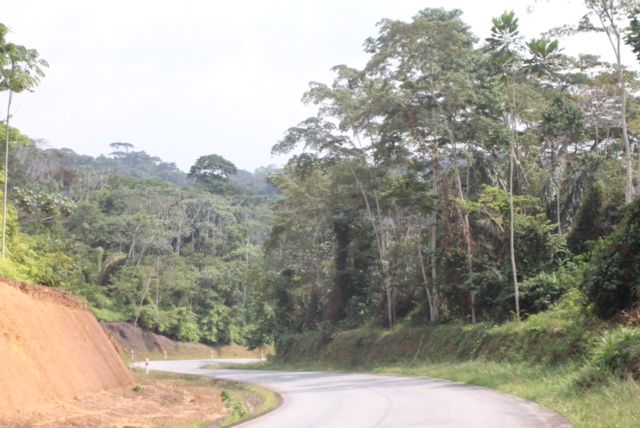
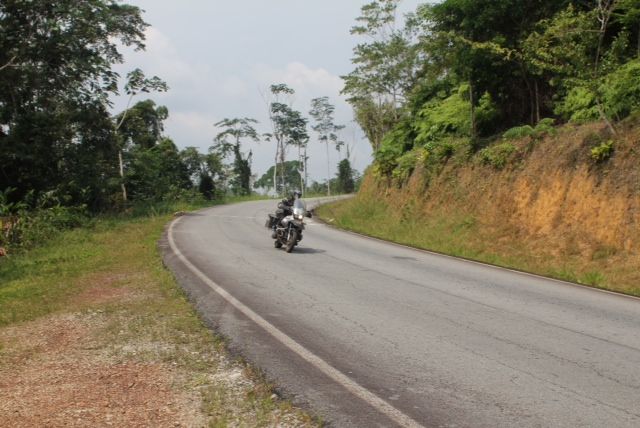
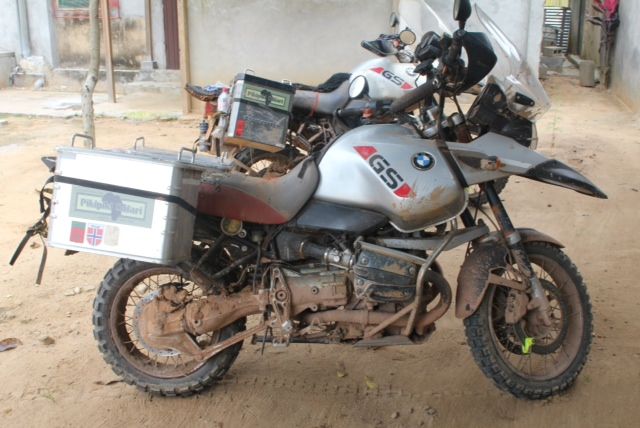
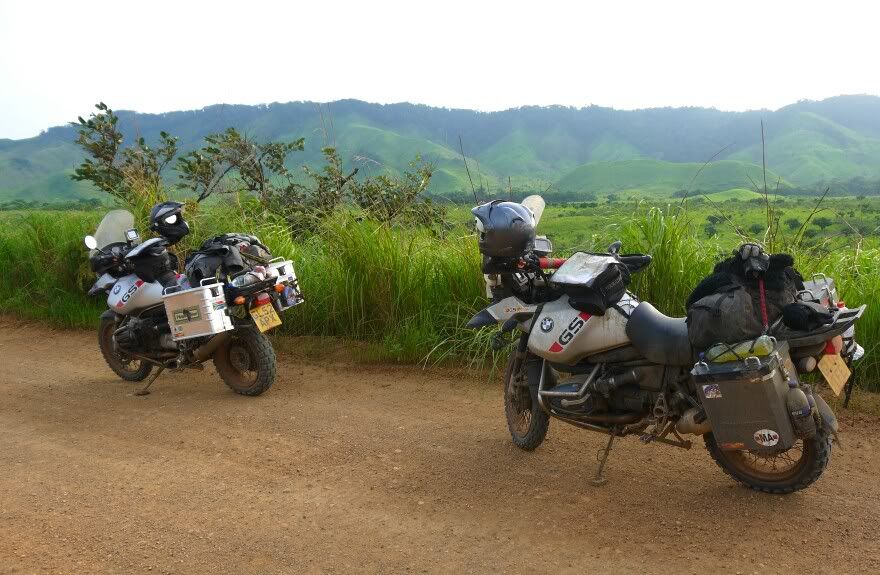
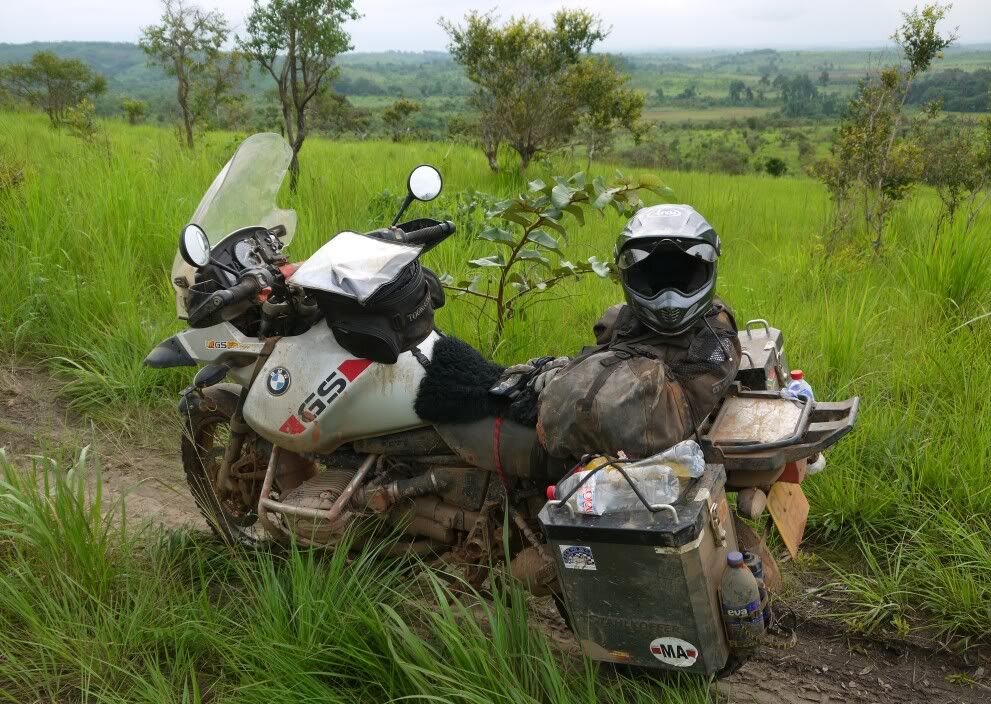
Communicating with the locals in our English French wasn't a problem and generated the usual smiles. The roads, however, are what made us giggle like little children. These empty race-track grade sweeping curves and gentle undulations through majestic rain forests welled up tears of joy at every peg-grazing turn. We pushed our bikes hard and fast at every opportunity. Well, as hard and fast as a packed R1150GS Adventure on TKC80's would let us.

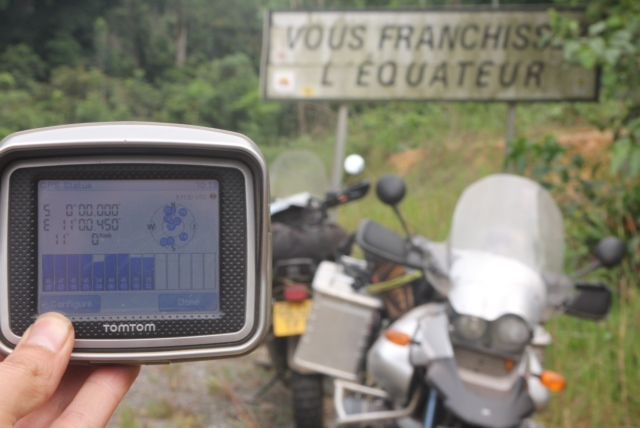
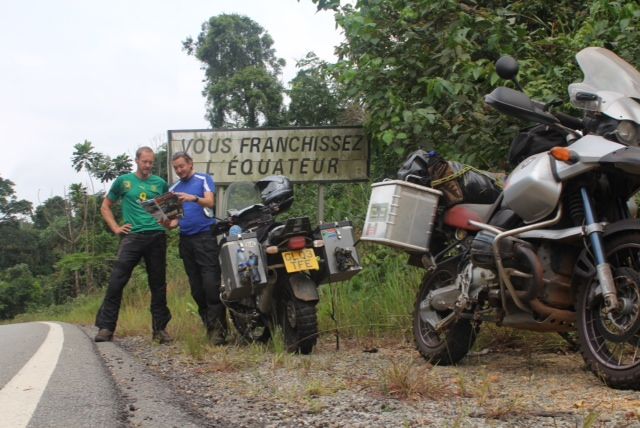
Our first 2 days were spent enjoying the fine roads and unbelievable scenery. We had no need to enter the capital Libreville and since it wasn't en route, we happily avoided it. We hit a few "iffy" sections where the old road is currently being repaired, but it wasn't long before we were back on track, so to speak. We also crossed the Equator, which was a massive milestone for us and we made sure of the photo opportunity.

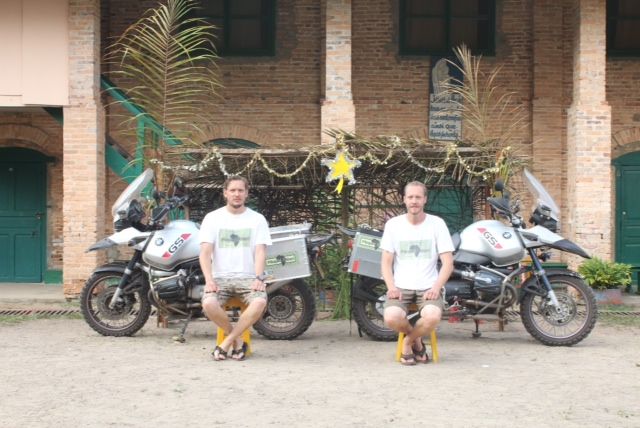
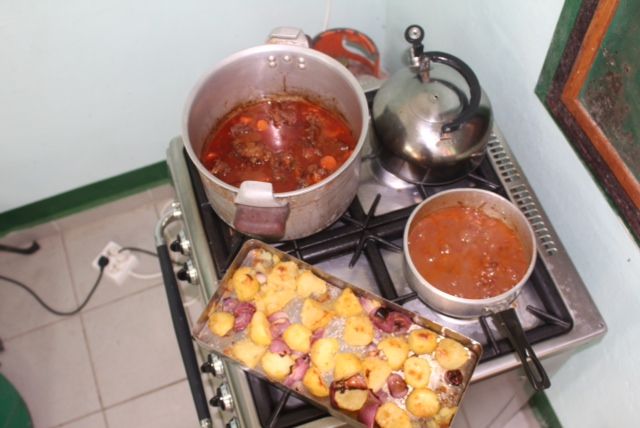
After Mutzig, we then made for Lambarene, a small town made famous by the Austrian physician Dr. Albert Schweitzer. It's a picturesque town surrounded by the waters of the Ogooue River. Since it was Christmas, we thought we would spend a few days here to relax, contact loved ones and do the usual routine of washing and stocking up. We stayed at the fantastically clean and relaxed Catholic Mission, which we thought was quite fitting, and took advantage of their Nativity Scene for our Christmas Greeting. We also utilised their well-equipped kitchen to whip up a Christmas fest of ox-tail stew, roast potatoes and a quality bean dish.

We toyed with the option of heading towards a few National Parks, but since we were chasing down visa dates which were expiring in countries ahead, and being warned about bad roads to and from these Parks (most visitors fly in), we decided against it.

After our little festive break, we continued heading south on brand-new roads and again enjoyed the hospitality of the Catholic Mission at the border town of Ndende. The next day we went to fill up the tanks before crossing, but the only petrol station in town was out of fuel. We didn't want to take a chance and cross borders without knowing what was on the other side, so we headed 30km in the wrong direction to find petrol. Fortunately the road was excellent (brand new, or course) and we were back at the border in no time.

We conducted the formalities and headed forth towards Congo. At the very last Gabonese military check point, we attracted the following caution: "the roads in Congo are very bad". We entered with trepidation and caution. Sound familiar? The good times couldn't last forever...

The awesome sweeping roads we encountered shortly after entering Gabon:
photo-24.jpg

Russ giving it horns as only Captain Slow knows how:
photo-25.jpg


Proof we didn't drag the sign with us:
photo-22.jpg


The sell-out (or money) shot. Yes, that is the recent copy of Adventure Bike Rider:
photo-26.jpg


Our Christmas Card:
photo-23.jpg


And our Christmas message:
<iframe width="853" height="480" src="http://www.youtube.com/embed/V2NMHB8l-QQ?rel=0" frameborder="0" allowfullscreen></iframe>

Our little feast:
photo-21.jpg


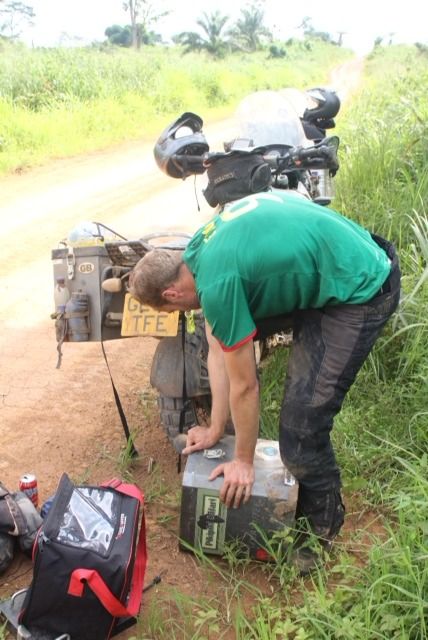
Russ doing some roadside pannier panel beating. Apparently hitting a deep puddle at full speed is the wrong option:
photo-20.jpg


Rainforests give way to hilly savannah once we crossed into Congo:
photo-19.jpg


A foretaste of what the next blog post is going to be about:
photo-17.jpg
 
Congo

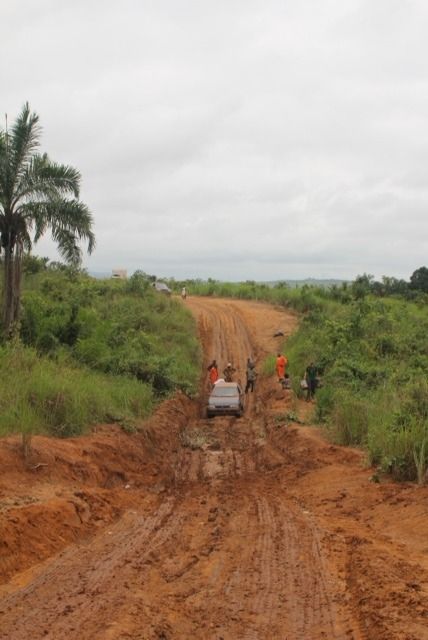
Immediately after entering Congo the gravel road deteriorated, it's clearly not maintained like the road on the Gabon side. Mud puddles quickly became the norm. After the first village we come across a truck stuck in waist deep mud, completely blocking the road. Some locals had cut an alternate track and wanted to charge us 5000CFA ($10) each to use their diversion. After an bit of haggling we agreed on 5000CFA for both bikes. They pushed Adrian through with such enthusiasm that he could have cut the engine and still made it through. It might seem like a con but these diversion cutters provide a valuable service, without them the traffic would stop completely, like the truck found out.

We continue south towards Dolisie, another 230 km along gravel piste. As we ride through the roadside villages, the locals stop and stare. This is not unusual on our trip, but in the Congo they are quite reserved, almost wary of us. We started to wave unprompted and they return our greetings with big waves and smiles, sometimes even cheering. We stop for a drink and everyone gathers round and asks if we are tourists, our confirmation is met with smiles and nods. It's as if they know that when the tourists start to return it will help the country recover from the many years of war.

The road improves and we are able to pick up speed, but it's a long hard slog to Dolisie which takes us about 7 hours.

P1000871_edit0-1.jpg


From Dolisie we join the main road east to Brazzaville. It’s marked as a dotted red primary road on the Michelin map for most of the 356 kms, but its one of Africa's most notorious highways. Known for being a muddy mess during the rainy season, we have our concerns as we are passing through during the tail end of the second and lesser rainy season.

The road starts off much the same as the previous day, a mix of fast gravel, jarring pot holes and loses shale. Its hard going, but we progress well through 210 kms towards our stop over at Mindouli. From there the map indicates a solid red major road; we think it should be fine until Brazza. The scenery is stunning, lush rolling hills dotted with small villages. The road improves to hard packed mud; it would be an absolute nightmare in the wet, slippery and extremely slow going. We think we have passed the worst of it, extremely grateful that it's dry.

Just before Mindouli we meet Dominik, a Belgian travelling the opposite direction on a Yamaha XT660. He is the first overlander we have met since Mauritania and he gives us some bad news. The 63 km stretch of road from Mindouli to Kinkala deteriorates, a lot. And it’s been raining there, recently.

Our night in Mindouli is filled with fear, but we reassure ourselves knowing it's only 63km and the rest is new tar. The next day we set of and the road immediately deteriorates with frequent mud puddles. Its only 63kms to the new tar...

Soon we meet our first obstacle, a steep gully with a muddy bottom. As we pull over to walk our route, a Toyota Corolla of questionable road worthiness pulls up in front of us blocking our route. He'll never make it. Pausing briefly, he blasts down and gets stuck. Now we are stuck to. Idiot. We find a diversion around the gully, but it involves a small track through a stream. We offload our panniers making the bikes lighter. Adrian goes first but gets stuck in mud a foot deep. We try unsuccessfully but can't get it out, it’s in too deep. A Landrover arrives with a few people, we ask them for some assistance and they help us get Adrian's bike unstuck. They went absolutely crazy when he reached the top of the hill. We turn our attention to the Corolla, the Landrover crew shaking their heads at the Corolla for even attempting the gully. It takes a lot of effort but we eventually get him free.

photo-16.jpg


About an hour later we come to the next obstacle and it’s a bad one. 40m of mud gradually getting deeper has trapped a truck and a car, the mud is waist deep. There is a queue of cars and trucks waiting to pass, including the Landrover. We go over and have a chat, their group consists of Madame Genevieve, the driver and 2 passengers. They show us an alternate route which we could get the bikes through, its a mess to, but less of a mess. While we have our lunch, some deviation cutters start converting the alternate route into a proper deviation. The Landrover and Corrolla make it through. We quickly suit up and cross before it gets blocked, it will get blocked, it just a matter of time.

A little while later we come across the Landy, its hood is up. We stop to ask if they are alright. "C'est bon, small fire, but fine. We leave now". We all resume, them blasting ahead. Its now 15:00 and we have done about 35kms, halfway. Its hot, hard going, we are extremely tired and we are running low on water.

We hit the next obstacle, its worse, a 30m stretch of waist deep mud. 3 trucks are stuck, the second and third both tried unsuccessfully to pass the first, resulting in the entire width being blocked. This time there is no space for us to go around. As we pull up Madame from the Landy tells us that they have hired local guide to show them a diversion using local village roads. We join the Landy and the Corolla. We don't have much time left, it will be dark in a couple of hours and we have a long way to go still.

photo-18.jpg


P1000885_edit0.jpg


The track through the local villages is stunning; it takes us through a mix of un-spoilt savannah and lush forests. We stop briefly while they lay 2 wooden planks over a small stream. The bikes cross the stream using a single plank. It was pretty scary but we have stopped worrying by now, we are just too tired and thirsty. We have to get to Kinkala before dark.

P1000880_edit0.jpg


By now the mud has let up, only to be replaced by soft sand. Being of questionable road worthiness, with a less than questionable driver, the Corolla gets stuck. Idiot. The Landy pulls them out; we finish the last of our water and continue. The Corolla gets stuck and rescued again. This little game gets repeated several times. Its hard going riding through the sand, the bikes take a pounding and so do we. We hit a particularly deep section section of sand, the Corolla gets stuck. Idiot. This time madame refuses to rescue the Corolla, "This man is an idiot, he can't drive! I'm not getting stuck in the dark because of him!"
In shame, Corolla guy stares at his feet like a naughty child. This is a big problem for us because he is blocking us, again. We plead with Madame to rescue him one final time so we can pass. She agrees to rescue Idiot Corolla guy on condition that he pulls over. We make it extremely clear to him, you must pull over. It’s very clear to everyone. Everyone understands the plan. With difficulty we eventually get the Corolla free. Idiot guy guns it, straight. And then gets stuck again. We would have shouted at him, but we have no enegry left. We leave the shouting to madame and she does a good job of telling him what we think. He stares at his feet in shame.

Fortunately we are able to dig a small deviation around him. But the Landy has now gotten stuck so we have to dig a second diversion around them. We say goodbye to Madame and the Landy crew, they we awesome but its getting dark quickly and we have to leave asap. The sand gets deeper, up and down steep hills. Very tired, very thirsty. The sand gets worse. No energy left.

In the distance we see an intersection. Suddenly a bush taxi blasts across the intersection, then a moto. We reach the intersection, its hard underneath. Tar, finally...

What should have been 63km ending up being 90km because of the diversions. And it took us 9 hours. 9 long and hard hours. Nothing on the trip has been as difficult, except obtaining an Angolan visa, but that’s another story.
 
Gabon's Roads

A little video of us enjoying Gabon's awesome roads:

<iframe width="853" height="480" src="http://www.youtube.com/embed/YFMu6Xhb_xg?rel=0" frameborder="0" allowfullscreen></iframe>


Back
Top Bottom