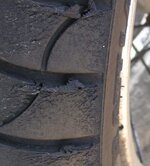
Chicken Strips

Nope. The pegs were scraping the road. It wouldn't lean over further.

Hanging off a bike allows you to corner faster for the same lean angle, as cornering without hanging off.
Those who claim I could lean the bike further without hanging off are talking twaddle.

Motogp racers go faster and lean more without looking like gibbons :D
 
For a given speed and bend radius ALL bikes will lean at the same angle regardless of bike weight. A bigger bike creates more cornering force than a small bike but it also weighs more so the lean angle is the same.

Better handling bikes will lean more than poor handling bikes simply because they take the same bends faster so have to lean at larger angles.

I think your comment is correct only if the centre of gravity is at the same height on each bike - which it isnt IIRC
 
Agree with Giles . Just sit on the bike and ride it with out moving about as all this does is upset the balance of the bike and alters the handling. It`s all about being smooth. Track riding is a different game. You have to remember that the top riders are super athletes and far stronger in the torso that any of us mortals. Just try hanging off your bike and getting up without pulling on the outside bar because if you do you end up counter steering without wanting to and unsettling the bike.
I`m guessing the guy dumping his bike probably allowed the center stand (or something else) to touch down taking the weight off the back wheel and lost grip.
My pennies worth.
 
I think your comment is correct only if the centre of gravity is at the same height on each bike - which it isnt IIRC

C of G makes zero difference to lean angle. Lean angle is dependent on speed and bend radius nothing else changes because everything else gets cancelled out. More weight higher up creates more cornering side force, but leaning also creates more side force. It all cancels out.

C of G does make a difference when changing direction. The angular change is the same, but high C of G has to swing though a longer distance than a low C of G so has more inertia (angular momentum) so bike feels less nimble. A Gold Wing and 125 taking the same bend at same speed have identical lean angles. But ask them to go from left to right and the 125 will flip much more easily. Less mass to move from one angle to another even though it might have a higher C of G.

Below about 5 mph all bikes need a combination of counter and normal steering. High C of G makes this feel more obvious.
 
C of G makes zero difference to lean angle. Lean angle is dependent on speed and bend radius nothing else changes because everything else gets cancelled out. More weight higher up creates more cornering side force, but leaning also creates more side force. It all cancels out.

The height is irrelevant, but it does make a difference to the angle of the bike if the CoG is off centre (left / right), and this is why hanging off can help a rider corner faster - e.g. it can help stop bits of the bike hitting the floor, or let you go faster once bits have already started hitting.
 
C of G makes zero difference to lean angle. Lean angle is dependent on speed and bend radius nothing else changes because everything else gets cancelled out. More weight higher up creates more cornering side force, but leaning also creates more side force. It all cancels out.

C of G does make a difference when changing direction. The angular change is the same, but high C of G has to swing though a longer distance than a low C of G so has more inertia (angular momentum) so bike feels less nimble. A Gold Wing and 125 taking the same bend at same speed have identical lean angles. But ask them to go from left to right and the 125 will flip much more easily. Less mass to move from one angle to another even though it might have a higher C of G.

Below about 5 mph all bikes need a combination of counter and normal steering. High C of G makes this feel more obvious.

Sorry this is erroneous, the cog acts through the contact patch otherwise one would fall over, whether at standstill or traversing a bend. In the latter instance the contact patch is not in the centre line of the bike.
Lets assume that the cog is in the centre of two bikes (left to right), then lets take some ridiculous extremes, cog is 100mm above ground on the first and 1000mm on the second. Because the contact patch moves away from the centreline of the bike as it leans over, the difference in lean angle is more exaggerated with the low cog bike.

Either that or my maths has gone tits up. Happy to admit I'm wrong if you can show otherwise.
 
The height is irrelevant, but it does make a difference to the angle of the bike if the CoG is off centre (left / right), and this is why hanging off can help a rider corner faster - e.g. it can help stop bits of the bike hitting the floor, or let you go faster once bits have already started hitting.

I thought angle of lean for a specific radius and speed was also influenced by wheelbase length
I.E the longer the bike the more it will have to lean to achieve the same cornering radius at the same speed as a shorter wheelbase bike !!
 
I have spent years fannying about with different styles, experimenting hear and there, and of course on different bikes. And for me, I'm far far quicker on the road on my GS when I just sit on it. The minute I start faffing around with half a bum cheek I become slower. :thumb2 Different on a sports bike ... A slightly different style there for me, but you're right, more often than not people are slower because they faff ... Just sit on it .... :thumb

Last track day I went on at Oulton, one of the instructors came looking for me to tell me to hang off the bike and not lean it over so far, as it looked as though the pots were going to touch down. ( his words, not mine)
It worked, I went slower. :eek
Feels totally alien, I'd rather not bother.
Mark

 
I thought angle of lean for a specific radius and speed was also influenced by wheelbase length
I.E the longer the bike the more it will have to lean to achieve the same cornering radius at the same speed as a shorter wheelbase bike !!


Ummmmmm, I'm not going to get into the physics argument that the others are having ( :rolleyes: ), but my experience with longer wheel bases (and that could be either just that - a big say ZZR14 that has 'normal' geometry but just a long wheel base or something quirky (say a Ducati Diaval) that is an average sized bike but has a longer Rake angle (cruiser / chopper geometry) is that they will steer much more slowly. Look at the head angle (Rake - whatever you want to call it) on a moto gp bike and the forks look like they drop vertically down from the bars - very little rake. That gives you super quick steering (but relative instability in a straight line which is why they tank slap and protest so easily ... ). So there Rik, partner to the gorgeous Susan, my thoughts on the mater ... :D


Last track day I went on at Oulton, one of the instructors came looking for me to tell me to hang off the bike and not lean it over so far, as it looked as though the pots were going to touch down. ( his words, not mine)
It worked, I went slower. :eek
Feels totally alien, I'd rather not bother.
Mark

On some bikes it's a no brainer - either hang off a bit and allow the bike to be more upright and improve ground clearance or yer gonna risk grounding it out on the floor and then potentially lift the wheels up and bin it! (My Job RT has crash bars which are a pain in the arse because they ground out so easily). I am a fan of moving my upper bodyweight about a lot, keeping those elbows very flexed and loose ... but my actual arse in the seat stays pretty still .... :D
 
Ummmmmm, I'm not going to get into the physics argument that the others are having ( :rolleyes: ), but my experience with longer wheel bases (and that could be either just that - a big say ZZR14 that has 'normal' geometry but just a long wheel base or something quirky (say a Ducati Diaval) that is an average sized bike but has a longer Rake angle (cruiser / chopper geometry) is that they will steer much more slowly. Look at the head angle (Rake - whatever you want to call it) on a moto gp bike and the forks look like they drop vertically down from the bars - very little rake. That gives you super quick steering (but relative instability in a straight line which is why they tank slap and protest so easily ... ). So there Rik, partner to the gorgeous Susan, my thoughts on the mater ... :D


On some bikes it's a no brainer - either hang off a bit and allow the bike to be more upright and improve ground clearance or yer gonna risk grounding it out on the floor and then potentially lift the wheels up and bin it! (My Job RT has crash bars which are a pain in the arse because they ground out so easily). I am a fan of moving my upper bodyweight about a lot, keeping those elbows very flexed and loose ... but my actual arse in the seat stays pretty still .... :D

I dont know about the physics of it either but from last year in scotland there is a particularly long left hand bend on which i noted that my mate on his KTM super duke was not leaning over that far where i was almost down to the foot pegs at the same speed !

Susan says HI
 
Decided to look around for something to either back up or destroy what I was saying and was initially a little worried as it seems that the angle of lean is determined only by the speed and radius of the curve. However, it appears that it is the 'effective lean angle' that is important bit and that will vary depending on the cg of bike and rider combined - which is of course, why getting ya bum cheek off the seat can help traversing a corner.

Little explanation here:


3iUD7u3_sI-PjqhzK0RVVNg969DoGVWRXInaTx6mawUyx0KDANnkUaZpSiECDHBlY0Z9=s151


Full page to be found here
 
That link is a convoluted explanation of something quite simple. At the same speed round the same corner all bikes / rider combinations lean the same angle. But that angle is the angle between the road surface and the centre of gravity of the bike and rider combination . When you move your bum towards the inside of the curve, the bike has to become a bit more upright so that the centre of gravity of the two of you combined stays exactly where it always was and the angle doesnt change. This means that the bike tyre is nearer upright gripping better and the clearance between things like exhausts and footpegs and the ground is greater than it would be if you werent hanging off.

The issue with bike length and fork angle is a different one altogether. The cruiser with its raked out forks will lean to exactly the same angle as an R1 at the same speed on the same corner but the distribution of weight between front and rear wheels will be very different. Tyres dont just grip the road - they slide slightly sideways as you corner at any speed and the sliding on the cruiser will be very different to the R1 because of geometry and weight distribution.
 
I got the information from Damian Harty of Prodrive and Coventry University.

He has done a lot of work on narrow track cars that lean like a bike or fall over. He explained how bikes with tele forks are in effect articulated vehicles. Small bikes can have 20% of the total weight in front of the hinge (steering head). This is why a tank slapper has such a horrible effect. Bikes with hub centre steering are more like cars in that less weight is coupled to the steering. BMW's Hossack/Duolever and Saxon/Telelever are hub centre steering systems.

When asked about lean angles he said for a given speed and bend radius, everything leans at the same angle. If the rider leans off the bike, the bike itself can lean less but the overall angle of bike and rider is the same. Hang off the side when going straight and the bike will lean the other way. Ride straight with a constant side wind and the bike will lean into the wind. Get hit by a gust of wind and the bike will move sideways away from the wind without leaning.

Heavy bikes generate more cornering side force than light bikes (or even a fast runner). A heavy bike also generates more force the other way when it leans. but the cornering force and lean force naturally cancel out so the final lean angle is the same and the rider feels no cornering force.

Wide tyres can make a bike lean more than narrow tyres. With a narrow tyre the road contact stays relative to the wheel centreline. With a wide tyre the contact moves towards the turn so the bike has to lean further to generate the necessary side force. So to some extent a big bike on fat tyres might lean more than a small bike on skinny tyres. Modern tyres minimise the effect but its always a compromise between grip and handling.
 

Attachments

  • image.jpg
    image.jpg
    79.5 KB · Views: 213


Back
Top Bottom