Clacks , Crunches, or cant get Neutral

My bike is getting the pushrod bm confirmed they are working on the part following feedback and the new pushrod is not listed yet, so if my dealer ordered the existing part no I'd get the same rod that my bike has i asked if all the bikes being built now are getting this mod and they confirmed the modified rod will go into the 2014 builds as standard, so i feel they'll be a few more cases of the above yet, I'm now happy to wait for the bike to be fixed as they have provided me with an identical bike only issue is i have a bit of OCD and don't want my bike marked in any way from them pulling it to bits, but than again my dealer knows ill moan like fook if it is.

Out of interest, what's the replacement gearbox performing like? As you don't mention it! Do we take it to be OK?
 
My bike is getting the pushrod bm confirmed they are working on the part following feedback and the new pushrod is not listed yet, so if my dealer ordered the existing part no I'd get the same rod that my bike has i asked if all the bikes being built now are getting this mod and they confirmed the modified rod will go into the 2014 builds as standard, so i feel they'll be a few more cases of the above yet, I'm now happy to wait for the bike to be fixed as they have provided me with an identical bike only issue is i have a bit of OCD and don't want my bike marked in any way from them pulling it to bits, but than again my dealer knows ill moan like fook if it is.


Just returned from a shopping trip ( NOT Tesco!!! but agric merchants) I must confess that the new push rod has made an improvement ~ not complete so work is still in progress. However, idiot though I am, I like the bike but have concerns for my wife when she is the pillion as the lower gear changes will not be as smooth as usual.

I like the suggestion of a smaller diameter slave cylinder so the plates separate more. Yes, the lever is on 4.

Also if the grove in the push rod was a spiral, it could pump oil into the clutch, excess oil could exit via the other end of the push rod.

SMB
 
I found that I could not wait for the rain to stop. I had to know, so out I went to try my shifting. I only rode a few miles on small "B" type roads, but there was no traffic, so I was starting and stopping and running up and down through the gears constantly, including after the bike was up to running temp. My opinion is:

SHIFTING PROBLEM SOLVED! :hogroast

The bike now shifts as I would expect it to. :thumb2

Many thanks to Magnon for discovering this simple fix for a vexing problem! :bow:bow

Emoto, which level is your clutch lever adjusted to?
 
I have big hands, so I adjusted it all the way as far away from the handlebars as I could. Is that #4? Are you thinking the lever position somehow affects this?

As I decreased the clutch fluid but gained a very slight improvement I thought lever position may also play a role here. Mine is set to 2. I will give 4 a try tomorrow.

cheers
 
As I decreased the clutch fluid but gained a very slight improvement I thought lever position may also play a role here. Mine is set to 2. I will give 4 a try tomorrow.

cheers

I don't believe that the lever position has any affect on the distance of the stroke of the master cylinder piston, but will be interested in your test nonetheless.
 
With the lever positioned further out (4), the master cylinder at the lever end will stroke more fluid to the slave cylinder which moves the clutch push rod and hence move the clutch pressure plate further than e.g. No 1 position but not all of us can cope with position 4.
 
Just returned from a shopping trip ( NOT Tesco!!! but agric merchants) I must confess that the new push rod has made an improvement ~ not complete so work is still in progress. However, idiot though I am, I like the bike but have concerns for my wife when she is the pillion as the lower gear changes will not be as smooth as usual.

I like the suggestion of a smaller diameter slave cylinder so the plates separate more. Yes, the lever is on 4.

Also if the grove in the push rod was a spiral, it could pump oil into the clutch, excess oil could exit via the other end of the push rod.

SMB
I'm guessing here but you may well be the 'Bob' who has the modified clutch push rod from Ocean. Did you see the push rods and are able to tell us what difference you could see? Bear in mind that BMW Tech at Garmisch told me the problem was related to too much oil getting to the clutch. Does the difference relate to this answer from the BMW Techie?
Wish I could have had it fitted to my bike before my Garmisch Partenkirchen trip, I could have put a couple of thou miles on it and hopefully improved my experience during the trip, especially during spells of city traffic.
Cheers
 
With the lever positioned further out (4), the master cylinder at the lever end will stroke more fluid to the slave cylinder which moves the clutch push rod and hence move the clutch pressure plate further than e.g. No 1 position but not all of us can cope with position 4.

Er... Take a look at the image from the fiche. The part of the lever closest to the m/c does not change. The adjuster is that round thing, and all it does is change the angle of the outer piece of lever. Regardless of which position is selected, the part closest to the m/c pivots until it hits the stop, making the m/c stroke distance identical no matter what.

Take it a step farther if you like and measure the outer part of the pin that the lever pushes into the m/c. Measure it against a fixed point like the edge of the handlebar switch cluster. You will find that whether position 1 or 4, the measurement will be the same.

B0007330.png
 
Er... Take a look at the image from the fiche. The part of the lever closest to the m/c does not change. The adjuster is that round thing, and all it does is change the angle of the outer piece of lever. Regardless of which position is selected, the part closest to the m/c pivots until it hits the stop, making the m/c stroke distance identical no matter what.

Take it a step farther if you like and measure the outer part of the pin that the lever pushes into the m/c. Measure it against a fixed point like the edge of the handlebar switch cluster. You will find that whether position 1 or 4, the measurement will be the same.

B0007330.png

Just checked and there is no doubt that No 4 strokes the cylinder further than No 1. The only stop is the lever contacting the handlebar grip and the difference that the lever position makes to the stroke is pretty easy to see and measures about 2 or more mm at the cylinder centre line.
I don't know which pin you're talking about but the one that matters is the one on the cylinder centre line and is not identified in your parts diagram but can just be seen hidden mostly by the cylinder body, close to your item 4, and is on the bell crank lever and which connects to the cylinder push pin.
Take another look.
 
Just checked and there is no doubt that No 4 strokes the cylinder further than No 1. The only stop is the lever contacting the handlebar grip and the difference that the lever position makes to the stroke is pretty easy to see and measures about 2 or more mm at the cylinder centre line.
I don't know which pin you're talking about but the one that matters is the one on the cylinder centre line and is not identified in your parts diagram but can just be seen hidden mostly by the cylinder body, close to your item 4, and is on the bell crank lever and which connects to the cylinder push pin.
Take another look.

Can you please describe what you checked and how you did it?

Measure how far the inner part of the lever pushes into the m/c on positions 1 and 4. There is a silver item in the center (that I called a pin) you can rest your caliper tail on, like I did. Do you get differing measurements? I didn't.
 
I've now got the dealers demo gs and with only 900 miles on the clock it does not like going into neutral on a few occasions tonight it was impossible and felt like it was stuck in gear i had to kill the engine to find it at one stage Not good .
 
Can you please describe what you checked and how you did it?

Measure how far the inner part of the lever pushes into the m/c on positions 1 and 4. There is a silver item in the center (that I called a pin) you can rest your caliper tail on, like I did. Do you get differing measurements? I didn't.

The stroke of the cylinder must be measured on the cylinder centre line between the lever fully out (released) and fully in (i.e. lever touching the bar grip). I just can't see how you're measuring this since there is a clear visual difference in the amount the cylinder is stroking by looking at how far the parts move inside the cylinder shrouding.
You're not by any chance just measuring the pin position with the lever setting in 1 and 4 without actually moving the clutch lever are you? Sorry if that sounds a daft question but I can't see how you don't get a change in stroke.
 
What's weird about all this that it's only affecting some not all bikes! Mine goes into neutral sweet every time although going down the gears now and then does get a bit clunky, maybe it's a batch of bikes that had some defective components.
 
The stroke of the cylinder must be measured on the cylinder centre line between the lever fully out (released) and fully in (i.e. lever touching the bar grip). I just can't see how you're measuring this since there is a clear visual difference in the amount the cylinder is stroking by looking at how far the parts move inside the cylinder shrouding.
You're not by any chance just measuring the pin position with the lever setting in 1 and 4 without actually moving the clutch lever are you? Sorry if that sounds a daft question but I can't see how you don't get a change in stroke.

Does this help?

7-15-2013%204-04-52%20PM%20clutch%20lever%20travel-L.jpg
 
What's weird about all this that it's only affecting some not all bikes! Mine goes into neutral sweet every time....
That's the bit i cant understand either.

The clutch and gearbox on the LC I had was problem free for the 2,500 miles I covered on it.

The only 'issue' was the loud crunch into 1st from neutral but neutral was always easy to find.
 
No problems on mine :nenau

Thrashed from day one and is as sweet as a nut ...
 
I'm guessing here but you may well be the 'Bob' who has the modified clutch push rod from Ocean. Did you see the push rods and are able to tell us what difference you could see? Bear in mind that BMW Tech at Garmisch told me the problem was related to too much oil getting to the clutch. Does the difference relate to this answer from the BMW Techie?
Wish I could have had it fitted to my bike before my Garmisch Partenkirchen trip, I could have put a couple of thou miles on it and hopefully improved my experience during the trip, especially during spells of city traffic.
Cheers

Yes I am that Bob, Who the heck were you?

Anyway, as I understand the problem.

I was told that there was not enough oil getting through to the clutch plates and as such the dry/dryish plates were sticking together - hence clutch drag. I believe that this happened on the early brick K series. The factory assembled the plates dry. The fix was to soak the plates overnight in oil. This was tried on my bike but failed to give a complete cure. Though it was a little better.

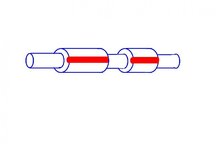
As I understand it, the replacement push rod was designed to allow more oil through the push rod bearings to the clutch plates. I was told that the push rod slides in a phosphor bronze tubes.

I saw the replacement rod.
It was about 100mm long and about 8mm in diameter
The bearing surfaces were of a greater diameter the overall rod and each bearing surface had 3 longitudinally groves ground into it to allow more oil through. The groves are shown in red on the diagram below. (The diagram is just a very quick knock up of what I remember and only approx relative proportions).

I was told that the old push rod had no groves, but I did not see the old one, so I don’t know if it was stepped.

At present my bike is better but it is not a complete cure. When I first got it, if you selected first, the bike would jump forward most of the time, but not always, sometimes it was perfect. It happened more when hot than cold. Maybe the oil spun off the plates when the engine was running making then dryer (?). Hence the not enough oil was getting through. If the push rod diameter was at the smaller end of the tolerance range more oil could get through, so not all bikes would have this problem.


SMB

 

Attachments

  • push rod.jpg
    push rod.jpg
    17.7 KB · Views: 281
Hi;

My problem has been of diffciulty in getting the bike in neutral (from 1st gear).

After reading one of these posts in GSOPT I got curious and went to check the level fluid on my LC. Having seen the pictures posted I first place a rag to catch any spilled fluid. I am glad I did as as soon as staretd to loosen up the screws, fluid started leaking. If you plan to do this on your bike, make sure you place a rag under the reservoir !

After removing some fluid, I left it at mid reservoir level, I closed it and cleaned it throughly using some alcohol. Keep in mind that brake fluid, which is about the same used in the clutch (hidraulic fluid) is highly corrosive and if left on painted surfaces it will remove the paint !


I went for a ride and must say I am IMPRESSED ate the improovement. After a while I started to count how many times I put the bike from 1st into neutral at stoplights. On about 60 counts, it went smooooooothly 52 times, of the other 8, 5 times the lever was a bit harder but went into neutral. The remaining 3 it went staright into second gear. Overall I would say it was a 20 to 30% improovement. I also found out that on the occasions when the lever becomes hard to pull up, a gas blip ( up to some 3K rpm ) makes it go smoothly into neutral.

Overall I find these statistics quite similar from what I recall my 3 previous GSs were.

To say I am really happy with these results is the understatement of the year !

Thanks for really GREAT tip !!!

Andre


Just a two days ago I was all so very happy that the diffculty in finding neutral on my GSLC was history...

Today it started acting again and for no apparent reason. Just about every time I try to go from first into neutral it goes straight into second.

Nothing has changed, not even my shoes !

The same way I couldn't undertand why lowering the fluid level improved things now I can't understand how the great improvement obtained just went away ! Back to square one...

Hope it doesn't happen to others !

Andre
 
Does this help?

7-15-2013%204-04-52%20PM%20clutch%20lever%20travel-L.jpg

That's exactly what I've been measuring. Position 4 moves the cylinder push rod further in than the other lever setting positions when the clutch lever is pulled back to the bar grip. The difference is quite visual.
However, the clutch drag problem still exists on bikes set on position 4.


Back
Top Bottom