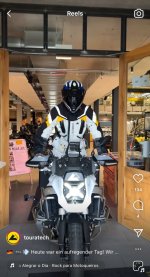
I recognise those roads!



He must have filmed this last Sunday (22nd) as he rides past Bahnstormer Alton @17.48 and they're closedI thought that too?

So the bike sounds much stiffer in the suspension department, than the previous GS'S.
That was always the beauty of the GS - a bike that soaks up the bumps.


IIRC on my previous LC GS's you could have the throttle in Dynamic yet the suspension set to Soft if you wanted toSo the bike sounds much stiffer in the suspension department, than the previous GS'S.
That was always the beauty of the GS - a bike that soaks up the bumps.

But only the damping can be adjusted unless you get the adaptive suspension option +£490, and then the spring preload can be adjusted too. (ride height).Had a look in the manual, P104 , the damping can be adjusted in each mode to fine tune it -2 -1 / +1 +2

You only get an option of Road or dynamic suspension on the regular suspensionBut only the damping can be adjusted unless you get the adaptive suspension option +£490, and then the spring preload can be adjusted too. (ride height).
Unlike current 1250 TE where ESA is standard. Don't know if there is even a manual preload adjustment on the 1300 without ADS ??
from the manual…….But only the damping can be adjusted unless you get the adaptive suspension option +£490, and then the spring preload can be adjusted too. (ride height).
Unlike current 1250 TE where ESA is standard. Don't know if there is even a manual preload adjustment on the 1300 without ADS ??
from the manual…….
DYNAMIC SUSPENSION AD- JUSTMENT (DSA)
with Dynamic Suspension Ad- justmentOE
How does DSA work?
Dynamic Suspension Adjust- ment (DSA) is as semi-active suspension-adaptation system that reacts automatically to rid- ing manoeuvres and to surface conditions. By interpreting ride height sensor signals, DSA detects movements in the chassis and suspension and responds by adjusting the damper valves. Additionally, the suspension characteristic can be set up to suit the desired riding experi- ence. This is accomplished by automatic adaptation of the spring rate in addition to the damping, depending on riding mode.
Load equalisation
DSA adapts the motorcycle automatically to the load it is carrying. The rider does not have to adjust the suspension to suit the load.
When driving off and when rid- ing, the system monitors the suspension at the rear wheel and corrects the spring setting in order to set the correct rid- ing position. The damping is also adjusted automatically to the load.
with Adaptive Ride HeightOE
Ride height control
Adaptive ride height control automatically adapts ride height to the riding situation. After pullaway, the suspension changes to the high ride height. When the vehicle is brought
to a stop the suspension automatically returns to the low
ride height, making it easier for the rider to put their feet on the ground.
Ride height can also be adjus- ted manually, depending on the riding mode
Clear as mud isn't itfrom the manual…….
DYNAMIC SUSPENSION AD- JUSTMENT (DSA)
with Dynamic Suspension Ad- justmentOE
How does DSA work?
Dynamic Suspension Adjust- ment (DSA) is as semi-active suspension-adaptation system that reacts automatically to rid- ing manoeuvres and to surface conditions. By interpreting ride height sensor signals, DSA detects movements in the chassis and suspension and responds by adjusting the damper valves. Additionally, the suspension characteristic can be set up to suit the desired riding experi- ence. This is accomplished by automatic adaptation of the spring rate in addition to the damping, depending on riding mode.
Load equalisation
DSA adapts the motorcycle automatically to the load it is carrying. The rider does not have to adjust the suspension to suit the load.
When driving off and when rid- ing, the system monitors the suspension at the rear wheel and corrects the spring setting in order to set the correct rid- ing position. The damping is also adjusted automatically to the load.
with Adaptive Ride HeightOE
Ride height control
Adaptive ride height control automatically adapts ride height to the riding situation. After pullaway, the suspension changes to the high ride height. When the vehicle is brought
to a stop the suspension automatically returns to the low
ride height, making it easier for the rider to put their feet on the ground.
Ride height can also be adjus- ted manually, depending on the riding mode
. Sounds like it's all automatic unless you have the adaptive ride height option -- is it??.
Definitely worth a test ride after that - the same but betterChopsie’s take on it
Sent from my Nokia 3310 using Thetwatcantalk
Only thing that I don't like the look of is that flat black radar cover, needs a sticker of some sort on it. Also is the carrying capacity the same or reduced compared to the old one?
One of these?that flat black radar cover, needs a sticker of some sort on it

Where can I buy one?One of these?
It seems to me you get DSA which is the damping and auto ride-height as standard.You only get an option of Road or dynamic suspension on the regular suspension
I think so, but the only option you get to change is Road or DynamicIt seems to me you get DSA which is the damping and auto ride-height as standard.

Only thing that I don't like the look of is that flat black radar cover, needs a sticker of some sort on it.
I'm sure that Touratech are workingon some really expensive piece of "vinyl".