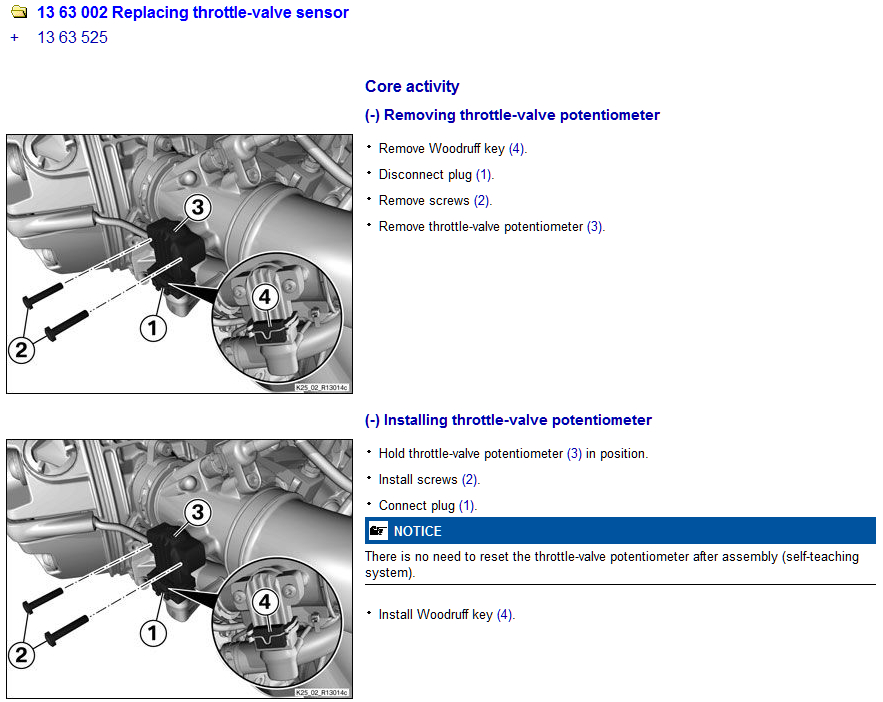
an example of not doing the adaptions...
R1200GS 2007, fitted new CAT sensors (one had died), serviced the bike including valve clearances and new air filter, set throttle body balance, reset adaptions and rebuilt over 2000 miles of various weather conditions including 1000 miles of cold weather temps between -5 and +11 - bike running reasonably OK, but I felt should be better - TPS a genuine BMW with 20k miles - checked live values and adaption state with GS911 - clearly CAT sensors working OK and long and short term adaptions settled and pretty close to each other between cylinders
before I was aware of the need to reset adaptations. I decided to try a new TPS - I get a
Motorworks TPS, the bike ran like a utter pile of junk - it was incredible - so much worse at low speed.
Motorworks confirmed many struggle to get the bike to behave after fitting a new sensor and posted some set up ideas to try - including the throttle play engine off, it made zero difference to the way it ran.
Decided to try the 10K mile original TPS from my 2011 GSA on the 2007 bike, that TPS also ran like an utter pig, if anything it was even worse. Got another Lucas TPS for a BMW car - looks like it’s the very same part as Motoworks one. The 2007 bike again ran like a dog.
Measured four TPS sensors ohm values between closed and fully open and a created a table showing the small variations. None showed substantial issues. Put one of the new TPS on the 2011 GSA and rode that - bike rode like an utter pig. Fitted its original TPS back on and it ran like it always had. With very stark changes between sensors
Confused spoke to control tech neighbour and he was adamant these wipe style sensors can have perfectly normal variation between one sensor to the next:
1) He was less interested in the ohm values at the extreme open and closed positions I’d measured, as it’s the changes in midway values the bike will work with.
2) You need to be aware of the system the sensor is fitted to, so you can grasp the potential impact changing a sensor could bring. In this case, for a given throttle opening to the next smidge further open, the air volume change can be extreme, especially off a closed throttle so the fuelling will require substantial variation around tiny throttle input movement. As this will be well within the limitations of one sensor to the next, expect the control loop to misbehave.
3) By not resetting the adaptions the bike is NEVER aware you changed the TPS. So starting out it doesn’t change what its always done, it will start out doing what it has learnt is the way to control the fuelling and any development otherwise will be slow and steady
4) On any control systems using such a sensor type – one should reset, so the system is aware in needs to adapt from a std base - or take forever / fail to create a new normal.
5) Let’s say over 20k miles it adapted to the sensor it has, and the bike learned to cope – when you exchange the TPS the natural variation of one sensor to the next, means the ECU now interprets the data from the (new) TPS as a different throttle opening,
During three occasions and more than 200 miles after replacing the TPS (where I had NOT touched the adoptions at any point) I took readings of the adaptions values, and found they got more and more muddled, and the bike continued to run terribly. Once I understood the five points above – I refitted the original TPS, it immediately felt and rode the way it did before trying any of the three different sensors (and was running far better), and within 20 miles the bike rapidly moved back towards the adaption values it had before I’d changed the sensor.
A key element I didn’t want to mess up was the cold weather condition adaptions it had stored. On my Mercedes using dealer tools I can actually reset adaptions for hot and cold weather conditions as two separate steps