Hall Effect TPS

Hubs

Active member
UKGSer Subscriber
Joined
Jul 14, 2008
Messages
166
Reaction score
28
Location
Totnes, Devon
My relatively recently acquired R1200GSA was having a series of light performance issues. Stuttering, the odd stall, fluttering tickover, uncertain pickup when rolling on. And, of course, none of that was predictable, repeatable or consistent. I’d run it on the really expensive petrol, which definitely helped a bit, but not enough.So, what to do? Having looked through the many TPS symptom articles, I came across The Old Mechanic on YouTube who had just installed a Hall effect TPS and seemed pretty happy with it. Hall effect sensors are well developed technology, well understood and arguably better than a wearing resistance track in traditional designs. So, why not try one out. I contacted Atcam and Ivan guided me to the right version to order. It arrived four days later. They take minutes to fit, and to reset the ECU’s throttle. So, what happened? There was a few minutes of twitching and stumbling, as I rode around giving the ECU time to learn what had happened. And now? The bike feels smoother, with no hesitations or stumbles. This would probably happen with a new standard tps, but I’m hoping I’ll get more consistent performance over time. Any downsides? Only one. The flange thickness is thinner than the standard ones and as a consequence, fitting a Touratech TPS guard took a bit of additional spacing to land it properly. And why a TPS guard? Having poked around the TPS I was suddenly aware of how exposed it was to a stray boot, and how easy the clip was to dispace. So, farkle mode engaged.

Pretty happy with the Hall effect sensor. Atcam are great to deal with. I’ll let you know if anything changes.
 
Looking forward to seeing if this works for you in the long term, I did watch the video a couple of weeks ago and although he didn’t pay for it he didn’t overly rave about it but did say he would buy it


Sent from my iPhone using Tapatalk
 
Any links to what you bought and pics if possible.

Sounds like similar symptoms to what I’m currently experiencing so this could be worth a shot.
 
Here is the link


Not cheap compared to the “normal” ones


Sent from my iPhone using Tapatalk
 
I wonder if this effects idle, the other day I noticed sometimes the idle was slightly higher even with the recommended slack in throttle cable.

Sometimes it sits and idles fine, then sometimes it would idle that little higher. Sounds similar to what the old mechanic describes as happening to him.
 
Last edited:
Be interested to know if the OP got caught for duties, interested in this and the throttle body kit, but that comes out at €278 posted plus VAT and duties which is not cheap but they do look quality parts.


Sent from my iPhone using Tapatalk
 
I’ve been talking with Ivan, I’m going to order one up but it won’t be here until end of next week.

Anyone got one in Uk that they would consider sending to me so I can use in my trip to France next Wednesday?

I’ll then buy and send new one to whoever is kind enough to do this for me.

Cheers
Mark
 
I take it Ivan was able to convince you that it was a lot better than a “normal” one then, what did he say to convince you, be interested to hear!!


Sent from my iPhone using Tapatalk
 
YouTube ,the old mechanic channel .he’s fitting one in his latest episode .
 
It was more about background research on how widespread the use of Hall effect sensors for this application is now, and both the over time degradation of signal, and the improved smoothness of signal now available. Is it better than a fresh out of the box resistance strip sensor? Probably not. Is it better than a 2 year old one? Possibly. If the r1200 was designed today, I imagine it would have a Hall effect tps, so I think of it more as an available upgrade than anything else. I’m also pretty sure there will be another new and yet undocumented failure mode in the future, because that’s the way of things!
 
he's mistaken in the video - there is no set up wasting your life twisting the throttle - read BMWs instructions....

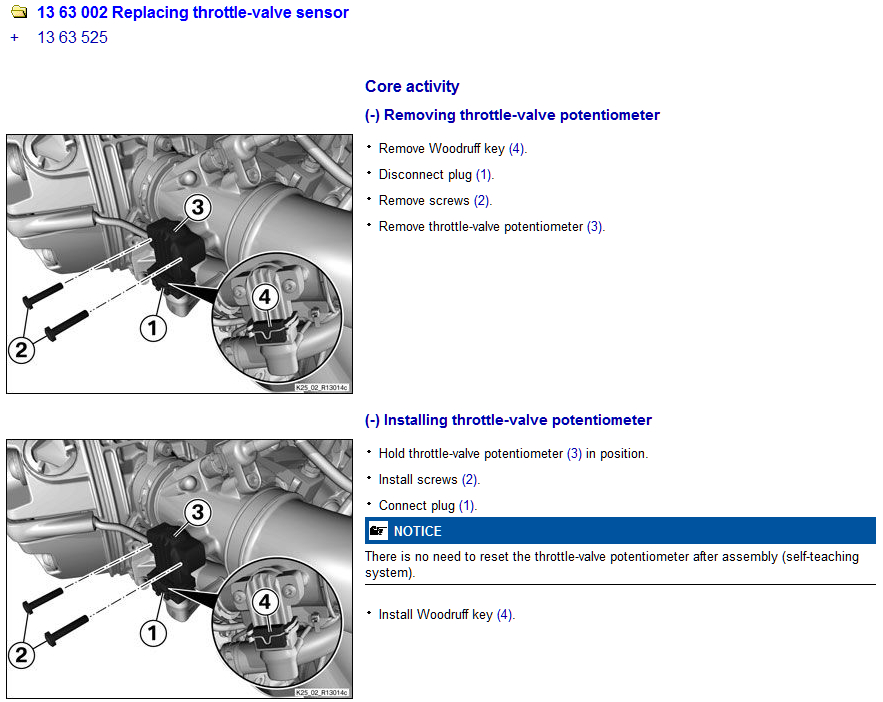
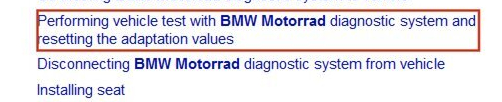
there is a critical step he's not talked about - re. wiping out the madness the bike adapted too on the old sensor - and starting afresh whenever you replace the TPS (see the RED bordered element in the picture)

sure given enough time (thousands of miles) it might come around close to what it was supposed to be doing - but if we fitted a new sensor we might as well clean out the old madness it thought was a good idea - and start adapting (based only on fresh info of what this replacement throttle position sensor is providing). AKA storing fresh minute optimisational changes to its fuelling and ignition based on the overall information provided by ALL the engine management sensors on the bike.

its the wiping adaptions element that is causing confusion for riders and the bike wasting your life playing with this sensor, without understanding how the bike operates

I still have my original 45k mile one - it performs perfectly well - and runs like a pig with any of three brand new ones, or indeed using the sensor directly off my 10k mile GSA - because you need to clear the ant brain of the way it set itself up on the old sensor.... that’s the trick to changing a TPS of either design

if you have a GS 911, too much money and you don't think the thing sticking out was too far will be an issue - wiping the adaptions and swapping it over might help it behave more correctly more often - if you can't wipe the adaptions leave the old one where it is

I gather at last, motoscan claim to have brought the adaption wipe feature - but I have still to find it within the tool - and a word of warning you'll get far more fun than a TPS being silly when the likes to play up CAT sensors start to misbehave….

Garbage.jpg

screenshot-2026-03-22-at-19-34-53-jpg.488846
 
The old mechanic talks of resetting by switching on ignition then slowly rotating throttle fully 3 to 5 times and this sets it up after swapping over.

I might try and get a tps off eBay and trying see if any difference firstly.

I’m off to France and be good to get it sorted.
 
The old mechanic talks of resetting by switching on ignition then slowly rotating throttle fully 3 to 5 times and this sets it up after swapping over.

I might try and get a tps off eBay and trying see if any difference firstly.

I’m off to France and be good to get it sorted.
that has NOTHING to do with using high level dealer type tools to wipe the engine management adaptions

indeed that action (messing with throttle) on a K25 / K26 bike has ZERO effect at all - it was a thing on some older models (maybe 1100 / 1150 bikes) and - on newer stuff, having set the bike in a learning mode with diagnostic tools its something you do on bikes with flyby wire madness (aka R1200LC R1250LC, R1300GS S1000, K1600 etc.) for both the flyby wire throttle body and the electronic throttle grip adaptions
 
Last edited:
Yaaaay Bulshit Botus is back in the house!!

It learns You Dickwad!!

None of us have the High End dealer Shit!

As @Steptoe has said Many many times You don;t have to the twist at Ign on It will learn the Range ! and Adapt
 
Yaaaay Bulshit Botus is back in the house!!

It learns You Dickwad!!

None of us have the High End dealer Shit!

As @Steptoe has said Many many times You don;t have to the twist at Ign on It will learn the Range ! and Adapt

as usual you can't read

there is no setup throttle twisting madness
and resetting the adaptions is part of the process

TPS.jpg
 
I'm slightly hesitant to join this discussion due to the passions involved, but here goes:

Do you need to reset the adaptations when replacing the TPS sensor?
In my view the answer is "it depends"..
1: If the old sensor has been producing wildly inaccurate outputs to which the BMS has attempted adapt (especially if it has reached the limits of what it can adapt to), then it will significantly speed the learning of the new sensor by letting the BMS start learning from a sane known default point.
2: If the old sensor is working more or less ok then the benefit is there but less noticeable.

So, 1: Definitely beneficial
2: Optional
Either way you won't kill the bike if you don't reset the adaptations following changing the TPS, it just might run crap for longer than if you did.

On the twin-cam the only way to reset the TPS adaptations is with a BMW specific diagnostic tool such as GS911/MotoScan/iCarsoftMTv6/BMW-ISTA, or similar
 
an example of not doing the adaptions...


R1200GS 2007, fitted new CAT sensors (one had died), serviced the bike including valve clearances and new air filter, set throttle body balance, reset adaptions and rebuilt over 2000 miles of various weather conditions including 1000 miles of cold weather temps between -5 and +11 - bike running reasonably OK, but I felt should be better - TPS a genuine BMW with 20k miles - checked live values and adaption state with GS911 - clearly CAT sensors working OK and long and short term adaptions settled and pretty close to each other between cylinders

before I was aware of the need to reset adaptations. I decided to try a new TPS - I get a Motorworks TPS, the bike ran like a utter pile of junk - it was incredible - so much worse at low speed. Motorworks confirmed many struggle to get the bike to behave after fitting a new sensor and posted some set up ideas to try - including the throttle play engine off, it made zero difference to the way it ran.

Decided to try the 10K mile original TPS from my 2011 GSA on the 2007 bike, that TPS also ran like an utter pig, if anything it was even worse. Got another Lucas TPS for a BMW car - looks like it’s the very same part as Motoworks one. The 2007 bike again ran like a dog.

Measured four TPS sensors ohm values between closed and fully open and a created a table showing the small variations. None showed substantial issues. Put one of the new TPS on the 2011 GSA and rode that - bike rode like an utter pig. Fitted its original TPS back on and it ran like it always had. With very stark changes between sensors

Confused spoke to control tech neighbour and he was adamant these wipe style sensors can have perfectly normal variation between one sensor to the next:

1) He was less interested in the ohm values at the extreme open and closed positions I’d measured, as it’s the changes in midway values the bike will work with.

2) You need to be aware of the system the sensor is fitted to, so you can grasp the potential impact changing a sensor could bring. In this case, for a given throttle opening to the next smidge further open, the air volume change can be extreme, especially off a closed throttle so the fuelling will require substantial variation around tiny throttle input movement. As this will be well within the limitations of one sensor to the next, expect the control loop to misbehave.

3) By not resetting the adaptions the bike is NEVER aware you changed the TPS. So starting out it doesn’t change what its always done, it will start out doing what it has learnt is the way to control the fuelling and any development otherwise will be slow and steady

4) On any control systems using such a sensor type – one should reset, so the system is aware in needs to adapt from a std base - or take forever / fail to create a new normal.

5) Let’s say over 20k miles it adapted to the sensor it has, and the bike learned to cope – when you exchange the TPS the natural variation of one sensor to the next, means the ECU now interprets the data from the (new) TPS as a different throttle opening,

During three occasions and more than 200 miles after replacing the TPS (where I had NOT touched the adoptions at any point) I took readings of the adaptions values, and found they got more and more muddled, and the bike continued to run terribly. Once I understood the five points above – I refitted the original TPS, it immediately felt and rode the way it did before trying any of the three different sensors (and was running far better), and within 20 miles the bike rapidly moved back towards the adaption values it had before I’d changed the sensor.

A key element I didn’t want to mess up was the cold weather condition adaptions it had stored. On my Mercedes using dealer tools I can actually reset adaptions for hot and cold weather conditions as two separate steps

 
Last edited:
Great information above, so basically fit new tps, reset adaptation values using GS-911 or similar, set up new tps again using GS-911 then all good so long as you use a genuine BMW tps unit unlike my week of titting about with the shit Motorworks copy. I’m now in possession of a genuine BMW part so all should be good tomorrow hopefully!
 
Great information above, so basically fit new tps, reset adaptation values using GS-911 or similar, set up new tps again using GS-911 then all good so long as you use a genuine BMW tps unit unlike my week of titting about with the shit Motorworks copy. I’m now in possession of a genuine BMW part so all should be good tomorrow hopefully!

not quite - fit a new TPS by ANYONE reset adaptions - expect 250miles of it being a little strange and again more fun when summer is over as it needs to learn values for cold weather - but once adaptions reset, you are in the standard BMW world of nearly correct - rather than the random (between bikes) of my sensors are odd and my bike learned to cope

adaptions are there to try and manage things short term, and optimise longer term - its not new, systems have had it for years - a rough idea of what its ant brain is trying to achieve

short term
someone put a load of junk fuel in lets calm down the mess and hope it not there tomorrow
wow WTF react now before it goes bang - goodness knows what that was - AKA massive detonation / muddled info for a split second etc. Don' bother to store that madness we managed for next ride, its a one off

long term
that's strange maybe we have a nasty TPS, lets manage its stupidity
here we go, the pot on this bike must have been machined by a worn tool and a muppet measured things wrong - wind back the ignition forever more - this is a duff one
this idiot must like crap petrol, he keeps buying junk, wind it back a smidge (what a moron, one day we might get lucky....)
 
Last edited:


Back
Top Bottom