Help please ...

Skippy

Well-known member
UKGSer Subscriber
Joined
Oct 5, 2004
Messages
8,618
Reaction score
2,978
Location
Everywhere and nowhere baby!
I have read through quite a few threads in my search for a sat nav for a new bike however, much of the jargon is like chaff, I can't decipher what I actually need to give me the following:

I like Carpuride but losing phone signal would concern me. Do I therefore need dedicated satnav, like Garmin, where the maps are stored on the device? Is TomTom for bikes like Garmin, but simpler? European maps are essential, particularly Western/Southern Europe, including Spain, Greece and Italy as well as the UK.

I want to link to my helmet to hear instructions, not just see them on a screen. I'll need speakers and a microphone using Bluetooth to what, the satnav (Garmin/other), my phone or to Carpuride? Any suggestion on what to get for this element.

Almost certainly, I only want sat nav and maybe the ability to connect and answer my phone (iOS), piped through to the helmet. Not interested in listening to Ride of the Valkyries, while feeling the wind on my face. :rob

I will be buying a new helmet, probably an Arai, new bike (a Honda)

Thank you.

Forgot to mention, I would like to consider the addition of front and rear cameras to the bike, if that has any bearing on the above.
 
Your needs seem to be purely navigation - for which i would say a dedicated 'nav is better. As you mention you have a dedicated device with downloaded maps & GPS.
For listening to the nav instructions, a headset can bluetooth to it. And the same for your phone.
Devices like the Garmin XT, work as a Hub and i can see who is calling come through, messaging & also what music is playing too.

Aocci/Carpuride and the alike are for phone mirroring if you wanted to use different apps (MRA,Google Maps,etc) and have the option to control your phone on the Bike.
Whilst some phones have a true GPS sensor, they are not as good of those in a Sat Nav. Even with downloaded maps it might not be accurate to pick you up on your route planner - especially if out of mobile phone signal range for triangulation of your position.
 
You do not really need to worry about loss of mobile signal, as both Google maps and MRA allow you to operate in offline mode.
What you would need to do is download the maps for the next day ride whilst on WiFi in the hotel or campsite the night before.

Also if your phone is modern enough you can download a eSim and use that for data only. Using someone such as Airalo as recommended by Arsey
 
Do not fear that old chestnut "You need an internet connection". . . .
Last august, six weeks through Sweden, Finland and Norway. I used a Carpuride. Navigating using Google maps. It was faultless. I just downloaded the maps at home before I went.
Phone - Carpuride
Headset - (Sena50S) to Phone
Everything works as it should.
 
You do not need an internet connection for Google maps other than, like all sat navs, to initially download the maps you wish.

The best bit about Google maps is all the additional stuff you can do on your phone/PC where ever you are before the next days ride where as most Sat Navs you require a laptop connection.

Even when I'm sat having a break in MacDonalds (which all have free WiFi) I can make changes etc...on my phone which then its immediately updated to Android Auto. NO stand alone Sat Nav can do that as easy as a phone/Google Maps.

I've travelled all over Europe in a Motorhome. Bike and car and never needed a stand alone sat nav as Google Maps does more

For free
 
Except that's showing the older obsolete Carpuride, Which will give wrong information.
But it also gives a broad overview of the other options available which I believe the op was also exploring. For what it's worth I'm not sure what the attraction is of dumb AA or CP devices on a motorcycle. I have it built in to my Honda Africa twin including buttons to navigate the screen. However, you still might have connection issues between your phone and the device or settings or apps on your phone that might interfere with each other. If i was going down that route from scratch I'd use a secondary dedicated rugged phone that I could use, or a larger tablet like the Oukitel RT3 both options can be obtained for the same price as an dumb AA/CP device. But there are options for everyone. (y)
 
Having used and tried various options for my european travels my personal thoughts are:

Tom Tom, was problematic and unreliable, returned for a full refund after 3 months.
Garmin XT, has never let me down, has worked without fault over numerous tours and 60,000 miles.
INNOV N1 Pro, jury still out on this as its on my M1000R, so far though it has been very good/faultless but not enough usage to really tell.
Chigee AIO5 Play, currently using this on my 1250 GSA and again so far no problems with 2-3000 miles of use.
 
Having a little think about this. Is this your first time dipping your toes into GPS navigation? Your best option to start with might be to use your phone (or even better an old phones) and get a decent bluetooth headset. You can try Google maps which is great for point to point navigation and an easy start and as stated above costs nothing. Then you can check out apps that use GPX files of which there are many. Lots of folk on here use MRA so there is plenty of help available. Unfortunately, once you get into creating routes all options have a learning curve. Many of the good navigation apps have a two week testing option before you pay and have free options that may be enough for your needs. Once you have done that for a while you might have a better idea of what you actually need/want in a GPS system for the type of riding you do and you can come back for more advice.
 
Mzokk’s advice is very good.

Like him, I can run up to three separate GPS navigation tools at once on my motorcycle, if I want to. The three being:

1. A Garmin GPX device, powered by the bike. This is running bespoke GPX routes, I have created in MyRoute.

2. A sacrificial phone, mounted on a Peak Design wireless charger, powered by the bike. This is usually running and displaying MyRoute’s Navigation app, again using the same bespoke routes. It could of course just as easily run and display Google Maps or any number of other navigational type apps

3. A second sacrificial phone, again powered by the bike, running BMW’s in-house navigation app, itself running the same bespike GPX routes I have created in MyRoute. This displays its route in my 1600’s TFT screen and is controllable by the bike’s wonder wheel thing.

When I ride my Himalayan, I can use 1 and 2.

All three have their strengths and weaknesses. As a pure standalone device, it is hard to beat a Garmin GPS unit. That said, MyRoute’s phone based Navigation app is now pretty damned good. So good in fact that last time I went away for a week to the Ardennes, running some pretty complex bespoke routes, I went only with device 2, the sacrificial phone running MyRoute.

I don’t listen to music, receive texts, do bike-to-bike or rider-to-pillion or make phone calls or any of that malarkey when on my motorcycle. That said, I could if I wanted to. The communications system, integral to my Shoei Neotech helmet can make calls, play music and, most importantly (to me at least) receive voice instructions from two separate GPS devices. I link it seamlessly to my Garmin XT and to my sacrificial phone running MyRoute’s Navigation app. I have altered the voice on each device, so I can tell which of the two devices is talking to me.

Data usage. Navigation uses very little data, whether at home or abroad. That said, most modern apps allow you to run downloaded maps and routes. Neither of my sacrificial phones has a SIM card in (or if one does, I turn the card off) and everything works just fine using the downloaded maps / routes in ‘off line’ mode. Of course the Garmin XT uses no data at all.

I have one of the Chigee ‘Car play’ dumb screens, which simply mirrors a phone but I haven’t plumbed it in yet. I have no reason to doubt that it’ll do a very good job, if and when I do use it.

So what is best for you? Only you’ll find out. My only tips are:

A. When you start, keep it simple.

B. The devices are ‘plug and play’ but only up to a point. That said, most of the errors and confusion we now see on these pages are self enduced.

C. Get to know at least the basics of the device, before you set off for two weeks away in the blazing sun or pouring rain.

D. Remember, no matter what, you really cannot break it. Unless that is, you jump up and down on the dumb device or lob it down a canyon in frustration. Likewise, don’t shout at the device, it can’t hear you. Nine times out of 10, it is only doing what you have told it to do, so it should really be shouting at you!
 
Whilst some phones have a true GPS sensor, they are not as good of those in a Sat Nav. Even with downloaded maps it might not be accurate to pick you up on your route planner - especially if out of mobile phone signal range for triangulation of your position.
Whilst this may have been true in the dawn of phones I'm not sure it holds true now. I'd think dedicated GPS devices and phones are likely to have the same internals to a degree, and given the quicker refresh cycles of new phones I'd even suggest they're more likely to have better GPS hardware than the older dedicated kit.

Also phones don't use just GSM signals for triangulation (if at all). They use the same GPS signals as dedicated kit (try running dedicated GPS sat software on your phone - eg GPS Status to see what satellites it can "see").

We've used phone based satnav for donkeys years and yet to have it get confused about where it is (unless eg there's been a change to the road network).
 
Whilst this may have been true in the dawn of phones I'm not sure it holds true now. I'd think dedicated GPS devices and phones are likely to have the same internals to a degree, and given the quicker refresh cycles of new phones I'd even suggest they're more likely to have better GPS hardware than the older dedicated kit.

Also phones don't use just GSM signals for triangulation (if at all). They use the same GPS signals as dedicated kit (try running dedicated GPS sat software on your phone - eg GPS Status to see what satellites it can "see").

We've used phone based satnav for donkeys years and yet to have it get confused about where it is (unless eg there's been a change to the road network).

It depends on the phone you have as to how good the GPS sensor is, and how reliable it'll be when only relying on GPS only for position location.. The lower end phones tend to have a single channel receiver whilst the higher end will have dual channel receivers.
 
Whilst this may have been true in the dawn of phones I'm not sure it holds true now. I'd think dedicated GPS devices and phones are likely to have the same internals to a degree, and given the quicker refresh cycles of new phones I'd even suggest they're more likely to have better GPS hardware than the older dedicated kit.

Also phones don't use just GSM signals for triangulation (if at all). They use the same GPS signals as dedicated kit (try running dedicated GPS sat software on your phone - eg GPS Status to see what satellites it can "see").

We've used phone based satnav for donkeys years and yet to have it get confused about where it is (unless eg there's been a change to the road network).
Dedicated GPS stand alone navigation units have their days numbered. Soon they will be a thing of the past, like betamax.
 
It depends on the phone you have as to how good the GPS sensor is, and how reliable it'll be when only relying on GPS only for position location.. The lower end phones tend to have a single channel receiver whilst the higher end will have dual channel receivers.
And as it appears you can get down to roughly 50cm accuracy with single channel and then extrapolate and correct for movement with on-board software (and then get down to 2 cm accuracy for a static receiver) that's not so much of an issue? TBH for a satnav (dedicated or phone) you don't really *need* dual or triple channel - it's more important to be able to lock on to multiple satellites and when you can't (think continuous built-up areas) to have other ways to extrapolate your position.

So for the OP both dedicated satnav or a phone will work equally well.
 
I bought my two sacrificial phones (one an iPhone, the other a Samsung) as reconditioned models, both from Back Market. Very good service and exactly as described in the advert.
 
Almost certainly, I only want sat nav and maybe the ability to connect and answer my phone (iOS), piped through to the helmet.

Then any modern GPS unit from the likes of Garmin or TomTom will do you.

There are lots of posts / threads on which communication (coms, to use the bikermate speak) system is best.

Me? I’d suggest:

BMW Nav V or a third generation Nav VI, especially if your bike has BMW ‘sat nav prep’ and the wonder wheel. Or, failing those, any Garmin equivalent, up to and including the first generation XT unit.

Several suitable devices come up for sale on UKGSer, quite regularly.
 
Just for a bit of transparency or whatever one wishes to call it.

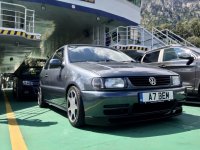
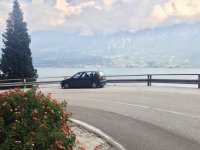
In 2014 I drove my 1996 VW Polo all the way to Lake Garda and back using nothing more than my iPhone 6 and Google maps. That’s over decade ago when dedicated satnavs were a must have. Never had any issue even when driving over mountain passes.
In 2025, I would be even less worried about using my phone for even more complex routing and navigating software.

Here is the little car on a ferry across Lake Garda.

IMG_4454.jpeg

And overlooking Lake Garda near Tremosine sul Garda.
IMG_2748.jpeg


Back
Top Bottom