JohnGS1100 Tuning Chip

Hi

I'm waiting in anticipation for the arrival of one of John's magical chips for my 850GS so spent most of yesterday trawling through the 40 odd pages of this thread and have a couple of questions:

1) Do I have to remove the tank completely or can you get at the ECU by just moving it back/propping up?

2) A number of people have reported higher tickover after fitting but when I 'Harmonized' mine last week the Big Screws were wound nearly all the way in (1/4 turn out at max) so there is little room to lower if I need to. I also note that John recommends that the screws are wound out 2 3/4 turns which would make my tickover about 3k rpm by my calculation. Any ideas what might be wrong before I make it worse??

It's a yr 2000 model with Lambda sensor, full Remus and std air filter if that helps. And I adjusted the valves etc and balanced with a Harmonizer which has made it silky smooth, almost.


Hi Nip.

Do not worry about idle speed, you can adjust by the stop by pass screws behing the throttles.

John, I really hope you get an LC-2, they are not very expensive and if you installed one in your R1100 or R1150, you would immediately know what your chips are actually doing. You could make a log of the AFR while riding, showing acceleration enrichment and cruising AFR. I could compare that log to stock. Then if you wanted, I would take a chip and confirm your results.

In truth, I think you will be very surprised by what you find when you take such a log on a Closed Loop bike.


Yes Roger, i will buy a LC-1 or 2 tool and i take the results by computer.
Let me know please what the different from LC-1 to LC-2 ?
 
Hi

I'm waiting in anticipation for the arrival of one of John's magical chips for my 850GS so spent most of yesterday trawling through the 40 odd pages of this thread and have a couple of questions:

1) Do I have to remove the tank completely or can you get at the ECU by just moving it back/propping up?

2) A number of people have reported higher tickover after fitting but when I 'Harmonized' mine last week the Big Screws were wound nearly all the way in (1/4 turn out at max) so there is little room to lower if I need to. I also note that John recommends that the screws are wound out 2 3/4 turns which would make my tickover about 3k rpm by my calculation. Any ideas what might be wrong before I make it worse??

It's a yr 2000 model with Lambda sensor, full Remus and std air filter if that helps. And I adjusted the valves etc and balanced with a Harmonizer which has made it silky smooth, almost.

Nige,
Is it possible that someone used the Zero=Zero procedure on your motorcycle at some time in the past? This can easily result in the high idle symptoms you describe. If you didn't use Zero=Zero, check and see if you have blue paint on the throttle body stop screws.
 
Yes Roger, i will buy a LC-1 or 2 tool and i take the results by computer.
Let me know please what the different from LC-1 to LC-2 ?

The LC-2 is the newer updated model. The functional differences are small but the internal design is more modern.

You can get the LC-2 with either an 8' extension cable (standard) to the Wideband O2 sensor or a 3' cable. Either will work but the 8' cable is much longer than you need. If you can, get the 3' cable.

When you are ready, email me. I can save you a lot of time setting it up.

I will post my riding logs from the test chip you sent me last November so it is easier to see what I'm talking about.
 
John, Here are the LC-1 logs I made from the richer test chip you sent me last November. The chart shows realtime AFR, sampled every 12 mS (about 80 times per second). This allows us to see the enrichments and fueling in realtime.

The first chart below was after I installed the chip in my bike, running with a stock O2 sensor but recording the results with the LC-1. This is the log after the bike was first started in my garage.

You can see that it starts out richer than stock due to your changes to the chip. But then you can also see that after about 4 minutes, when the bike is warmed up, it goes into Closed Loop operation and the AFR is the same as stock. The Motronic has adapted out the fuel that you added in the tables and that the mixture has returned to stock at 14.7:1. It took about 10 seconds to remove the fuel.

JohnGS1.jpg


In the next chart, you can see the effects of your chip as I rode over a five mile course, recording the AFR with the LC-1. Look closely at Segments C and E on the chart. This is riding with your chip and a stock O2 sensor. These are the same results I see with the stock Motronic chip and a stock O2 sensor. In other words, there is no enrichment of the mixture. You can see that the average fueling is 14.7:1 and that the peaks and valleys of the chart are the same as Segment D, which I will describe next.

On my bike, I can switch in a richer O2 sensor at any time with a toggle switch. At the beginning of segment D, while riding down the road, I switched from the stock O2 sensor to a 13.8:1 O2 sensor, but I'm still using your modified chip. See that the average AFR shifted quickly to 13.8:1? The peaks and valleys are the same as in segments C and E (your chip, stock O2 sensor) but the cruise fueling is richer.

So from this second test, it is clear that although you've added fuel to the map, when you run a stock O2 sensor, you get stock fueling ... and when you run a richer O2 sensor, you get richer fueling.

JohnGS2.jpg


When you get an LC-2 installed you will learn a lot about your chips. If you get a GS-911 you can measure the timing and dwell as you ride down the road and compare stock and the chips you modify. But first, I recommend you get an LC-2.
 
Nige,
Is it possible that someone used the Zero=Zero procedure on your motorcycle at some time in the past? This can easily result in the high idle symptoms you describe. If you didn't use Zero=Zero, check and see if you have blue paint on the throttle body stop screws.

I would hazard a guess you are right as no ‘blue paint’ in sight.

I am now reading up on carrying out the zer0 = zero/250mV routine. Didn’t think it would be as simple as lowering the stop screws

Thanks guys
 
The reason that you want the same AFR/Lambda all the time is that the catalytic converter only functions efficiently (or at all) very near Lambda = 1.

Hi Roger. I all due respect, I think you are missing a few points.

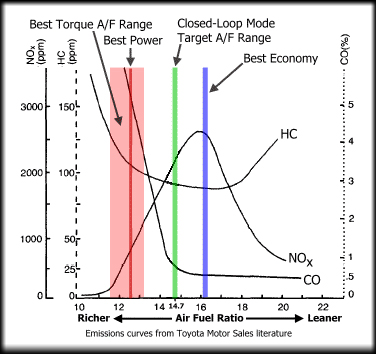
Stochiometric (14.7) air/fuel ratio is good for two things : better emissions (lower hydrocarbons) and fuel economy. But stochio is not best power. Far from it. As soon as you accelerate, you need way more fuel. So, if you expect to run stochio even under acceleration, your bike will be totally anemic as the average best power air fuel ration is between 12.0 and 13.0 :1 which is way outside the oxygen sensor working parameter. Remember the good old carbs where there was an "acceleration pump"? Yup. Gobs of extra fuel being squirted down the intake to allow better acceleration. Of course, as soon as you add that much fuel, don't expect to stay stochio. Or the engine will bog down. But if riding all day long at steady throttle, there's no need to run rich. So stochio is acceptable for economy and much reduced engine load. Twist that throttle, and dump some fuel ;-)

Therefore oxygen sensor is far from controling everything. Quite the contrary. It will only be used on steady throttle. John may have more experience than many here, having spent perhaps morw tinme on a dyno. Sue, he missed a few things, but I trust his practical experience.

The corruption problem I had with my AFXied leaning out the mixture was evident. As soon as would slightly twist the throttle, the DME would bypass the O2 sensor and dump enough fuel to accelerate. Release the throttle and the engine bugs down. Not too happy.

airfuel.jpg
 
Lee. My answers highlighted below. R

Hi Roger. I all due respect, I think you are missing a few points. Hi Lee, I was addressing your point that higher air temperatures cause the Motronic to lean out the mixture. As I explained, that isn't true. Higher air temperatures cause the Motronic to very slightly reduce the amount of fuel injected to achieve the SAME AFR.

Stochiometric (14.7) air/fuel ratio is good for two things : better emissions (lower hydrocarbons) and fuel economy. That is true. But as you point out Best Economy is even leaner than Stoic.

But stochio is not best power. Far from it. That is correct. Best Power mixture is about 10-15% richer than Stoic, depending on engine configuration. It should be noted that Stoic produces the hottest exhaust. Leaner OR richer is cooler!

As soon as you accelerate, you need way more fuel. That is partly true. The Motronic adds about 6-12% depending on how much you open the throttle, how fast you open the throttle and the engine & air temperatures. Most of the fuel is added to replenish the fuel which has evaporated when the throttle was first opened. A part throttle acceleration returns to Closed Loop & Stoic after several seconds. A full throttle acceleration stays richer than Stoic until you release the throttle or hit redline.

So, if you expect to run stochio even under acceleration, your bike will be totally anemic as the average best power air fuel ration is between 12.0 and 13.0 :1 which is way outside the oxygen sensor working parameter. True. But since the long term trims (calculated with the O2 sensor) are used during ALL fueling, the O2 sensor has an indirect influence even at WOT.

Remember the good old carbs where there was an "acceleration pump"? Yup. Gobs of extra fuel being squirted down the intake to allow better acceleration. Of course, as soon as you add that much fuel, don't expect to stay stochio. Or the engine will bog down. But if riding all day long at steady throttle, there's no need to run rich. So stochio is acceptable for economy and much reduced engine load. Twist that throttle, and dump some fuel ;-) How true. But remember that your bike will be closed loop 40-90% of the time, newer bikes are at the higher end of the range. Riding an Oilhead very aggressively still results in Closed Loop 30-40% of the time. That is why, if you want the best riding, most responsive bike it pays to shift lambda toward Best Power. Chip reprogramming does not richen cruise, as a result it is not near best power and is not as responsive as shifted lambda. That is the point of the chart I showed John above.

Therefore oxygen sensor is far from controling everything. Quite the contrary. It will only be used on steady throttle. Not true. You are closed loop 40-90% of the time. But all the sensors matter and must be working accurately.

John may have more experience than many here, having spent perhaps morw tinme on a dyno. Sue, he missed a few things, but I trust his practical experience.Inertial dynos are just okay. The don't have a "brake" load meaning a resistance at the start of the "pull". The inertial load is often less than 50% of a road-load" so it is too lightly loaded. And an inertial dyno only measures about 2% of the fuel map cells for each pull. Road testing with instrumentation is better.

The corruption problem I had with my AFXied leaning out the mixture was evident. As soon as would slightly twist the throttle, the DME would bypass the O2 sensor and dump enough fuel to accelerate. Release the throttle and the engine bugs down. Not too happy. Did you get your AF-XIED repaired?
 
............................

airfuel.jpg
.

Lee, i made full modification at the stage 6 chip (bin file of your ECU).

There are many maps in to the chip :

engine.temp
inlet-air.temp
100_atm.press
106_rpm
battery voltage
IAT_fuelcorr
Map all coding
map_eng.temp
eng.temp.ign.corr
ign.corr.IAT
ign.advance middle throttles
ign.advance high throttles.
fuel injection


I made modification at maps :

inlet-air.temp (+5%) - (+8%) plus aditional values.

eng.temp.ign.corr I give a value which means " no fuel correction when the engine is at 5-6 or higher values". So the AFR is the same when the engine is 4,5,6 and more lines..

IAT_fuelcorr .. +5%

ign.advance : I give variable timing advance as :

1.100-1.900 +40 %
2.000-2.800 +25%
2.900-4.900 +12-15%
4.900-5.700 +8 %

ignition advance high throttles : (+5)- (+)8%

fuel injection

I give additional value as:

1.100-4.900 + 8%
4.900-8.100 (+5%)-(+12)%


Let us know please, what improvement did you see on your bike by the stage 6 chip.

Note that this chip needed 94 or higher octane as european petrols.
 
Wouln't it be curious if the air temp parameter was disgarded once the engine is warmed up? It goes against all I have learned on previous Motronics for the past 30 years. An engine requires a different fuel mixture wether it runs thru 0°C or 30°C weather. Also, closed loop is only used at steady throttle, correct? As long as you accelerate or go WOT (wide open throttle), the closed loop is bypassed as you need a much richer mixture, right?

BTW i love my stage 4 on pins 30-87
I will soon swap the chip to a stage 6 to see what happens beyond 5K rpm ;-)

Lee

Lee how long have you been running with the Stage 4 chip ?
Has the performance/ economy improvement when first fitted remained or has it returned to stock as Roger suggests ?
 
Lee how long have you been running with the Stage 4 chip ?
Has the performance/ economy improvement when first fitted remained or has it returned to stock as Roger suggests ?

To be fair, I'm not suggesting that it will revert to Stock I'm saying I've attached an instrument, measured it, and shown it goes to stock. Chart below from earlier.

However I am suggesting (since I'm not showing a measurement) that changes above 30-40 degrees throttle (open loop area) will stick, minus the amount added below 30-40 degrees throttle (closed loop area) since a long term trim will be created to reduce the amount in the closed loop area. So if 8% is added to closed loop and 12% to open loop the net addition to open loop is 4%. It's just the way it works.

I'm also saying that any timing changes or acceleration enrichment changes John makes won't return to stock and the bike can benefit from them.

These comments are why I am offering to help John attach a wideband O2 and get it programmed. I think unless he measures it for himself he won't believe.

JohnGS2.jpg
 
Lee how long have you been running with the Stage 4 chip ?
Has the performance/ economy improvement when first fitted remained or has it returned to stock as Roger suggests ?

So far, I have two 30 litre gas tanks, and currently in the midle of my third. Performance hasn't decreased as far as I can perceive. I am quite happy. There are a few points I will discuss with John later. I will keep the stage 4 chip a few more tanks to get a better feel. Then will switch to the stage 6.

So far, the only question I have to John is if the idle mixture has been made richer too? If so, is that really necessary? I feel my idle "smells" at stoplights.... ;-) I will recheck if my TPS is still at 340mv before any other comment on fuel mixture at idle.

BTW As a side note, BMWs from the e30, e36 and e46 series running a narrow band oxygen sensor (and we're talking 30 years of BMW production) have all been chipped. Modified fuel and spark advance. They don't revert to a stock performance after a few gas tanks.

Anyway, John. Good job. Now returning to the restoration of my Africa Twin in need of more spark advance as the motor is getting old ;-)

At Roger. With your LC1 connected, can you tell us if AFR stays stochio when cruising (no load), but goes to a richer mixture as soon as the throttle gets twisted (even slight acceleration) and WOT (wide open throttle).

At John. Yes, you should hook-up a wideband sensor in the original location, where it is hot (certainly not in the rear muffler) and let us know what kind of AFR you get. Cruising. Acceleration. WOT. If all is well, you should get a stock AFR in cruising mode, but richer when twisting that throttle. ;-)
 
...
At Roger. With your LC1 connected, can you tell us if AFR stays stochio when cruising (no load), but goes to a richer mixture as soon as the throttle gets twisted (even slight acceleration) and WOT (wide open throttle).

At John. Yes, you should hook-up a wideband sensor in the original location, where it is hot (certainly not in the rear muffler) and let us know what kind of AFR you get. Cruising. Acceleration. WOT. If all is well, you should get a stock AFR in cruising mode, but richer when twisting that throttle. ;-)

Lee, Althougth the charts I've posted may not be familiar to you, yes, with the LC-1 connected you can see the moment by moment AFR. in those charts there is a new data point every 80 milliseconds. If you expand the time scale you can even see the AFR variation in Closed Loop as the fueling is ramped up and down by the Motronic.

Closed Loop on the Motronic extends to fairly high loads as shown by the LC-1 and GS-911. I've recorded closed loop at 100 MPH, which is 45 HP. The Motronic also returns to closed loop if you accelerate at 40%+ throttle, which I've also recorded.

The LC-1 also shows acceleration enrichments and deceleration lean-offs in realtime. Up to 40-50% throttle, which is the majority of accelerations, the Motronic can be shown to return to Closed Loop in a few seconds. What you see is the AFR going from the value set by the O2 sensor (or AF-XIED if you use one) to 12.5-13:1 for a couple seconds, then returning to the O2 sensor value for the remainder of the acceleration. So if the O2 is set to 14.7:1, that is the AFR for much of the acceleration. With shifted lambda to say 13:8:1 you accelerate with much closer to Best Power mixture after acceleration enrichment is over.

At WOT, the AFR is fairly rich, even on a stock bike, below 13:1, again, clearly recorded by LC-1. Chip reprogramming can permanently affect WOT AFR, as long as you don't reprogram the chip to add fuel in the Closed Loop area. The reason you must not add fuel in any closed loop area (documented by Power Commander with Wideband O2) is that any fuel added In closed loop causes a long term trim to be created, which reduces fueling everywhere, even at WOT. So if you add 8% to closed loop points in the chip and 12% to open loop points in the chip, you get a net gain of 0% in the closed loop area (due to a stock O2 sensor) and 4% in the WOT area due to a long term trim of 0.92. The long term trims are in the Motronic documentation and I've measured them with the LC-1. Just last month, hexcode SA upgraded the GS-911 Wifi to show the long term trims for 2005-2012 R1200 bikes, something they have never previously done. This also confirms the effect of long term trims.

In truth you can't see much of anything if you're only looking at a gauge, you must have realtime data to see what's happening. That's why an LC-1, LC-2 or LM-2 is so effective when mounted a foot or so from the exhaust valve.

When I get a minute, I'll show an acceleration enrichment as seen be the LC-1.
 
Lee, Below is an example plot of a realtime acceleration, measured on my bike at WOT, using the LC-1, on the road. The acceleration was in 4th gear. You can see the AFR richen starting on the left and then return to cruise AFR (13.8:1 in my case) at the 27:50 mark, even though I'm going 100 MPH at that time. These AFRs were achieved with no chip reprogramming, just a lambda-shift. Also, note how well behaved the AFR is during the acceleration period.

You can see a small acceleration at the 28:0 mark, where the AFR dips to 13.25:1.

wotafrplotr1150rt.jpg
 
Good news !! Today i made a super mod chip for full aceleration, max faster timing advance and modification at weel advance little later than stock. Also i made mods at ATM pressure maps and at oil temp maps, that give stantard power at all temps of engine with no additional fuel-stantard and very good consumption by full power !!

Anybody who wants try the super mod chip ?

Needed only a K/N air filter and a good aftermaker exhaust :duck:

The bike runs very faster, rear tire difficult to keep on the road, spins from 2,100 rpm until red line 8.100 rpms..

I'm ecstatic by the improvement and the power !! The power comes at the slightest opening of throttles..!

Pm please for anybody wants to try this super mod chip :)
 
Hi John

I am at a 6th fuel tank on the stage 4 chip. Wondering if you have retested your bike on a dyno after a few fuel tanks to see if there would be any change. In my case the rich running and smelly idle is gone and the engine started pinging in some accelerations when it did not before. I have reset the DME and will redo a test. I am wondering if the extra fuel is not making the DME lean out the mixture in all conditions, over time.

Lee


Back
Top Bottom