NEARSIDE REAR INDICATOR NOT WORKING

Michael R1150GS Adventure

Well-known member
UKGSer Subscriber
Joined
Apr 24, 2009
Messages
1,656
Reaction score
19
Location
Tyne Valley
had the thing to bits, no voltage to the wire terminals at the light, traced it back can see no damage

anything common here going on or am i just lucky? :confused:

 
ah ha - would that failing allow the front nearside to work and the rear nearside to fail?

interesting - i'll check me wiring diagram :thumb2
 
It's unlikely to be a flasher unit.

The power for the left indicator comes out of the flasher unit to a crimp connection, where it then T's off to feed the front and back indicators. The same for the right side.

If you have one indicator out only, it will be either bulb, or wiring.

Edit
I would look for a poor earth or broken corroded wiring, in the area of the rear indicator.
 
cheers for replies - have cross checked bulb so not that. no power getting to wire ends at light so must be 'forward' from there (up the bike that is!)
cant see any breaks or anything so will have to check that t area then - hate electrics. sodding impossible to diagnose simply in this instance
 
It's easy.

First substitute the earth for a known good earth at the bulb end if it works it's a bad earth.

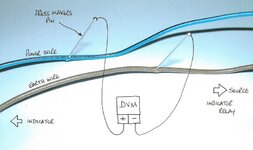
If it still doesn't work, get yourself a dress makers pin and push it through the insulation of the power wire, moving away from the light until you get power.

That will show you if it's not to obvious visually where the break is.

:thumb2
 
I seem to remember that there are some connectors inside the body coloured plastic area under the rack.
 
It's easy.

First substitute the earth for a known good earth at the bulb end if it works it's a bad earth.

If it still doesn't work, get yourself a dress makers pin and push it through the insulation of the power wire, moving away from the light until you get power.

That will show you if it's not to obvious visually where the break is.

:thumb2

so i earth the indicator end - right ive learned a new trick there thanks.
NOW what do i connect to the pin? the earth cable?
 
so i earth the indicator end - right ive learned a new trick there thanks.
NOW what do i connect to the pin? the earth cable?

I think he means get a pin and test meter (or a bulb with wires attached to it). Connect the black test lead (or bulb earth) to earth and then attach the pin to the red test lead (or the wire connected to the bulb contact terminal). Stab the live indicator lead with the pin at points between the indicator and the power source until the meter shows voltage (or the bulb glows). You'll either find a break in the wire or have crossed a connector which will prove to be not connecting. A clever trick that I've never heard before.
 
it is a clever method. just testing the circuits now - live gives a good resistance to earth but nothing on the ohmeter from the black cable to the same earth, so looks like an earth problem.

bugger.
 
...........................nothing on the ohmeter from the black cable to the same earth, so looks like an earth problem.

bugger.

Unless I've misunderstood your quoted post there should be zero resistance between the black wire (assuming that is earth) and an earth point as they should be connected somewhere through the chassis. Zero ohms resistance = good connection.

Also, if you have a corroded terminal it may make enough of a connection to show voltage but not conduct enough current to light the bulb. If you are right about an earth issue though you should be able to get a length of wire, one of the cables from your test meter should do, put one end on the bulb earth case whilst it's in the indicator and connect the other to a known good earth like the engine cases to test.
 
A picture paints a thousand words.

Generally you only need to just prick through the insulation of the wire with the pin. I've been a bit heavy handed just to show the principles.

Also you generally only need to use the pin on the power wire, the negative end of the DVM going to an known earth source.

Just be careful using this method to make sure the exposed pin does not touch an earth when doing power checks.

It make no difference whether you work from the source to the indicator or vice versa. the results are the same.

Usually the plastic insulation will partially self seal after you have removed the pin, but if your concerned. a wipe with some silicon grease or similar will seal the tiny hole.
 

Attachments

  • scan wire.jpg
    scan wire.jpg
    41.2 KB · Views: 131
I think he means get a pin and test meter (or a bulb with wires attached to it). Connect the black test lead (or bulb earth) to earth and then attach the pin to the red test lead (or the wire connected to the bulb contact terminal). Stab the live indicator lead with the pin at points between the indicator and the power source until the meter shows voltage (or the bulb glows). You'll either find a break in the wire or have crossed a connector which will prove to be not connecting. A clever trick that I've never heard before.

Thanks Packer.

That is spot on what I was trying to get across in my post.

Ian :thumb2
 
Following on what Packer said about using a test bulb instead of a meter that the meter will sometimes read voltage but it will not run a lamp so always follow up a meter reading with a test lamp and not an LED but a good old fashioned light bulb. Hope that makes sense and dont prick yourself with the needle blood on wiring gets messy.

Adrian
 
thanks for the help gents - enormous help and a few things learnt

i found the problem - a dry connection inside the rear indcator stalk extenders (for the panniers) - took the lot apart and bingo it lived.

very satisfying repair (in other words, for once i got somewhere!) :D
 
Success always feels good. Did you check all the others at the same time? They will probably be in similar condition.


Back
Top Bottom