Ah....the misinformation thread.



If there was going to be an advantage in using a different gas I'd try helium. Why? Lower weight. Yes really. Still wouldn't bother. JJH

That would be worse than my thread JJh.

You've not heard of the Haber-Bosch and the Born-Haber processes?

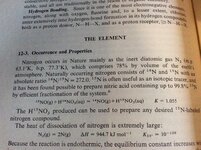
I’ve just dusted of my 1972 copy of Cotton and Wilkinson ‘Advanced Inorganic Chemistry, A Comprehensive Text, third edition’
Page 344, section 12-3 states,
‘Nitrogen occurs in Nature mainly as the inert diatomic gas N2........’


Costco use Nitrogen in their tyre places ( allegedly)

It's a fad to give some bikers yet more bragging rights to a problem that doesn't exist for road conditions. One of the advantages in racing is less pressure sensitivity with temperature changes hence more predictable grip which is AFAIK why racing teams may use Nitrogen. Longer term, Nitrogen is less likely to migrate through micro-porous tyre walls (apparently). There's little to no chance of most people's tyres prematurely ageing to the point it becomes a problem due to using air over an inert gas. Your tyres will wear out long before that ever becomes a real issue. UV degradation may be more problematical for those who don't have a garage (long exposure can harden compounds and reduce grip levels) but even then not until 2 or 3 years have passed from fitting new rubber. Nitrogen won't prevent that. Air is free and good enough!
I’ve just dusted of my 1972 copy of Cotton and Wilkinson ‘Advanced Inorganic Chemistry, A Comprehensive Text, third edition’
Page 344, section 12-3 states,
‘Nitrogen occurs in Nature mainly as the inert diatomic gas N2........’

I’m very disappointed you needed to look it up.
Only the details, it is very well known that Nitrogen gas is very inert.
I have just let some gas go, it was not inert at all.
Then don’t fill your tyres with it.
I'd not heard of either until I googled.You've not heard of the Haber-Bosch and the Born-Haber processes?
Nitrogen, on the other hand, is an inert, dry gas and does not support moisture. The use of 93-95% pure nitrogen will prevent premature tire aging and wheel corrosion due to internal moisture. However, some experts say that under normal driving conditions, a tire’s tread will reach its minimum usable depth long before any effect of oxidation on the tire wall

I'd not heard of either until I googled.
I'm still trying to work out the relevance to Engineer's post.