Progressive springs

Sunny Jim

Well-known member
UKGSer Subscriber
Joined
Jul 24, 2010
Messages
1,274
Reaction score
39
Location
Haworth
Just about to start stripping tank/handlebars prior to up-grading to Wilbers progressive springs on a '91 GS.

The Clymer goes into all kinds of detail about fork removal, the Wilbers German translation to English is :eek: to say the least:rolleyes:

As far as I see it, all I need to do, independently of course, is:

1. Remove exisitng spring
2. Drain as much oil from each leg (will be using hot air gun on bottom of leg to free up as much oil as I can)
3. Insert new spring
4. Top up with new oil

Is it really that simple?
 
Yep.

I've never got on with progressive springs. Let us know how you find them.
 
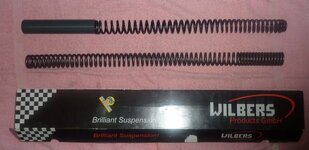
Job done - too late for a test ride but first impressions are it's all a bit :bounce1:bounce1:bounce1 at the front.

Top spring/spacer is what's come out - bottom spring is, well, the new one.

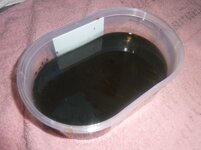
Oil was pretty good to say it's been there 20yrs.

Pics of the bits and oil...
 

Attachments

  • 3.10.11 016a.jpg
    3.10.11 016a.jpg
    30.7 KB · Views: 173
  • 3.10.11 017a.jpg
    3.10.11 017a.jpg
    33.7 KB · Views: 160
Think the spacer may be the spanner you refer to John.
 
Just in from a quick blast around Bronte Country to check all is well and must say they are performing way ahead of the old springs - cornering on crap, bobbly tar for example is very good indeed.

Looking forward to a more extended :tarka later this week:D
 
So to me, that looks like a dual-rate spring, rather than progressive in the strict sense of the word.
Is this what people talk about when they say progressive? Who can enlighten for me please?
 
'Progressive Rate Fork Springs have several advantages over straight rate springs. A Progressive Rate Spring has the advantage of a rising rate resistance to compression. The benefit of this is that the spring can be soft enough at the start of the travel to offer a "plush" ride, yet be firm enough at the end of the travel to soak up the big bumps'

Wish I was still firm enough at the end of a ride:rob
 
A spring will only be progressive if some of the coils become coil bound, and change the effective length of the spring.

And it seems that when you compress a spring all the gaps close by the same percentage, and very little of the spring becomes coilbound, 1/2 a coil or around 3% on the Konis on my /7 as an example.

According to Ohlins " The technology does not currently exist to make a spring which is progressive to any meaningful degree." and that is why they fit straight wound springs to everything the make.

Doesnt seem to stop them selling progressive wound springs for aftermarket use though!

This is confirmed by a graph which someone posted here a few months back, when compressing a so called progressive spring - the line was dead straight, no progression whatsoever, and even an experiment with two spring of different rates gave no progression, there was one straight rate until the softer was coil bound , then an abrupt change to a different rate there after.

Air is progressive, which is why the Ohlins Moto GP forks have a separate air reservoir behind the main stanchion.

Fork oil has improved in the last 20 years too, and it is likely that the new oil will be a different level from the old stuff, reducing the air gap which will give a more progressive action, and the improved formulation giving less stiction and providing more consistent damping in both directions.
Which is probably why Wilbers and others supply the good oil with the springs

So I dont doubt that your front end feels much better now, but the progressive wound Wilbers springs I fitted to my F650 GS were no improvement whatsoever.
The important setting is balance front to rear, and the GS had a remote preload adjuster for the rear shock which could be adjusted on the move.
And when you get it just right both ends come good at the same time.

And if you get it just right you will notice the deterioration in the action as the damping oil thins out - you will want to change it a bit more often in the future!

 
The big difference I noticed on my R100GSPD after fitting progressive springs was a less harsh ride over smaller irregularities. I rode my normal circuit, changed the springs then rode it again so the difference was pretty obvious. For the cost of the springs I reckon it was a worthwhile mod for me particularly after fine tuning the fork oil weight and quantity.
 
Jim, do you have to remove the forks, or do you just do everything from up top.? I am a mechanical numpty!!

Nope - tank off, handlebars off then remove screw at bottom of each fork/30mm nut at top, drain oil, remove spring with bent coathanger (being careful not to scratch inner tube) and replace all - if you need a hand give me a shout and I'll come over - takes a couple of hrs and some tea:aidan
 
A spring will only be progressive if some of the coils become coil bound, and change the effective length of the spring.

And it seems that when you compress a spring all the gaps close by the same percentage, and very little of the spring becomes coilbound, 1/2 a coil or around 3% on the Konis on my /7 as an example.

According to Ohlins " The technology does not currently exist to make a spring which is progressive to any meaningful degree." and that is why they fit straight wound springs to everything the make.

Doesnt seem to stop them selling progressive wound springs for aftermarket use though!

This is confirmed by a graph which someone posted here a few months back, when compressing a so called progressive spring - the line was dead straight, no progression whatsoever, and even an experiment with two spring of different rates gave no progression, there was one straight rate until the softer was coil bound , then an abrupt change to a different rate there after.

Air is progressive, which is why the Ohlins Moto GP forks have a separate air reservoir behind the main stanchion.

Fork oil has improved in the last 20 years too, and it is likely that the new oil will be a different level from the old stuff, reducing the air gap which will give a more progressive action, and the improved formulation giving less stiction and providing more consistent damping in both directions.
Which is probably why Wilbers and others supply the good oil with the springs

So I dont doubt that your front end feels much better now, but the progressive wound Wilbers springs I fitted to my F650 GS were no improvement whatsoever.
The important setting is balance front to rear, and the GS had a remote preload adjuster for the rear shock which could be adjusted on the move.
And when you get it just right both ends come good at the same time.

And if you get it just right you will notice the deterioration in the action as the damping oil thins out - you will want to change it a bit more often in the future!

Thanks Beemer - Ohlins already fit to the rear and been running great for a few years now - will bear this in mind for a few years time and chuck the oil more often :D


Back
Top Bottom