RISE NOW AND BE A NATION AGAIN !

List of countries that have gained independence from the United Kingdom
From Wikipedia, the free encyclopedia

This is a list of countries and territories formerly ruled or administered by the United Kingdom or part of the British Empire, with their independence days:
Country Date Year of Independence Notes
Afghanistan 19 August 1919
– loads and loads of countries –
Zimbabwe 18 April 1980

When you se that list, it makes you think that at one time we must have been some seriously bad assed mother fuckers for a nation so small.
 
List of countries that have gained independence from the United Kingdom
From Wikipedia, the free encyclopedia

This is a list of countries and territories formerly ruled or administered by the United Kingdom or part of the British Empire, with their independence days:
CountryDateYear of IndependenceNotes
Afghanistan19 August1919
Antigua and Barbuda1 November1981
Australia01 January1901
Bahamas10 July1973
Bahrain16 December197115 August 1971
Barbados30 November1966Barbados Independence Act 1966
Belize21 September1981September Celebrations of Belize
Botswana30 September1966
Brunei1 January1984
Canada1 July1867Constitution Act, 1867
Canada Day
Cyprus1 October196016 August 1960, but Cyprus Independence Day is commonly celebrated on 1 October.[1]
Dominica3 November1978
Egypt13 June1956
Fiji10 October1970
The Gambia18 February1965
Ghana6 March1957
Grenada7 February1974
Guyana26 May1966
India15 August1947
Israel14 May1948
Iraq3 October1932

Ireland (26 counties)24 April (Easter Monday)1922Proclamation of the Irish Republic commencing the Easter Rising on 24 April 1916
Jamaica6 August1962
Jordan25 May1946
Kenya12 December1963
Kiribati12 July1979
Kuwait25 February1961
Lesotho4 October1966
Malawi6 July1964
Malaysia31 August1957Hari Merdeka
Maldives26 July1965
Malta21 September1964
Mauritius12 March1968
Myanmar4 January1948
Nauru31 January1968Independence from the United Kingdom, Australia and New Zealand on 31 January 1968.
New Zealand6 February1840Celebrated as Waitangi Day. Also see Independence of New Zealand
Template:Country data Western Nigeria1 October1960
Pakistan14 August1947Yaum e Azadi. Independence from the United Kingdom on 27 Ramadan ul Mubarik, 14 August 1947
Qatar3 September1971
Saint Lucia22 February1979
Saint Kitts and Nevis19 September1983
Saint Vincent and the Grenadines27 October1979
Seychelles29 June1976
Sierra Leone27 April1961
Solomon Islands7 July1978
South Africa11 December19311931. Not a public holiday. Union of South Africa formed on 31 May 1910 and Republic of South Africa declared on 31 May 1961
Sri Lanka4 February19484 February 1948, Sri Lanka had their independence. Nearly 150 years of UK ruling the countries they finally had independence. At the time the country's name was British Ceylon.
Sudan1 January1956
Swaziland6 September1968
Tanzania9 December1961
Trinidad and Tobago31 August1962
Tuvalu1 October1978
Uganda9 October1962
United Arab Emirates2 December1971National Day (United Arab Emirates)
United States4 July1776Fourth of July. Declaration of Independence from the Kingdom of Great Britain in 1776
Vanuatu30 July1980Independence from United Kingdom and France in 1980
Yemen30 November1967South Yemen 1967
Zambia24 October1964
Zimbabwe18 April1980

Was it something we said?
 
Nobody know what the vote is really for.

The conditions have not been laid out... not that I've seen.

If Scots want to be independant so be it, as long as it's fair to all and that includes those without a vote.

:nenau
 
Nobody know what the vote is really for.

The conditions have not been laid out... not that I've seen.

If Scots want to be independant so be it, as long as it's fair to all and that includes those without a vote.

:nenau


The vote is simple, YES to an Independant Scotland or NO Scotland to stay part of the UK and carry on as normal.
How and who would run an Independant Scotland would be voted on later if the YES vote goes through.
 
The vote is simple, YES to an Independant Scotland or NO Scotland to stay part of the UK and carry on as normal.
How and who would run an Independant Scotland would be voted on later if the YES vote goes through.

Thank you. You're the first person that has actually explained that.

:beerjug:
 
Well I'm voting no. The SNP have already fucked up my job, I'd rather they didn't fuck up the country now as well.
 
Your previous post asserted your right to take part in the debate. My point is that only voters resident in Scotland have a right to take part in the decision next September.

.... Of course you're free to quote me against any post you wish, even ones that make many stereo typical accusations , but your explanation for quoting me is rather lacking and suggests you've not really taken time to understand my view, some of which I would say match yours.
 
Your not voting for the SNP or any other party! Your voting for Scotland to have its independence to have complete control over its future. If the vote is for Independence then there will be a second vote for who you want to run the country, then you can vote against the SNP and choose the party you want.
 
Your not voting for the SNP or any other party! Your voting for Scotland to have its independence to have complete control over its future. If the vote is for Independence then there will be a second vote for who you want to run the country, then you can vote against the SNP and choose the party you want.


I don't think Pedro quite understands that bit.
 
I don't think Pedro quite understands that bit.

I think many people won't understand that bit. However, supposing that the country does vote for Independence, who would you vote for in a subsequent Scottish Parliamentary Election - the SNP or one of the parties that didn't support Independence in the first place and which by definition probably don't have a well thought out set of policies? Hmmm.....:nenau
 
I think many people won't understand that bit. However, supposing that the country does vote for Independence, who would you vote for in a subsequent Scottish Parliamentary Election - the SNP or one of the parties that didn't support Independence in the first place and which by definition probably don't have a well thought out set of policies? Hmmm.....:nenau

One of the questions I would like to ask the SNP high heid yins is whether the SNP would be wound up in the event of a majority YES vote. My inclination is to vote YES but I have no wish to see the Scottish Labour party's previous monopoly replaced with an SNP version. I see Alec Salmond is talking about scrapping coalition tax breaks for married couples in the event of a YES vote "if it was elected to lead an independent Scotland." http://www.bbc.co.uk/news/uk-scotland-scotland-politics-25524768

Independence would offer the chance of a real shake up and a new start for democracy in Scotland but not if the people currently running things in Holyrood simply want to sit pretty and hang onto their salaries and expenses. We need to clear out some of the party hack numpties and start again.
 
The Australian view on self determination........

This era of globalisation has had a suffocating effect on local, ethnic and national traditions. Unified global markets and the speed and ease by which ideas and products can be exchanged are a powerful force for uniformity.
The Scottish government released its blueprint for independence last month, ahead of the 2014 referendum. If Scotland votes to assert its independence identity next year, it may inspire others to follow and, as a consequence, help reverse this era's dulling tendency towards assimilation.
The independence march held in Edinburgh in September reflected a wider movement advocating self-determination. The 20,000 marchers also included representatives from similar movements that desire self-determination, for Flanders, Catalonia and Sardinia. Scotland could be the catalyst for other movements to grasp the opportunity to agitate for a political expression of their respective unique cultural or national identities if the ''Yes'' vote is successful next year.
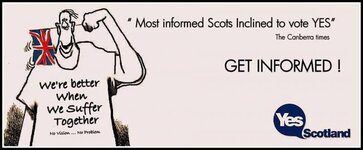
Both reason and romance would leave most informed Scots inclined to vote yes. The current political context alone is a compelling argument for change. Scottish voters strongly rejected the Conservative-Liberal government last year - only one Conservative MP holds a seat in Scotland - yet it is this government that will define the immediate future of the Scottish people. Most of the arguments against Scotland becoming an independent nation that appear in the mainstream press in Britain relate to economics. Even if one were to make an informed, rational decision based on economic interest and fiscal reality, however, Scotland should vote for independence next year.
Democracies are occasional servants of minorities. Scotland pays more in taxation than it receives in public spending. Scotland has, in recent years, contributed national surpluses to the overall deficits run by Britain.
It also has comparative advantages suited to the times. Scotland is energy rich in an era of energy insecurity. It has invested wisely in renewable energies to complement its impressive oil resources. Some believe that there are about 300 oilfields off Scotland's coast not yet explored or not properly tapped.
In recent years, Scottish exports have also often increased at a faster rate than those of their southern neighbours - further evidence the argument that Scotland cannot afford to be independent is baseless.
This rational approach to Scottish independence complements the romantic argument to vote yes. If some assume that sentimentality is behind the campaign for independence, it is only because there is good reason to be both angry about Scotland's past and optimistic about what could be achieved if it separated from its southern master.
The streak of romantic stoicism in the face of oppression runs particularly deep.
One recalls Burns' song Scots Wha Hae, written to commemorate the Battle of Bannockburn, where the Scots defied great odds to defeat the English army:
By oppression's woes and pains!
By your sons in servile chains!
We will drain our dearest veins,
But they shall be free!
Many Scots feel they are treated as an appendix of England or, worse, as second-class citizens. Governments of both political persuasions have been guilty. Examples are many, but those most often cited are sobering for those favourably inclined to the union. More recent examples include the unpopular poll tax, introduced in 1989 but inflicted on Scotland one year before the rest of Britain, making Scotland the testing ground for London's public policy.
A decade later, both the House of Commons and the House of Lords acted on the recommendation of a select committee in the Scottish Office to shift Scotland's maritime boundaries from Berwick-upon-Tweed to Carnoustie, a distance of about 100 kilometres. A golfer who wistfully looks out to the sea from the sixth tee at St Andrews is actually looking upon English waters.
Even though the romantic and emotional arguments align in favour of Scottish independence, it remains to be seen if people will take the leap of faith necessary to grasp the opportunity open to them. Why would any nation wish to remain a minority in a larger political entity when there is no sound economic, emotional or political reason to do so?
Are the majority of Scots now ''fearty-gowks'' (a colloquial Scottish term for ''fearful'') on the question of independence? Do they collectively lack the national confidence to believe that they can self-govern? If the Yes Scotland campaign fails, it would be an unfortunate indictment on the nation. Not all contexts are alike, and not all movements for self-determination reflect the civic nationalism desired in Scotland.
The broader regional arrangements in Europe, however, provide an opportunity denied of nations in Asia intent on asserting their cultural independence. Local and national identities may be inspired to reassert their cultural vitality and find an appropriate political expression for it. If Scotland finds the national strength of character to stand alone, other nations in Europe may follow.
If it votes for independence next year, Scotland will have resisted one of the more destructive consequences of this era of rapid integration and increasing interdependence: cultural assimilation. The impact may be more far-reaching than one can in this moment reasonably anticipate.
Andrew Hunter is chairman of the Australian Fabians. He collaborated with Derek Hunter on the writing of this article.


Read more: http://www.canberratimes.com.au/com...ndependence-20131130-2yiys.html#ixzz2ofIKjqwi

 

Attachments

  • image.jpg
    image.jpg
    37 KB · Views: 133
"Independence would offer the chance of a real shake up and a new start for democracy in Scotland but not if the people currently running things in Holyrood simply want to sit pretty and hang onto their salaries and expenses. We need to clear out some of the party hack numpties and start again."

This is where we fall down on an independent Scotland. The politicians we've presently got, with a couple of exceptions, are not fit to govern a country......
 
This is where we fall down on an independent Scotland. The politicians we've presently got, with a couple of exceptions, are not fit to govern a country......

That's one stumbling block. Another is the SNPs lack of any certainty about exactly what they intend to do if they win. You'd think that after fifty odd years the SNP would have it all planned out.
 
A quite frightening but astute observation Wully. If the Parliamo/Tram fiasco is a measure of the future government in Scotland......

Not To mention the farce of spending millions on the new Toll booths on the FRB only to have all tolls disbanded a short time later...:blast

As for another bridge, why they didn't go for a tunnel is beyond me (yes, I know they cite costs but come on, since when does that really matter) when you consider the bloody great detour for heavies/high sided vehicle, bikes etc etc every time it gets a wee bit blowy.... :blast
 
That's one stumbling block. Another is the SNPs lack of any certainty about exactly what they intend to do if they win. You'd think that after fifty odd years the SNP would have it all planned out.
thats the problem the snp have always bleated about an independent scotland as they knew it would never happen.now they are shitting themselves as they think it might & totally fuck the country.
 
This is where we fall down on an independent Scotland. The politicians we've presently got, with a couple of exceptions, are not fit to govern a country......

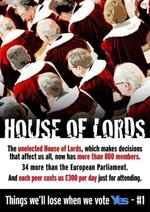
There are plenty of able people in Scotland. Some of them (just some) are elected politicians. It's not enough to list all the things we could get rid of: House of Lords, trident etc. To get my vote sewn up, the YES campaign is going to have to convince me that things will be done differently in an independent Scotland AND show me how it's going to be different.
 
There are plenty of able people in Scotland. Some of them (just some) are elected politicians. It's not enough to list all the things we could get rid of: House of Lords, trident etc. To get my vote sewn up, the YES campaign is going to have to convince me that things will be done differently in an independent Scotland AND show me how it's going to be different.

They can't tell you how it would be different because it won't be different. We will still have our laws made in the EU., Scotland will still be socialist but without the opportunity ever of a right wing government every few years to get us back on a stable economic path. The bank of England will still decide our interest rates and the Chinese economy will still decide our financial future. Oh! and if the unthinkable ever happened and somebody started lobbing nukes at the rest of the UK our nuclear free status would count for diddly squat because we are still geographically attached to England and no enemy is going to leave the airbases, deep water harbours and command and control infrastructure intact for the UK to continue the fight from.

I want to know what every pound in my savings will be worth, what rate of income tax, VAT and council tax I will pay and how much my house will be worth after the socialist republic of Scotland (with the Queen at its head) is declared. I don't know the answers to these questions after the next UK election but I can have a much better guess about that than I can about an independent Scotland based on the fantasy land document that the SNP hold up as a blueprint.

On that basis I will vote No.
 
And in deference to the title of this thread Scotland is and always will be a nation and a proud one at that. What I want is for it to remain a nation that chooses, note chooses, not is forced to, govern in partnership with the rest of the nations in the United Kingdom


Back
Top Bottom