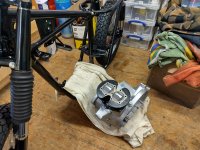
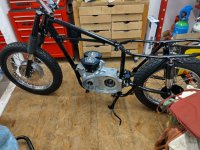
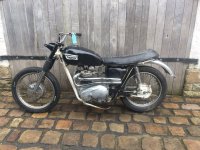
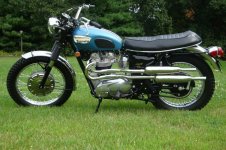
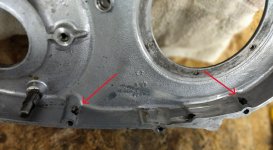
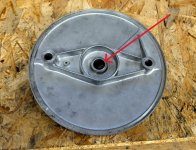
The next fuck-up was potentially much more serious, well in a time-wasted manner so not really a problem although it felt like it at the time. When I fitted the front brake plate retaining nut it locked the brake plate solidly against the drum instead of it rotating freely on the wheel bearing. The spigot on the inside of the brake plate, arrowed in red, should sit against the inner race of the wheel bearing to hold the brake plate away from the hub, so something was wrong but I wasn't sure just what.
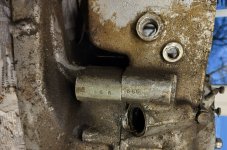
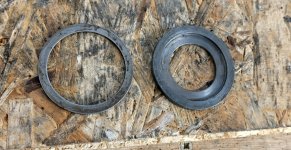
I took it all apart and realised that I'd used a rear wheel bearing backing ring instead of a front wheel one. The front ring is 2mm thicker than the rear and so gives the required clearance between brake plate and hub. The rear ring is on the left, the front and correct, ring is on the right. (The outside diameters are the same although they don't look it.) It's an easy mistake to make as with modern rubber shielded bearings several parts such as shims and grease retainers are no longer required so it can be confusing as to what goes where.
So I rebuilt the hub with the correct backing ring, the brake plate was now spinning freely, and put the wheel back in the forks. Unfortunately the wheel was now way over to the left hand side of the forks so much so that the tyre was almost rubbing on the fork slider. I couldn't understand why a diference of only 2mm thickness of the backing ring could make such a difference, there was now a 12mm difference in clearance between the left and right fork legs. I realised that the problem was that as well as the 2mm difference in the thickness of the backing rings the right hand bearing had not been fully seated in the hub, this gave a total of 6mm which caused the 12mm difference between the left and right fork legs. I should have taken a picture but I was too pissed-off at the time, I thought I would have to take the tyre off again to get the rim offset adjusted. I left it overnight and came back to it this morning, by carefully slackening all the left hand spokes and then tightening the right hand side I managed to get it true and central within the forks withought having to take the tyre off. It's amazing how far you can move the rim with just a few turns of the nipples.
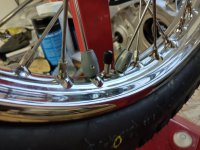
I'd already balanced the wheel but had to remove the weights to adjust the spokes so it needed doing again. I like to use the original lead weights as used by most British bike manufacturers but they were crimped on originally and are difficult get properly attached to the spokes. I drill and tap them M4 and use a small grub screw to hold them in place, I've done this for a few years now and never lost a weight so far.
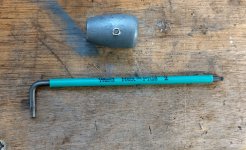
I'm also a big fan of these Wera Hex plus allen keys, they're really good, especially if you have a damaged hex socket, they still grip.
Balance weights in place.
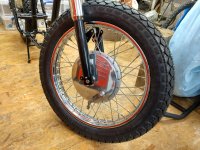
And the finished wheel back on the bike, so what could have been a twat of a day turned out OK in the end.
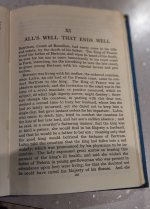
I'm reading this at the moment.................

This chapter seems quite appropriate today.
I took it all apart and realised that I'd used a rear wheel bearing backing ring instead of a front wheel one. The front ring is 2mm thicker than the rear and so gives the required clearance between brake plate and hub. The rear ring is on the left, the front and correct, ring is on the right. (The outside diameters are the same although they don't look it.) It's an easy mistake to make as with modern rubber shielded bearings several parts such as shims and grease retainers are no longer required so it can be confusing as to what goes where.
So I rebuilt the hub with the correct backing ring, the brake plate was now spinning freely, and put the wheel back in the forks. Unfortunately the wheel was now way over to the left hand side of the forks so much so that the tyre was almost rubbing on the fork slider.
I couldn't understand why a diference of only 2mm thickness of the backing ring could make such a difference, there was now a 12mm difference in clearance between the left and right fork legs. I realised that the problem was that as well as the 2mm difference in the thickness of the backing rings the right hand bearing had not been fully seated in the hub, this gave a total of 6mm which caused the 12mm difference between the left and right fork legs. I should have taken a picture but I was too pissed-off at the time, I thought I would have to take the tyre off again to get the rim offset adjusted. I left it overnight and came back to it this morning, by carefully slackening all the left hand spokes and then tightening the right hand side I managed to get it true and central within the forks withought having to take the tyre off. It's amazing how far you can move the rim with just a few turns of the nipples. I'd already balanced the wheel but had to remove the weights to adjust the spokes so it needed doing again. I like to use the original lead weights as used by most British bike manufacturers but they were crimped on originally and are difficult get properly attached to the spokes. I drill and tap them M4 and use a small grub screw to hold them in place, I've done this for a few years now and never lost a weight so far.
I'm also a big fan of these Wera Hex plus allen keys, they're really good, especially if you have a damaged hex socket, they still grip.
Balance weights in place.
And the finished wheel back on the bike, so what could have been a twat of a day turned out OK in the end.
I'm reading this at the moment.................
This chapter seems quite appropriate today.
Last edited:


 As I have now effectively shortened the timing side and lengthened the drive side all will be well, there is still plenty of thread length left. There is also a heavy duty rim tape protecting everything. Thanks for making the point though.