1965 Triumph Bonneville TT

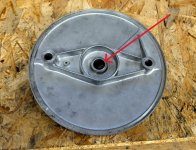
The next fuck-up was potentially much more serious, well in a time-wasted manner so not really a problem although it felt like it at the time. When I fitted the front brake plate retaining nut it locked the brake plate solidly against the drum instead of it rotating freely on the wheel bearing. The spigot on the inside of the brake plate, arrowed in red, should sit against the inner race of the wheel bearing to hold the brake plate away from the hub, so something was wrong but I wasn't sure just what.
165a.jpg

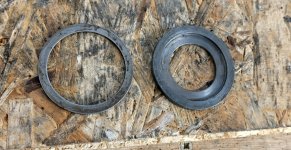
I took it all apart and realised that I'd used a rear wheel bearing backing ring instead of a front wheel one. The front ring is 2mm thicker than the rear and so gives the required clearance between brake plate and hub. The rear ring is on the left, the front and correct, ring is on the right. (The outside diameters are the same although they don't look it.) It's an easy mistake to make as with modern rubber shielded bearings several parts such as shims and grease retainers are no longer required so it can be confusing as to what goes where.
166.jpg

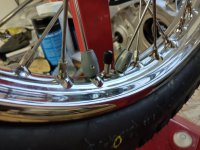
So I rebuilt the hub with the correct backing ring, the brake plate was now spinning freely, and put the wheel back in the forks. Unfortunately the wheel was now way over to the left hand side of the forks so much so that the tyre was almost rubbing on the fork slider. :mad: I couldn't understand why a diference of only 2mm thickness of the backing ring could make such a difference, there was now a 12mm difference in clearance between the left and right fork legs. I realised that the problem was that as well as the 2mm difference in the thickness of the backing rings the right hand bearing had not been fully seated in the hub, this gave a total of 6mm which caused the 12mm difference between the left and right fork legs. I should have taken a picture but I was too pissed-off at the time, I thought I would have to take the tyre off again to get the rim offset adjusted. I left it overnight and came back to it this morning, by carefully slackening all the left hand spokes and then tightening the right hand side I managed to get it true and central within the forks withought having to take the tyre off. It's amazing how far you can move the rim with just a few turns of the nipples. ;)

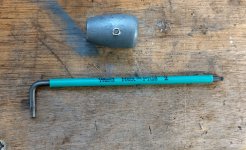
I'd already balanced the wheel but had to remove the weights to adjust the spokes so it needed doing again. I like to use the original lead weights as used by most British bike manufacturers but they were crimped on originally and are difficult get properly attached to the spokes. I drill and tap them M4 and use a small grub screw to hold them in place, I've done this for a few years now and never lost a weight so far.
167.jpg

I'm also a big fan of these Wera Hex plus allen keys, they're really good, especially if you have a damaged hex socket, they still grip. :thumb2

Balance weights in place.

168.jpg

And the finished wheel back on the bike, so what could have been a twat of a day turned out OK in the end.
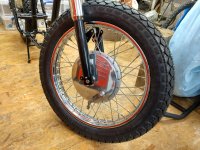
174.jpg

I'm reading this at the moment.................
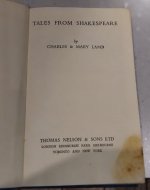
IMG_20250101_193527.jpg

This chapter seems quite appropriate today. :cool:
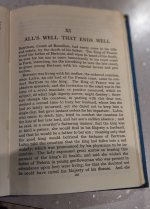
IMG_20250101_193548.jpg
 
Last edited:
You have probably considered this already given your meticulous engineering skills, but is there not a danger of a spoke now protruding into the inner tube and causing a puncture?

I’m really enjoying reading this thread. You have real in depth knowledge of these bikes👍
 
You have probably considered this already given your meticulous engineering skills, but is there not a danger of a spoke now protruding into the inner tube and causing a puncture?

I’m really enjoying reading this thread. You have real in depth knowledge of these bikes👍
Good point, but no. There were a couple things that should have rung alarm bells when I built the wheel initially. Firstly I had noted down the rim offset from a previous build and when I built this one there was a discrepancy of 6mm yet the wheel sat in the centre of the forks. Secondly, when the wheel was built up I had to grind off about 3mm from the drive side spokes as they were protruding through the nipple into the rim well and the timing side spokes were recessed far down into the nipple. I should have stopped then and re-checked everything. :blast As I have now effectively shortened the timing side and lengthened the drive side all will be well, there is still plenty of thread length left. There is also a heavy duty rim tape protecting everything. Thanks for making the point though. (y)
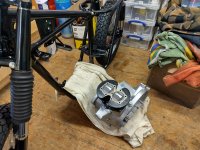
 
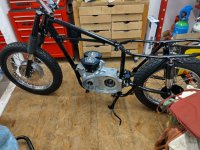
Only a little progress made this week, the engine is now loosely in the frame. Nothing can be tightened up until the rear mounting plates are attached and the footrests and brake lever need fitting to those first.

IMG_20250109_152344_HDR.jpg

IMG_20250109_160149_HDR.jpg
 
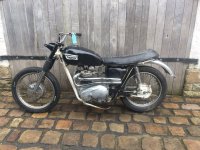
I needed to make some working space and I have a 1968 TR6C project that's been sat since 2017 so decided to get it stripped down. This is how I bought it, I paid £3500 for it which seemed a bit pricy at the time but I really wanted that particular model.

1.jpg

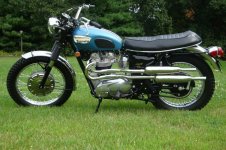
The tank is a T140 and it had the wrong fork yokes and rear mudguard, which I knew. Unfortunately it had the 7" front brake instead of the 8" which it should have had. The seat was scrap, the base was rusted out beyond repair and the headlight ears were wrong. Basically it had been cobbled together with new handlebars and exhaust pipes to make it look less of a basket case. But it was a genuine matching numbers '68 which I really wanted and they're not easy to find. This is what it will look like when finished. :cool:

triumphtrophy-1968-1-1024x682.jpg

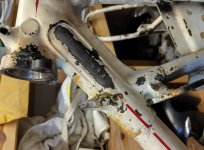
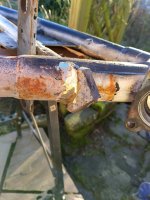
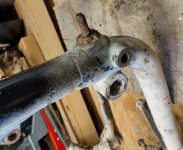
When I started to pull it apart I found a couple of things I'd forgotten about. There had been a very substantial bracket brazed onto the front down tube just below the frame number which had been roughly chopped off with an angle grinder. 1/4" thick steel plate, god only knows what that was for. :confused:

IMG_20250102_143627_HDR.jpg

IMG_20250102_144945_HDR.jpg

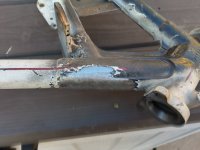
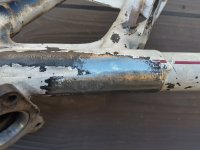
I cut as much away as I could with the angle grinder then filed and sanded it back to remove all traces of it. Thankfully whoever put it on had just avoided the frame number.

IMG_20250102_153338_HDR.jpg

IMG_20250102_153353_HDR.jpg

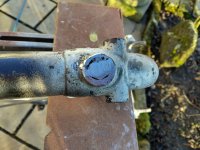
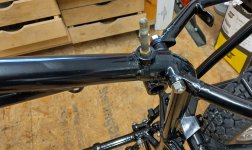
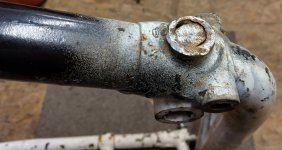
The second thing was someone had welded a stud to the frame to act as the rear petrol tank mount. The threads can strip on these but the repair seemed a bit OTT. There was a time when these bikes were worth very little money, especially in the US where they were often just given away as scrap and little consideration was given to preserving them.

IMG_20250102_143635_HDR.jpg

I thought this was going to be a right Starmer to fix, I cut off the 'stud' with a slitting disc and then thought I could see a vague hexagon shape?

IMG_20250102_145005_HDR.jpg

I then realised that hopefully it wasn't a stud but possibly an upturned bolt which should leave the original mounting hole relatively undamaged.

IMG_20250104_144445_HDR.jpg

I centre punched the remains to start to drill it out to re-tap it and the bloody thing moved!

IMG_20250104_145211_HDR.jpg

A bit of poking around and out it came.

IMG_20250104_145408_HDR.jpg

It cleaned up nicely and the threads weren't completely stripped but I'll fit a Helicoil anyway. Sometimes you just get lucky. :)

IMG_20250104_153015_HDR.jpg

That's all for now, back on the T120C next week. Thanks for the kind words and comments, it helps with the motivation when it's bloody freezing in the garage!
 
Last edited:
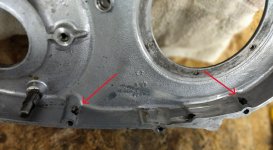
Rant Time. :mad: I decided to strip down the '68 TR6C engine today whilst I'm waiting for parts for the T120C. The thing had silicone sealant on everything, it's bloody horrible stuff. If the mating surfaces are damaged and a dry gasket won't suffice then use a proper sealant such as Hylomar or Wellseal. The problem with silicone is that it will fill any blind holes and then when the screws are put back in they act as a hydraulic ram and blow out the side of the threaded holes. This is the drive side crankcase and when the primary cover has been put back on sometime in the past, five out of the eight tapped holes have blown out. These are two of them, there are three more.

IMG_20250112_163452.jpg

The crankcases are going for vapour blasting tomorrow, when I get them back I'll repair the damage. I'll clean out all the old sealant and fill in the broken out sides with JB Weld. I'll then try re-tapping them to the original 1/4 BSF, if that doesn't work I'll Helicoil them.

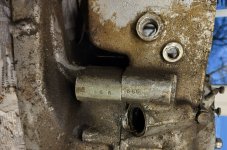
This engine has fought me all along whilst taking it apart, mainly due to previous owners bodgery and Gorilla mechanics. Then when I turned it over to check underneath I saw the crankcase numbers.........:eek::eek::eek:

IMG_20250111_161726_HDR.jpg

Luckily I have some of these in the fridge, I'll fight fire with fire. :thumb

IMG_20250112_165111_HDR.jpg
 
Rant Time. :mad: I decided to strip down the '68 TR6C engine today whilst I'm waiting for parts for the T120C. The thing had silicone sealant on everything, it's bloody horrible stuff. If the mating surfaces are damaged and a dry gasket won't suffice then use a proper sealant such as Hylomar or Wellseal. The problem with silicone is that it will fill any blind holes and then when the screws are put back in they act as a hydraulic ram and blow out the side of the threaded holes. This is the drive side crankcase and when the primary cover has been put back on sometime in the past, five out of the eight tapped holes have blown out. These are two of them, there are three more.

View attachment 377006

The crankcases are going for vapour blasting tomorrow, when I get them back I'll repair the damage. I'll clean out all the old sealant and fill in the broken out sides with JB Weld. I'll then try re-tapping them to the original 1/4 BSF, if that doesn't work I'll Helicoil them.

This engine has fought me all along whilst taking it apart, mainly due to previous owners bodgery and Gorilla mechanics. Then when I turned it over to check underneath I saw the crankcase numbers.........:eek::eek::eek:

View attachment 377009

Luckily I have some of these in the fridge, I'll fight fire with fire. :thumb

View attachment 377010
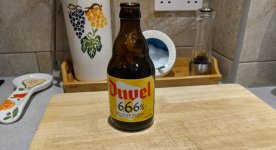
😜


Woe to you, oh earth and sea
For the Devil sends the beast with wrath
Because he knows the time is short
Let him who hath understanding reckon the number of the beast
For it is a human number
Its number is six hundred and sixty-six


Keep it coming Number 6. 👏
 
As you've probably guessed by now I've got three 650 twins that I've had for some time that all need restoration. There's this 1965 T120C, and 1967 and 1968 TR6Cs. I'm not going to start separate threads as they would basically be just duplicates of this one, so the question is should I incorporate them all into this thread or just keep this thread dedicated to the '65 T120C only? I don't mind either way but I don't want to confuse things and detract from the original thread. My intention was to build this bike first then do the two TR6Cs together but as things have turned out it's probably easier for me to do all three bikes simultaneously but I don't need to document them all unless you want to see them. If you've got any preference let me know on here. (y)
 
As you've probably guessed by now I've got three 650 twins that I've had for some time that all need restoration. There's this 1965 T120C, and 1967 and 1968 TR6Cs. I'm not going to start separate threads as they would basically be just duplicates of this one, so the question is should I incorporate them all into this thread or just keep this thread dedicated to the '65 T120C only? I don't mind either way but I don't want to confuse things and detract from the original thread. My intention was to build this bike first then do the two TR6Cs together but as things have turned out it's probably easier for me to do all three bikes simultaneously but I don't need to document them all unless you want to see them. If you've got any preference let me know on here. (y)
Nah, keep this just for the '65 T120 if you don't mind. (only my own selfish thoughts that's all 😉)

👍
 
Whatever works best for you will be fine for the rest of us. I just enjoy reading about and looking at the the updates and seeing these historic machines being restored so well.
I didn't know the wrong gasket material could cause the casting to blow!
 
It's your call Number 6, but your article is ongoing and so readable. For me please keep it ongoing from bike to bike, as you work through them. If you have the time and inclination, please. You will have other problems on the remaining bikes .... applicable to other peoples rebuilds, maybe every one of them.

I can see a time where your input will become a timeless reference for those that follow .... don't let them down please :thumby:

Thank you

:beerjug:
 
It's your call Number 6, but your article is ongoing and so readable. For me please keep it ongoing from bike to bike, as you work through them. If you have the time and inclination, please. You will have other problems on the remaining bikes .... applicable to other peoples rebuilds, maybe every one of them.

I can see a time where your input will become a timeless reference for those that follow .... don't let them down please :thumby:

Thank you

:beerjug:
Well put Micky - completely agree!
 
It's your call Number 6, but your article is ongoing and so readable. For me please keep it ongoing from bike to bike, as you work through them. If you have the time and inclination, please. You will have other problems on the remaining bikes .... applicable to other peoples rebuilds, maybe every one of them.

I can see a time where your input will become a timeless reference for those that follow .... don't let them down please :thumby:

Thank you

:beerjug:
Thanks for that Micky. :thumb2

These three bikes are all based on the same frames and engines with just detail changes between the years. It would be of no use to duplicate (triplicate?) the exact same procedures. Where there are significant differences or problems I'll detail them but otherwise keep the thread centred around the '65 T120C. There's some technical stuff I've left out thinking it might be too anoraky but it's obvious there's some interest in it, so I'll add bits of it as and when.

I'll do a post about oil leaks, something which is all too common on old British bikes.
 
Thanks for that Micky. :thumb2

These three bikes are all based on the same frames and engines with just detail changes between the years. It would be of no use to duplicate (triplicate?) the exact same procedures. Where there are significant differences or problems I'll detail them but otherwise keep the thread centred around the '65 T120C. There's some technical stuff I've left out thinking it might be too anoraky but it's obvious there's some interest in it, so I'll add bits of it as and when.

I'll do a post about oil leaks, something which is all too common on old British bikes.
Agree No 6, not much point duplicating or even triplicating posts,, but otherwise just keep it flowing in your very own inimitable way, bringing in new stuff as required, Very watchable, very readable, with excellent photographs indeed :thumby:

Don't be too "anoraky" with us lot of ardent followers :D :thumby:

Now carry on regardless please :thumby:

:beerjug:
 
I didn't know the wrong gasket material could cause the casting to blow!
To be honest any excess gasket sealant in the threads can cause the side of the hole to blow out but silicone seems to be the worst. Whenever I find silicone sealant in an engine I just know that there's trouble ahead, especially if it's orange. It's the bodgers go-to sealer. :mad:


Back
Top Bottom