1965 Triumph Bonneville TT

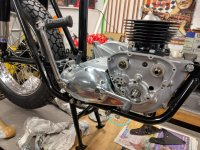
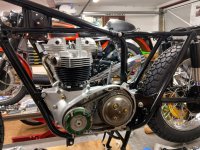
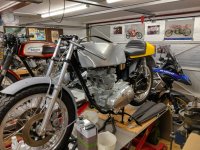
I hate working on the floor and so I wanted to get the bike on a lift before going any further. I had to juggle a few things around but finally managed it this week. This T150 Trident has been in this state for about 7 years now, for some reason I just can't get motivated enough to finish it, I suppose I should try and sell it.
IMG_20250112_210246_HDR.jpg

T120C off the floor, much easier to work on now. (y)
IMG_20250116_114726_HDR.jpg

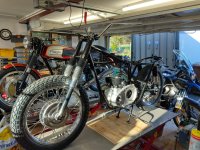
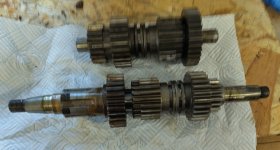
The gearbox components are in really good condition so I thought I'd start with that. I'm guessing that because it's a competition bike it hasn't done many miles and has hopefully been maintained as a race bike should be.
45.jpg

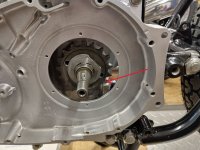
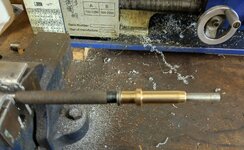
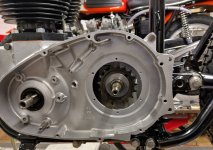
The mainshaft high gear goes in first and then the sprocket, tab washer and reataining nut are fitted to hold it in place. I haven't tightened the nut up yet, the manual says to fit the drive chain, put it into top gear, apply the rear brake and tighten the nut. I don't like that method, it puts a lot of strain on the chain. I prefer to sprag the sprocket against the lower frame rail, I'll make up a suitable length of bar and take some pictures. The nut, which is hard to make out, is just hand tight yet.
IMG_20250118_173938_HDR.jpg

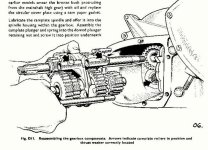
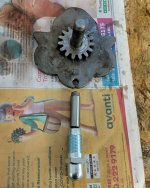
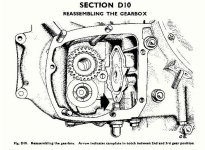
Then the camplate and detent plunger are fitted with the camplate set to between 2nd and 3rd gears. The main thing that gives gearbox trouble on old Triumphs is a worn plunger, Triumph changed the design a few times and there are aftermarket ones that use a rolling ball. I always fit a new plunger. housing and spring, they're not expensive.
IMG_20250118_153452_HDR.jpg

Screenshot camplate.jpg


The factory workshop manual says that the entire gear cluster can then be inserted as an assembly, So that's 12 separate parts loosely assembled in your left hand whilst trying to fit two selector forks into the camplate and then the spindle throught the selector forks into the back wall of the crankcase with your right hand whilst trying not to dislodge the layshaft thrust bearing that's merely held in place by a dab of grease and is completely hidden from view. :eek Unfortunately they don't mention which profanities work best. They should have a list, with part numbers. :anger

gearbox screenshot.jpg

When it's finally all in place the temptation is to try and see the that the thrust washer is still correctly seated by pulling everything back out slightly. DO NOT DO THIS! Because the bloody thing will stick to the adjacent gear and pull off it's mounting peg and then you can go through the whole process again.

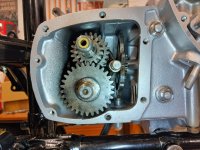
Gear cluster finally in place.
IMG_20250118_153605_HDR.jpg

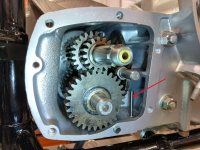
The upright tube is the oil level tube. It's a two-part item, unscrewing the whole thing drains the gearbox oil, unscrewing the inner part allows oil to drain down the tube when filling so as to achieve the correct level. On most British bikes the correct level is up to the layshaft centre-line.
IMG_20250118_153610_HDR.jpg

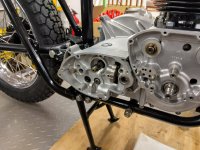
I stripped down the inner gearbox cover and cleaned it up with 0000 wire wool. I placed it loosely into position to check that the layshaft was fully seated and that the thrust washer hadn't come adrift whilst fitting the gear cluster. All good so far. :)
IMG_20250118_153500_HDR.jpg

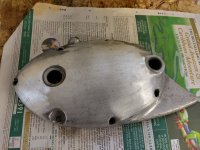
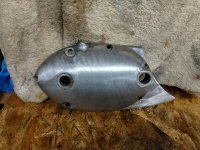
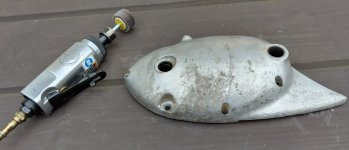
Next up the outer gearbox cover. This was a bit battered and scratched, I wanted to tidy it up a bit without making it look super shiny and new, it's hard where to draw the line but it's getting there.
IMG_20250117_143357_HDR.jpg

60 grit flap wheel.

IMG_20250118_105739_HDR.jpg

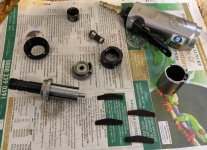
And then the die-grinder packed up. I'm not sure why, it's not had a lot of use and it was an expensive item. I took it apart but couldn't see anything obvious so I put it back together and it spins but it's not right. I have an old Sealey one which I'll use to finish this cover with.
IMG_20250118_105706_HDR.jpg

120 grit.

IMG_20250118_161010_HDR.jpg
 
Last edited:
I was wondering how you were going to fit that gear cluster, it had 'bloody awkward' written all over it. I assumed (hoped !!) that there was a magic way of doing it that I hadn't thought of? - Nope, bloody awkward it is !!

Great stuff Sir... :thumb2
 
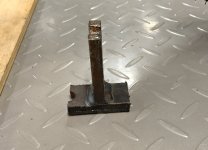
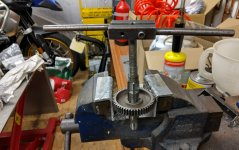
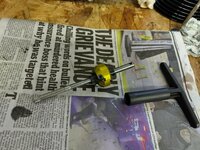
Rather than use the chain and back brake to tighten/loosen the gearbox sprocket nut I made this simple tool. Just two pieces of scrap steel welded into an inverted T. The bottom side has a few lengths of gaffer tape stuck on to protect the paintwork and sits on the lower frame rail and the upright mates with the sprocket teeth to prevent it from turning. The hole was already there, I just cut it through the centre-line to give better engagement with the sprocket. It works on Triumph Twins and Triples and also various other bikes.

IMG_20250119_140658_HDR.jpg

In place....

IMG_20250119_140637_HDR.jpg

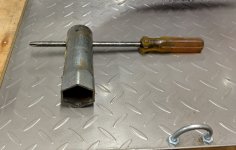
The sprocket nut size is 1" Whitworth (about 45mm AF). Fitting the nuts is no problem with a Tommy bar but getting them undone can be a struggle. This is just a screwdriver but it's strong enough for for fitting.

IMG_20250119_140804_HDR.jpg

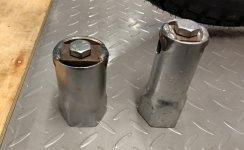
I've a couple of other box spanners which fit other bikes that I've adapted by welding a bar across the end with a bolt welded into it so a socket can be used instead of a Tommy bar. It also means I can use an Impact Wrench to undo any stubborn nuts. I had a Manx Norton with a gearbox sprocket nut that had gone incredibly tight for some reason. I tried to undo it with a 24" breaker bar but it just wasn't for moving. It was that tight that I thought it was going to shear off the mainshaft and it was a very expensive TTI 6 speed Magnesium gearbox! I bought a Milwaukee 620Nm Impact Wrench just to undo that one nut, very costly but it did the job without causing any damage. On the left 2" AF for the Norton and on the right 1 7/8 AF for 5 speed Triumphs.

IMG_20250119_140908_HDR.jpg
 
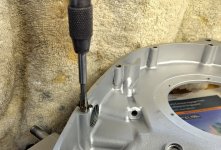
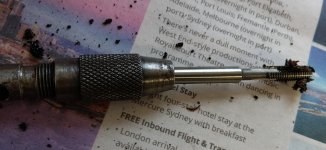
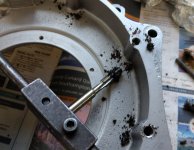
Just an update about the TR6C with the damaged holes in the drive side crankcase, I cleaned them out with a tap and couldn't believe how much crap came out.

IMG_20250125_104410_HDR.jpg

The tap flutes were plugged solid, I had to run the tap twice down each hole to clear them out.

IMG_20250125_104435.jpg

Years of neglect and various types of sealant packed on top of each other all meant that the depth of the holes was gradually reduced. That coupled with using allen screws rather than the original Pozidriv screws tightened with a screwdriver, means that something has to give and that's what causes the hole sides to blow out.

IMG_20250125_105209.jpg
 
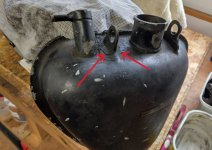
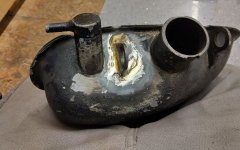
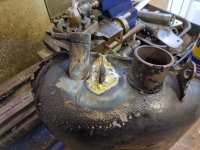
Back to the T120C TT. The oil tank was in very good condition apart from a suspicious bulging and cracking around the rear mounting. These tanks are well known for cracking and most bikes will have had some repair to this area. They are made from two pressings of thin sheet steel welded (or brazed?) together. The mountings are then gas-welded on, the steel is far too thin for Mig welding and all of this causes brittleness in the material and it eventually cracks despite being rubber mounted. Triumph changed the tank design in 1966 which increased the capacity and also used a slightly different mounting system but they still crack.

IMG_20250127_150344_HDRa.jpg


I burnt off the paint and found 'Bondo' or body filler as we call it. I cleaned that off and found the previous repair, which had cracked again.

IMG_20250127_152947_HDR.jpg

I cleaned up the area with an emery drum in the Dremel.

IMG_20250127_153415_HDR.jpg

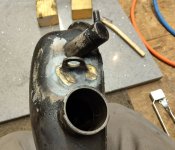
Then re-brazed it around the whole mounting.

IMG_20250128_120911_HDR.jpg

I'm going to modify the mounting system to incorporate thicker rubber to try and prevent any further cracking. The problem is that some people overtighten things and the tank ends up being rigidly mounted with no flexibility to absorb any vibration.
 
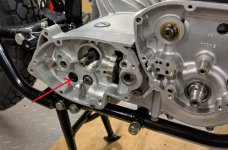
Today I finished the gearbox build. There are inner and outer gearbox covers and the parts book shows two gaskets, one between the crankcase and inner cover and one between the inner and outer covers. I never fit the inner gasket, I use Three Bond sealer instead, this allows a closer fit between the inner cover and the crankcase which reduces the end float on the layshaft. If you stick your finger through the arrowed hole it's possible to check that there is still some end float by moving the layshaft 1st gear, if there isn't then you would need to fit the gasket but I've never had to yet. This also applies to the Trident and Rocket 3. Less end float lets the gears mesh closer together which can only be a good thing.

IMG_20250118_153500_HDRa.jpg

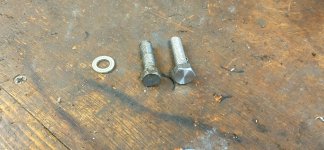
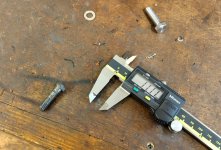
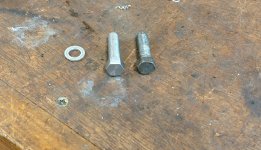
One of the original cover bolts was a bit scabby and although it's hidden from view when assembled I wouldn't be happy knowing it was there. It's 5/16 BSF x 1 1/8" with a reduced head size, it also sits in a counterbored hole with a reduced diameter washer which just fills the counterbore. I can't see any possible reason for this, the bolt is out of the way, doesn't interfere with anything and is hidden from view. It may have served a purpose at some time and then they just carried on doing it that way becuase they'd always done it that way, who knows. :nenau

I had a standard sized 5/16 BSF bolt in stainless steel.

IMG_20250131_105631_HDR.jpg

The original measured 11.11mm AF, 5 minutes with a file and I had the new one resized.

IMG_20250131_105943_HDR.jpg

IMG_20250131_111600_HDR.jpg

Outer cover now fitted (with gasket) then check that all gears select cleanly and the kickstart works properly. :thumb

IMG_20250131_150649_HDR.jpg
 
(I JUST REALISED THAT DOUBLE CLICKING ON THE PICTURES WILL ZOOM THEM IN.)

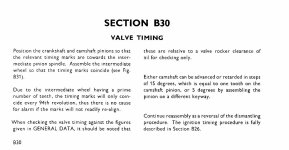
Whilst on this side of the bike I decided to refit the timing gears and do the valve timing. Bearing in mind this engine was designed around 1935 I'm surprised that Triumph never promoted the fact that it's a Twin Cam engine. All the car manufacturers certainly proclaimed the 'sportiness' of Twin Cam motors but Triumph never did which is rather strange when they always marketed their machines as Sporting Motorcycles. :nenau The benefit of two separate camshafts are that they can be timed independently of each other to suit whatever performance characteristics are desired. Triumph made this even easier by giving each cam wheel three equally spaced keyways so that the gear could be indexed to alter the cam timing as necessary. One tooth on the cam wheel equates to 15 degrees, which can be reduced to 5 degrees by using the alternate keyways, this is the reason Triumph engines were so often used in Norton frames to make Tritons, they are highly tunable without having to spend shed loads of money.

valve timing.jpg

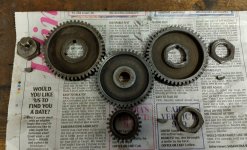
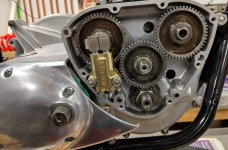
However if you wish to use the standard valve timing Triumph make this very simple by marking up the gears so that they go together very easily. Here is the gear train laid out. The bottom gear is the crankshaft pinion which is keyed to the crankshaft so will only go in one position.

The middle gear is the idler, or intermediate gear which the drive to the cam wheels, which are top left - inlet, top right - exhaust. The nuts are stamped 'LH' to signify left-hand thread, almost impossible to see when covered in black oil. Double click on the pictures to zoom in.

(Edit.......FFS! It's not my newspaper, it was used as packing in a box of bits from TriCor :rolleyes: )

IMG_20250131_153747_HDR.jpg

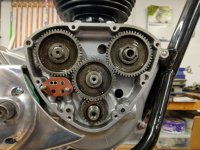
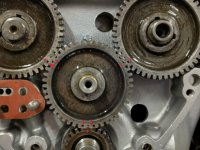
Firstly the camshafts are rotated until their respective keyways are facing the Intermediate gear spindle. The gears are then fitted to the camshafts and the keways used are the ones aligning with the dots. The timing marks don't show up too well on camera, they're dots and dashes. These are set to the standard factory positions.

IMG_20250131_163118_HDR.jpg

IMG_20250131_163118_HDRa.jpg

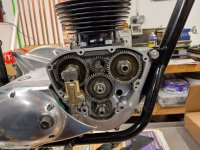
To lock the engine in position whilst tightening/untightening the nuts I use a spare crankshaft pinion to lock the gears together, this will work for parts on both sides of the engine and I prefer it to other methods such as locking the crankshaft by placing a bar through the conrod little ends.

IMG_20250131_202112_HDR.jpg


The camwheels are a very tight press fit onto the camshaft ends despite being keyed and having left-hand threaded nuts. I always ream them out ever so slightly to make removing them easier, especially if I'm altering the valve timing from standard and need to fit and remove them several times in succession whilst making adjustments.

IMG_20250131_161049_HDR.jpg

The final part inside the timing chest is a new Morgo oil pump. These are very high quality items that have been made for many years now. :thumb2

The lubrication system on these bikes is very basic. The pump has two cylinders containing plungers, one is to feed oil to the crankshaft and the other is to scavenge oil from the bottom of the crankcase and return it back to the oil tank. It's driven by an eccentric peg on the inlet camshaft nut and so delivers one squirt of oil for every second revolution of the engine but that's not a lot of oil even at 60 psi. 😲

IMG_20250131_164022_HDR.jpg
 
Last edited:
It's someone's Birthday. 60 years old today. :beerjug:

View attachment 384197
Richard Wheadon ... I used to meet him and his brother over at the local Triumph Club meeting at Binfield Nr Bracknell back in the late 70's

I still see him at the occasional autojumble

He lives not far away from me over in Andover
 
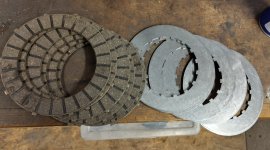
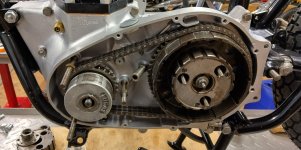
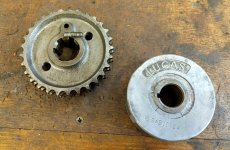
Time to get the primary drive and clutch back together. The engine sprocket and clutch drum were in excellent condition with no wear to the teeth or to the channels where the clutch plate tabs locate. The primary chain was shagged though as were the clutch plates, too many years sat doing nothing had taken their toll. The shock absorber rubbers in the clutch hub were in great shape but I fitted new rollers and thrust washer that run between the clutch hub and drum and a new set of plates along with a new Renold chain.

IMG_20250208_132814_HDR.jpg

The whole assembly has to be fitted as one unit which is a bit of a faff trying to line up the splines on the engine sprocket and crankshaft whilst at the same time mating the clutch hub to the Woodruff key on the gearbox mainshaft without dislodging it. It took three attempts but finally all was good.

IMG_20250208_132755_HDR.jpg

The original ignition system was the Energy Transfer (ET) system whereby the alternator supplied power directly to the ignition coils without any battery. It's not a very good system and parts are pretty much unobtainable so an upgrade was required. The ET system used a normal rotor but instead of being keyed to the crankshaft it was pegged to the engine sprocket with a choice of three different holes in the rotor marked R, M and S. Altering the position of the rotor doesn't alter the ignition timing it just alters the point at which peak electical power is supplied to the coils. There are two sets of points driven off the exhaust camshaft which can be adjusted as with the ignition systems fitted to road-going bikes. There are no timing marks on the rotor though so the ignition timing has to be done with a degree wheel. When I do this I'll mark the rotor with TDC and 38 deg BTDC so the timing can be set with a stroboscope.

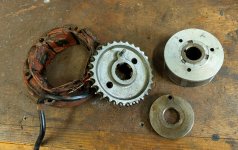
This is the original ET Stator, rotor, sprocket and distance piece. I'll fit a new RM21 stator along with a Boyer Power Box and Ignition system but still without a battery, the Power Box will run the ignition just fine. I've retained the original rotor but removed the peg drive and keyed it to the crankshaft instead.

IMG_20250207_140958_HDR.jpg

Drive peg removed. (just a press fit)

IMG_20250207_141155_HDR.jpg
 
Richard Wheadon ... I used to meet him and his brother over at the local Triumph Club meeting at Binfield Nr Bracknell back in the late 70's

I still see him at the occasional autojumble

He lives not far away from me over in Andover
I've never met him but spoken a few times on the phone. He's very helpful, I've had quite a few dating certificates from him over the years. :thumb2
 
Alternator stator in place and the Primary drive is almost done. The chain tensioner needs to be fitted and I need to make up a clutch cable to get the clutch properly adjusted. The cylinder head and rocker boxes are bare, I have a set of new valve guides, valves, springs, seats and collars to go in, hopefully next week)


IMG_20250209_215056_HDR.jpg
 
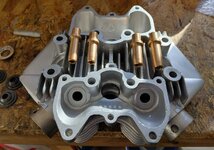
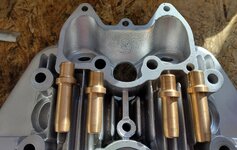
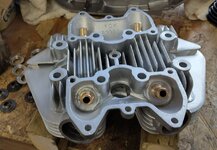
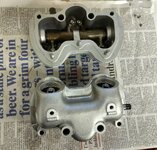
Now to the cylinder head and rocker boxes. I'd stripped them down and had them vapour blasted at the same time as the crankcases so it's time to get them built up and installed. The valve guides were worn so new ones were fitted. Two of the four 1/4 BSF rocker box mounting holes were stripped so I fitted fitted Helicoils to them.

IMG_20250214_143758_HDR.jpg

1960s Triumph 650 heads had manufacture dates cast into them. This is the correct '65' head.

IMG_20250214_143801_HDR.jpg

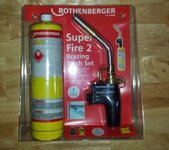
The guides are a medium press fit, helped by heating the head with a MAP/Propane torch, I use one of these. (stock picture)

torch.jpeg

I have a punch which fits inside the valve guide perfectly but I add a couple of washers to spread the load across the full face of the guides then drift them in with a copper mallet.

IMG_20250214_150505_HDR.jpg

IMG_20250214_151016_HDR.jpg

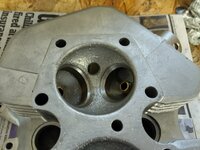
Whenever new valve guides are fitted the valve seats must be re-cut to ensure concentricity with the new guides. I have a 'Neway' seat cutter which is turned by hand but does the job perfectly, an expanding mandrel keeps the cutter centred to the guide and only a very light cut was needed to clean up the seats.

IMG_20250214_163430_HDR.jpg

IMG_20250214_163535_HDR.jpg

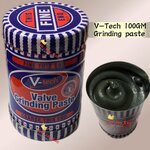
The valves are then lapped in with grinding paste to create a gas-tight seal.

paste.jpg

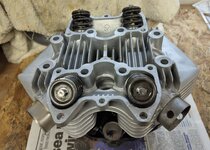
All valves fitted to the head, I'm glad it's not a 24 valve Honda CBX :DD (the valve stem tips look heavily indented but they're not as bad as they appear to be, just lightly marked as is normal)

IMG_20250215_144846_HDR.jpg

The rocker boxes were then reassembled, the only new parts these ever need are the 'O' rings on the spindle ends.

IMG_20250215_164003_HDR.jpg

I refitted the cylinder head to the engine but didn't torque it down, I do this when the rocker boxes are on as four of the cylinder head bolts also go through the rocker boxes. However when I came to fit the rocker boxes I couldn't get the correct valve clearances. The 0.080" cylinder base gasket had raised the cylinder barrels and head to the point that the pushrods were now too short. Bollocks. :mad:
I've ordered some 6082T6 aluminium bar to make some new pushrods, it should be here in the next few days. I've plenty of other things to do whilst waiting so not a problem.
 
Last edited:
Today was Cable Making Day. I really enjoy making cables, I don't know why but I find it very therapeutic. After having a couple of cables fail due to the nipples pulling off when racing in the Classic TT (fortunately clutch not brake cables) I bought myself a Venhill cable kit together with their 'bird caging tool' and a solder pot. I've had this for 10 years now and what a fantastic investment it has proved to be, yes it's expensive but the satisfaction it brings plus the peace of mind knowing that the cables are as good as it's possible to get is worth every penny. :thumb2

First job the front brake cable. I start off by selecting the appropriate ferrules and adjusters if required then cut the outer conduit to length, I use Venhill LB3TS for brake and clutch cables.

IMG_20250217_161023_HDR.jpg

IMG_20250218_103050_HDR.jpg

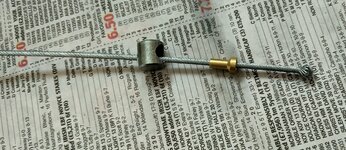
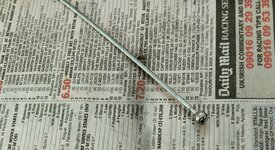
Then I make up the inner cable with 2mm galvanised wire strand.

IMG_20250217_161028_HDR.jpg

The bird caging tool makes a fantastic job of creating a ball of cable that when filled with solder is virtually failure proof. This is the tool, it does 1.5mm, 2mm and 2.5mm cable.

IMG_20250217_163401_HDR.jpg

All it takes is a tap with a hammer with the appropriate size punch to create the form. The finished 'bird cage'.

IMG_20250218_105122_HDR.jpg

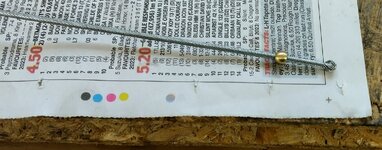
Then dipped into the solder pot to fill the cage with solder and attach the trumpet nipple. Any excess is then ground off to get a good fit into the barrel nipple.

IMG_20250218_111158_HDR.jpg

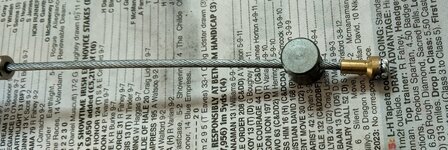
Next up the clevis end using a ball nipple.

IMG_20250217_163418_HDR.jpg

.......and then filled with solder, job done. :thumb

IMG_20250218_133958_HDR.jpg

IMG_20250218_103050_HDRa.jpg

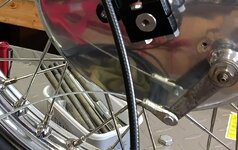
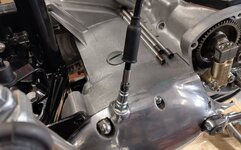
Next up the clutch cable, the exact same procedure but with different fittings. This is the gearbox end of the clutch cable. Inner wire, outer conduit, ball nipple, cable housing, solid ferrule, split ferrule and rubber boot, not the simplest of connections.

IMG_20250218_141959_HDR.jpg
Venhill's own video shows the process better than my description.

 
Last edited:
Triumph didn't use Stroboscopic ignition timing until 1968. They marked up the alternator rotor at 38 deg Before Top Dead Centre which is the maximum ignition advance at 2000 rpm with points. (Most aftermarket electronic ignitions for Triumph twins are timed to give full advance at 4000 rpm.) They also changed the primary drive cover to incorporate a removable plate that exposed a pointer that should line up with the mark on the alternator rotor at full advance. I wanted to be able to set the timing by strobe so I had to mark up the rotor at the appropriate position.

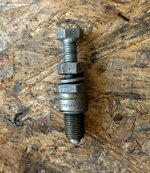
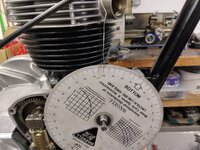
I started by finding true TDC. I have a tool made from an old spark plug with the centre removed which is then tapped to take an M10 bolt with the tip rounded so as not to mark the piston.

IMG_20250219_115213_HDR.jpg

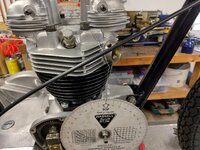
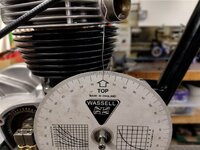
This is screwed into the sparkplug hole with the engine positioned just before TDC. The engine is then rotated slowly forwards until the piston stops against the bolt tip. With timing disc fastened to the exhaust camshaft and a suitable pointer, the disc is set to zero.

IMG_20250219_120338_HDR.jpg
The engine is then rotated in the opposite direction until the piston meets the bolt tip again. The disc has rotated 140 degrees so true TDC is at the halfway point, 70 degrees.

IMG_20250219_120000_HDR.jpg

The engine is rotated forwards again to the 70 degree mark (TDC) and the timing disc reset to zero.

IMG_20250219_115908_HDR.jpg

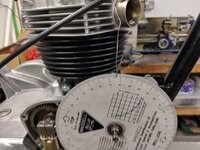
I now need to position the crankshaft at 38 degrees BTDC to make a timing mark on the alternator rotor but because the disc is on the camshaft it needs to be double that figure. (76 degrees)

With the piston stop removed I turn the engine backwards past the 76 degree mark then forwards again to eliminate any backlash in the timing gears. It's now positioned at exactly 38 deg BTDC.

IMG_20250219_120445_HDR.jpg
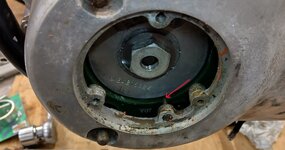
I fit a spare primary drive cover that has the pointer fitted and mark the rotor adjacent to the pointer.

IMG_20250219_121147_HDR.jpg

IMG_20250219_121248_HDR.jpg

I then scribe a line from the dot to the rotor centreline so the ignition timing can now be set with a stroboscope. Once it's set I can refit the correct primary cover that doesn't have the inspection plate and so keep the bike looking original. :thumb2

IMG_20250219_121911_HDR.jpg


Back
Top Bottom