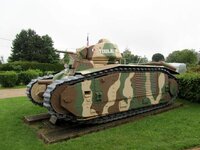
That tank looks more WW1 vintage. I suppose when you look back at the German designs, it seems they were very much ahead of the game compared to many others.
Not really, it was more to do with intended use than actual design. The French and British still thought in terms of WWI and their armour was designed as "infantry tanks" meaning that they were thought of as support for infantry when attacking fortified defensive positions.
The German armour was designed with rapid envelopment and concentrated armoured penetration (Blitzkrieg) in mind (a concept that was British and pushed by the two main proponents between the wars but rejected by the military).
Neither side initially considered the concept of tank on tank engagements. The German (and Czechoslovakian Pzk 38T captured) tanks were much more mobile but they suffered from poor armour protection and limited fire power.
The French and British tanks were far too slow (being designed to operate with advancing infantry) but had better armour. Often their main armament was superior to German tanks but suffered because the main gun as in the case of the Char B was in the hull requiring the driver to aim the tank at targets or because the turret was only a one or two man affair. This meant that the crew were overloaded with tasks.
Had the French and British attacked Germany instead of engaging in "Sitzkrieg" between September 1939 and May 1940, the design of their tanks would probably have worked well enough as German armoured mobility tactics would have not been so effective in defence.
Another factor that benefited the Germans was that the French and British deployed their tanks in small numbers spread across their front. Despite being unable to knock British and French tanks out in gunnery duals they were able to overwhelm them by sheer numbers. It was at this time that the Germans turned to their excellent, very high velocity, 88mm AA gun and used it as an anti-tank weapon because their 37mm anti-tank rounds just bounced off.
Interestingly, a certain Colonel in the French tank units named De Gaulle argued that their armour should be massed and not wasted in penny-packets but no-one listened.