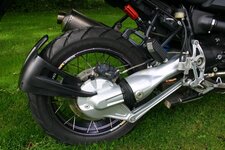
Got Shaft Rot.... again WTF

So I went into the garage today to check this rubber boot, and it was sucked hard onto the shaft. :blast

I got a flat head screwdriver and pulled back the rubber flap and pressed on the boot, where the notch is on the swingarm and.......

Swwwoooooooooooooooooshhhhhh

Air was sucked in, and the rubber boot inflated back to normal.

Must be a hell of a lot of pressure vacuum inside there :eek:

Anyways, that's how to release the pressure if you seal it all in :confused::rolleyes:

I'm a bit concerned of the impact this might be having on the final drive shaft seal?

Told you so, that notch has something to do with it.........................:hammer:hammer:hammer
 
I have booked my 2017 GS Rallye in to my dealer on Monday to assess the small hole in the top of mine which, as said by Warlord previously, appears to have been punched from the inside.

My dealers are dire so who knows what they will say. That said I have an extended warranty so it is no skin of their nose to action this and charge the insurer.

Neil
 
I have booked my 2017 GS Rallye in to my dealer on Monday to assess the small hole in the top of mine which, as said by Warlord previously, appears to have been punched from the inside.

My dealers are dire so who knows what they will say. That said I have an extended warranty so it is no skin of their nose to action this and charge the insurer.

Neil

Hi Neil,

Best case scenario : They warranty a new rubber boot, check your shaft and final drive for rust... and replace all that as well.

Average case scenario : They warranty a new rubber boot. Then do nothing more.

Worse case scenario : They dismiss the whole lot as wear and tear, or that you damaged the boot.

If you can... get them to show you photo's of the inside of your final drive condition. The shaft knuckle, final drive splines and input shaft.

They'll have to seperate it all to fit the new rubber boot anyways.
 
Thanks for the advice Warlord. Although my only dealer has a lot to be desired. When it comes to warrantee work they are generally okay. Watch this space......
 
I've been thinking.... yes I know, it scares me too.... :D

The swing arm has rubber boots at each end of the shaft tunnel.

The top boot (gearbox end) I sealed with White Lithium Grease and cable tied one end. So this is now airtight. No water can get in and trickle down the tunnel.

The bottom boot (final drive end) I also sealed with White Lithium Grease. So this is now airtight. No water can get in and sit in a pool of doom, washing the shaft knuckle as it rotates causing rust.

BUT..... when you drop the bike off the centre stand, the swing arm is pushed upwards compressing your suspension under weight of bike. This then squishes the top boot compressing the air inside it. Hence, my bloated rubber boot picture.

As the ride continues throughout the day, some air may eventually escape to even the pressure.....

..... then, when you get home and put your bike back up onto its centre stand, the top rubber boot stretches... and as no air can get back in, creates a vacuum. Causing the lower boot to be sucked onto the shaft knuckle.

So.... air needs to get in and out.... but not water !!!
 
Some folks that have rubber boots with holes worn into them, most probably have had a vacuum in the shaft tunnel caused by sealed boots.

This then allows the shaft to make contact as it spins, until the hole is made... then air pressure is balanced and boot expands back to normal.

Then feckin water gets in and rusts it all, because it can't get back out.
 
If you unseal the bottom boot.... water will get in and rust everything.... for sure.

If you unseal the top boot instead.... water 'may' get in... and if it does, it'll trickle down and sit in the pool of doom, and no way to get out.

So a valve or a hole needs installing that allows the pressure variations, and water to get back out... if water gets in.

Thats my final answer.
 
If you unseal the bottom boot.... water will get in and rust everything.... for sure.

If you unseal the top boot instead.... water 'may' get in... and if it does, it'll trickle down and sit in the pool of doom, and no way to get out.

So a valve or a hole needs installing that allows the pressure variations, and water to get back out... if water gets in.

Thats my final answer.

Have a look at the boots on a 1100/1150..................your answer for success may lie there

What did they change that was so different?
 
Have a look at the boots on a 1100/1150..................your answer for success may lie there

What did they change that was so different?

Good idea, unfortunately I have no experience of these bikes, and have no access to one either :(
 
Good idea, unfortunately I have no experience of these bikes, and have no access to one either :(

You should, you would enjoy it:D;)

Find someone with these bikes locally maybe?

Main difference visually..............at the bevel end, is the boot is held on by 2 stainless steel bands (1100) or large zip ties (1150) at the awingarm and bevel end respectively
 

Attachments

  • IMG_4705.jpg
    IMG_4705.jpg
    258.6 KB · Views: 356
You should, you would enjoy it:D;)

Find someone with these bikes locally maybe?

Main difference visually..............at the bevel end, is the boot is held on by 2 stainless steel bands (1100) or large zip ties (1150) at the awingarm and bevel end respectively

I need a schematic diagram really of the shaft tunnel mouldings and parts. It'll give me a better idea of how it's all connected and whats involved.

Too hard to see from just the picture
 
Have a look at the boots on a 1100/1150..................your answer for success may lie there

What did they change that was so different?

On the first generation of paralevers the rear bearing was centered in the swingarm, hence suspension movement did not cause any change in volume inside the swingarm.


On the new, and may I ad, vastly improved swingarm/rear-drive, the drive was hinged at the bottom, allowing for a much stronger bearing. However, suspension movement now will cause some variable volume inside the swingarm, thus ventilation will be required.


All in all the generation og the rear drives that BMW stared to make for the R1100 and on, including the 1200 brick engines and up to the R1200 and the new K's has proven to be the most prone to failure rear drives that BMW has ever made, and any kind of copying anything from that design should be avoided.
 
On the first generation of paralevers the rear bearing was centered in the swingarm, hence suspension movement did not cause any change in volume inside the swingarm.


On the new, and may I ad, vastly improved swingarm/rear-drive, the drive was hinged at the bottom, allowing for a much stronger bearing. However, suspension movement now will cause some variable volume inside the swingarm, thus ventilation will be required.


All in all the generation og the rear drives that BMW stared to make for the R1100 and on, including the 1200 brick engines and up to the R1200 and the new K's has proven to be the most prone to failure rear drives that BMW has ever made, and any kind of copying anything from that design should be avoided.

I have done 300,000 miles on R1100/R1150's and can't agree with that, about rear drive failures

Yep bearings do go, but easy enough and cheap to replace/rebuild
 
I have done 300,000 miles on R1100/R1150's and can't agree with that, about rear drive failures

Yep bearings do go, but easy enough and cheap to replace/rebuild

The culprit has been, like you say, the bearings. But, to any rider, a failed bearing means that the bike needs repairs before any further driving is possible. Even if it is reparable, it is a failure. Therefor I don't quite understand this gloryfication of that old crap.
 
Therefor I don't quite understand this gloryfication of that old crap.

Judging by the number of 1100/1150's still giving sterling service worldwide .....I don't think they're are crap

I would have any 1100/1150 than any 1200 or WC model personally
 
My dealer has just called me to advise that they are replacing my rear gator under warrantee. The part will arrive tomorrow and they will inspect the gubbins inside for water damage and video that for me, for my piece of mind. So far so good.

Mine had a tiny tear at the top in the last ridge which also appears to be thinner, probably due to wear from the inside. 2017 GS with 11,500 miles.

Warlord mentions extremes of movement from loaded up suspension to being on the centre stand. Interestingly (or not) I don't have a centre stand on my bike so it is not subjected to the same extreme movement (except when on a dealers work bench for a service/repair?).
 
This just just a thought, given that the stock BMW rear shock is set for 80kg riders weight with gear on, maybe, and just maybe, given the weight of some of the tossers here and the loads they carry, maybe the spring is bouncing up and down to much, maybe a way heavier rear shock with a 180nm spring and decent tractive suspension inside might fix it, I know Warlord has gone to Ohlins and is still trying to find his sweet spot.
 
I am that customer that BMW set the suspension up for though! I am circa 80kg with my kit on. Granted when touring (never taken a pillion) I have more weight on the bike however the ESA gizmo is supposed to account for that so suspension travel should be comparable. No?


Back
Top Bottom