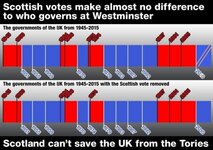
Westminster elections without Scotland
Here's what I can find.....
Why Labour doesn’t need Scotland
One of Labour’s sneakier tricks in opposing Scottish independence is to appeal to Scottish voters’ sense of social responsibility. The former party of socialist internationalism begs the Scots to show Unionist solidarity with their poor comrades in England, Wales and Northern Ireland, who would – the story runs – be abandoned permanently to the mercies of the evil Tories if the Westminster Parliament was deprived of its traditional sizeable block of Labour MPs from Scotland.
This narrative is regularly propagated by Labour’s friends in the media (and sometimes by gleeful Tories too). Only today, for example, the Scotsman carries the line in a piece which asserts that an independent Scotland would leave David Cameron “with an inbuilt Tory majority for his party in the rest of the UK”.
There are, of course, innumerable things wrong with this argument – for one, the dubious morality of using Scottish MPs to impose a Labour government on English voters who may have rejected one, when Scotland has its own Parliament and England doesn’t. (An offshoot of the timeless West Lothian Question.) And for another, the highly questionable premise that the modern-day Labour Party is ideologically significantly different from the Tories anyway.
But the biggest problem with the notion is simply that it’s completely untrue.
Much of the reason is careless pundits who focus on the fact that Scotland habitually returns 40+ Labour MPs, but who forget that it also sends members to Westminster from the other parties to offset them. In October 1974, for example – which we’ll discover shortly is a significant date – Labour won 41 Scottish seats. That sounds impressive, until you realise that Scotland also voted in 30 non-Labour MPs (16 Tory, 11 SNP, 3 Liberal), meaning that the net contribution of Scotland towards a Labour majority was just 11. So let’s take a look at the whole historical picture.
Labour didn’t become a significant electoral force at all until the 1920s, with Ramsey MacDonald its first ever Prime Minister in 1923, albeit leading an extremely shaky minority government which only lasted 10 months. Universal suffrage for all men and women over 21 finally arrived in 1928, but the modern political era starts with Clement Attlee’s post-war Labour landslide, and particularly with the Representation Of The People Act 1948, which abolished multiple voting, multi-member constituencies and other anachronisms to create the framework which still essentially, with a few tweaks around the edges (eg lowering the voting age to 18 in 1969), governs British elections.
The 67 years since the end of World War 2 have seen 18 General Elections to the Westminster Parliament, with the following outcomes (sources below):
1945 Labour govt (Attlee)
————————————
Labour majority: 146
Labour majority without any Scottish MPs in Parliament: 143
NO CHANGE WITHOUT SCOTTISH MPS
1950 Labour govt (Attlee)
————————————
Labour majority: 5
Without Scottish MPs: 2
NO CHANGE
1951 Conservative govt (Churchill/Eden)
——————————————————–
Conservative majority: 17
Without Scottish MPs: 16
NO CHANGE
1955 Conservative govt (Eden/Macmillan)
——————————————————–
Conservative majority: 60
Without Scottish MPs: 61
NO CHANGE
1959 Conservative govt (Macmillan/Douglas-Home)
————————————————————————
Conservative majority: 100
Without Scottish MPs: 109
NO CHANGE
1964 Labour govt (Wilson)
————————————
Labour majority: 4
Without Scottish MPs: -9
CHANGE: LABOUR MAJORITY TO CONSERVATIVE MAJORITY OF 1
(Con 280, Lab 274, Lib 5)
1966 Labour govt (Wilson)
————————————
Labour majority: 98
Without Scottish MPs: 77
NO CHANGE
1970 Conservative govt (Heath)
——————————————–
Conservative majority: 30
Without Scottish MPs: 55
NO CHANGE
1974 Minority Labour govt (Wilson)
————————————————
Labour majority: -33
Without Scottish MPs: -50
POSSIBLE CHANGE – LABOUR MINORITY TO CONSERVATIVE MINORITY
(Without Scots: Con 276, Lab 261, Lib 11, Others 16)
1974b Labour govt (Wilson/Callaghan)
—————————————————–
Labour majority: 3
Without Scottish MPs: -8
CHANGE: LABOUR MAJORITY TO LABOUR MINORITY
(Lab 278 Con 261 Lib 10 others 15)
1979 Conservative govt (Thatcher)
————————————————
Conservative majority: 43
Without Scottish MPs: 70
NO CHANGE
1983 Conservative govt (Thatcher)
————————————————
Conservative majority: 144
Without Scottish MPs: 174
NO CHANGE
1987 Conservative govt (Thatcher/Major)
——————————————————
Conservative majority: 102
Without Scottish MPs: 154
NO CHANGE
1992 Conservative govt (Major)
———————————————
Conservative majority: 21
Without Scottish MPs: 71
NO CHANGE
1997 Labour govt (Blair)
———————————–
Labour majority: 179
Without Scottish MPs: 139
NO CHANGE
2001 Labour govt (Blair)
———————————–
Labour majority: 167
Without Scottish MPs: 129
NO CHANGE
2005 Labour govt (Blair/Brown)
——————————————–
Labour majority: 66
Without Scottish MPs: 43
NO CHANGE
2010 Coalition govt (Cameron)
——————————————
Conservative majority: -38
Without Scottish MPs: 19
CHANGE: CON-LIB COALITION TO CONSERVATIVE MAJORITY
.
Sources:
All UK general election results
General election results in Scotland 1945-2001 (Table 1e, p.13)
General election results in Scotland 2005 and 2010
So in summary we can see the following:
- on ONE occasion (1964) Scottish MPs have turned what would have been a Conservative government into a Labour one. The Tory majority without Scottish votes would have been just one MP (280 vs 279), and as such useless in practice. The Labour government, with an almost equally feeble majority of 4, lasted just 18 months and a Tory one would probably have collapsed even faster.
- on ONE occasion (the second of the two 1974 elections) Scottish MPs gave Labour a wafer-thin majority (319 vs 316) they wouldn’t have had from the rest of the UK alone, although they’d still have been the largest party and able to command a majority in a pact with the Liberals, as they eventually did in reality.
- and on ONE occasion (2010) the presence of Scottish MPs has deprived the Conservatives of an outright majority, although the Conservatives ended up in control of the government anyway in coalition with the Lib Dems when Labour refused to co-operate with other parties in a “rainbow alliance”.
- which means that for 65 of the last 67 years, Scottish MPs as an entity have had no practical influence over the composition of the UK government. From a high of 72 MPs in 1983, Scotland’s representation will by 2015 have decreased to 52, substantially reducing any future possibility of affecting a change.
The simple reality of the matter, established indisputably and unambiguously by these stats, is that England and the rest of the UK are and always have been perfectly capable of electing a Labour government if they want one, whatever Scotland does.
The truth is that Labour doesn’t need Scottish MPs, and an independent Scotland would NOT give the Tories a permanent majority in the remnant UK. Those are the facts, and voters should be deeply mistrustful of anyone who tells them anything else.