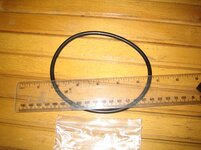
What is the seal for?

jimbo

Well-known member
UKGSer Subscriber
Joined
Jul 26, 2003
Messages
2,798
Reaction score
13
Location
Looking for a way out
I found this in my GS service cardboard box along with an air filter, oil filter plugs etc. Its in a plastic bag with CAD05 GS written on it.
Anybody know what it's for :nenau
 

Attachments

  • IMG_5285.JPG
    IMG_5285.JPG
    34.6 KB · Views: 379
Ring for fuel tank ,used when changing fuel filter . Thats my guess.
 
That's a result. I have a fuel filter in the box too, and I was just thinking odd I hadn't bought a new gasket with it. I was kind of thinking it would be a paper thing.
thanks.
 
When you replace the fuel filter, you'll take the tank off the bike & undo the 6 nuts under the righthand tank lobe. Be really careful with these as they have a tendency to rust onto the studs & these are quite thin, so snap off very easily if you use too much force. Dowse them in WD40 or the like, before trying to undo them.

Once you've removed the fuel pump plate, don't throw away the old O-ring. It'll expand quite a lot once it's released, as it absorbs the petrol fumes & swells up in use. You can dry them out with a hairdryer or, better still, stick them in the airing cupboard for a few days. Then it can be reused next time...
 
Just done this very job my tips are run the bike very very low on petrol before hand and ffs make sure you mark the two hoses which are the overflow and vent hoses before removing them and note where they fit
good luck
 
That is not a seal.
That is a rubber ring which fits tightly,twice round the balls of BMW apprentices.
It is tolerable for the length of time it should take to fit the service parts, but becomes excruciating a short time after that.
The apprentice is not allowed to remove it untill the job is finished.

Apparently, the one used on the apprentices who assemble 1200s was found to be too tight recently and was replaced by a looser one which allows them an extra 10 minutes.
 
The o'ring in the pic is only about 4" in diameter, could it be the seal under the filler cap? Been a while since I last changed one but I thought the o'ring sealing the pump mount etc was bigger?
 
When you replace the fuel filter, you'll take the tank off the bike & undo the 6 nuts under the righthand tank lobe. Be really careful with these as they have a tendency to rust onto the studs & these are quite thin, so snap off very easily if you use too much force. Dowse them in WD40 or the like, before trying to undo them.

Once you've removed the fuel pump plate, don't throw away the old O-ring. It'll expand quite a lot once it's released, as it absorbs the petrol fumes & swells up in use. You can dry them out with a hairdryer or, better still, stick them in the airing cupboard for a few days. Then it can be reused next time...

this is one job I dont miss.
1200 doesn't have a fuel filter (different type of pump I am told)
 
Just done this very job my tips are run the bike very very low on petrol before hand and ffs make sure you mark the two hoses which are the overflow and vent hoses before removing them and note where they fit
good luck
Surely this makes no difference, as they both outlet to the open air -
one lets the surplus form overfilling drain away ( and rainwater too),
the other allows air in via the "roll-over" valve, to replace used fuel , so what can happen if they get switched around ? One's air in, the other is to let fuel/water out - both pipes on the bike, after the "separators" are the same !:o
 
Fuel pipes

Surely this makes no difference, as they both outlet to the open air -
one lets the surplus form overfilling drain away ( and rainwater too),
the other allows air in via the "roll-over" valve, to replace used fuel , so what can happen if they get switched around ? One's air in, the other is to let fuel/water out - both pipes on the bike, after the "separators" are the same !:o

Listen to the expert and take note.
 
Listen to the expert and take note.

No way am I an expert, just that I have had to figure some things out "on the hoof", and by trial and error, and for myself :confused: -but often with help from the forum here.

Easy way to "trial & error" the two pipes (not fuel pipes) in question is just to blow through them !
Now ask me about fuel injectors or hall sensors etc., and I know bugger all ...but, may well need to know in the future -let's hope not. :hammer


Back
Top Bottom